In September 2024, a startup called 11x from London announced a $24 million Series A led by Benchmark. Nine months later, a $50 million Series B led by Andreessen Horowitz was announced. The
In September 2024, a startup called 11x from London announced a $24 million Series A led by Benchmark. Nine months later, a $50 million Series B led by Andreessen Horowitz was announced. The entire pitch was centered around AI “digital workers” that would complete the job of a sales development rep.
Then on March 24, 2025, TechCrunch published a report that 11x had been displaying customer logos for companies that were not their customers. Former and current employees told the publication that early churn was between 70% to 80%. Then in May of this year, Hasan Sukkar, the founder and CEO stepped down into a non-executive chairman role.
This episode brought some direction to this market as more tools that do narrower jobs well came to the fore. This article highlights those AI SDR and sales tools that have found traction.
Quick Comparison
ToolTypePricingEntry commitmentSends email itself?Review base (G2)ClayData layerFree; $185/mo Launch; $495/mo GrowthMonth to monthYes. 4.6 (226)
LavenderCoachFree; $29/mo Starter; $49 Pro; $69/user TeamsMonth to monthNo.4.8 (63)
Regie.aiHybrid$180/user/mo (10-seat min); $499/user/mo (5-seat min)AnnualYes, with rep checkpoints4.4 (355)
InstantlyInfrastructure$47/mo Growth; $97 Hypergrowth; $358 Light SpeedMonth to monthYes, at high volume4.8 (4,135)
Salesforge (Agent Frank)Autonomous, toggleable$499/mo Frank + ~$48/mo platform + $33/mo infraQuarterly on FrankYes, on autopilot or with approval4.6 (137)
AiSDRAutonomous$250/mo Solo; $900 Explore; $2,500 ScaleMonth to month on Solo, quarterly aboveYes, unsupervised4.6 (100)
Artisan (Ava)AutonomousDemo-gatedAnnualYes, unsupervised4.1 (50)
Qualified (Piper)Autonomous, inboundDemo-gated, roughly $40k to $68k/yearEnterprise annualReplies to inbound only4.9 (1,500+)
Let’s start with what an SDR actually does on a day to day basis. A sales development rep is the person at the front of the sales process. They are tasked with coming up with a list of companies worth contacting, finding the right person to reach out to at each one, write the first email, follow up when there is no response and pass a potential contact who shows interest. The work is repetitive and most of the work can go into research rather than talking to buyers.
An AI SDR is essentially software that is meant to replace the person. You give it a description of your ideal customer, connect a few email accounts and the AI will take care of the rest, which includes creating the list, drafting the email, sending it and even replying by itself. That said, there are tools out there that help for different use cases in the sales funnel.
Some tools help in building the list but never actually write a word. Some grade your writing and never touch the list. The AI SDR label is attached on all of these tools but the fact is you are actually not buying the same tool. Therefore the useful way to classify them is by how much work the software does and how much still sits with a human.
Data tools sit underneath everything else. These are tools that help in finding the contact within a company, any information that is missing about the company or a person and watch for any sort of event that is worth reaching out about. These tools are useful for giving you a clean, current list. They are not tools to write anything nor do they send anything. Therefore the outreach in this regard is still handled by a person. Clay is the best example of a tool that fits into this type.
Coaches work on the messaging part instead of any sort of list. When you type an email, the tool helps in grading it as you go. In other words, it highlights lines that sound like a template and the parts a buyer might skip past. No message is sent until a rep actually clicks the send button. Lavender built its product around this single job.
Hybrids help run the campaign but stop at checkpoints. The AI picks the targets and writes the drafts. A person then reviews and approves before anything is sent and daily volume has a set limit rather than being open-ended. The best examples of Hybrids are Regie.ai and Salesforge.
Autonomous AI SDRs as the name suggests do the entire loop without any human intervention. Enter in your ideal customer, connect your mailboxes and the software finds prospects, writes to them and follows up unsupervised. This is what 11x was selling. It is also where results have the potential to swing the most, because when writing is bad, there is nobody in the chain to catch it before it lands in thousands of inboxes.
Vendor case studies never usually show who was on the list. Emailing a cold list of people who have never come across you is a different task from emailing someone the week they changed jobs or their company raised a round. The first cold list of people reply at around 1%. The second can hit 5%.
Instantly, a cold email sending platform, published a benchmark report which stated that the average reply rate across its platform was 3.43%. Buried in the same report is a more telling stat in that 58% of all replies came from the first email.
AiSDR, which sells one of these tools, looked at 75 customer rollouts and published something more useful than a win rate. Teams with outbound already working got two to three times more out of it after adding AI whereas teams without got nothing. These tools, therefore, will not show the intended results if there is a broken outbound process to begin with.
The Deliverability Constraint No AI Removes
In February 2024, Google and Yahoo changed the rules when it comes to spam emails. Every tool within this list has had to function within them. Sending more than 5,000 messages in a single day to Gmail addresses gets you classified as a bulk sender. Bulk senders need SPF, DKIM and DMARC, which are the three DNS records that prove the mail is really coming from your domain. They also need an unsubscribe button with removal processed within two days. Any sort of spam complaint has to stay under 0.3% and Google recommends staying below 0.1%.
Microsoft also began running its own version of these rules in May of last year. Any non-complaint mail now gets rejected at the server rather than ending up in the spam folder.
The reality is that this deliverability constraint does not care about how well a mail is drafted using AI. Volume raises compliant risk, compliant risk damages domain reputation and a burned domain does not recover because the vendor upgraded to a better model. The good tools that work around this constraint do it by sending across mailboxes and domains, have a daily volume limit in place and warm new domains for weeks before live sends.
The Data & Copilot Layer
- Clay: the GTM Data Workspace
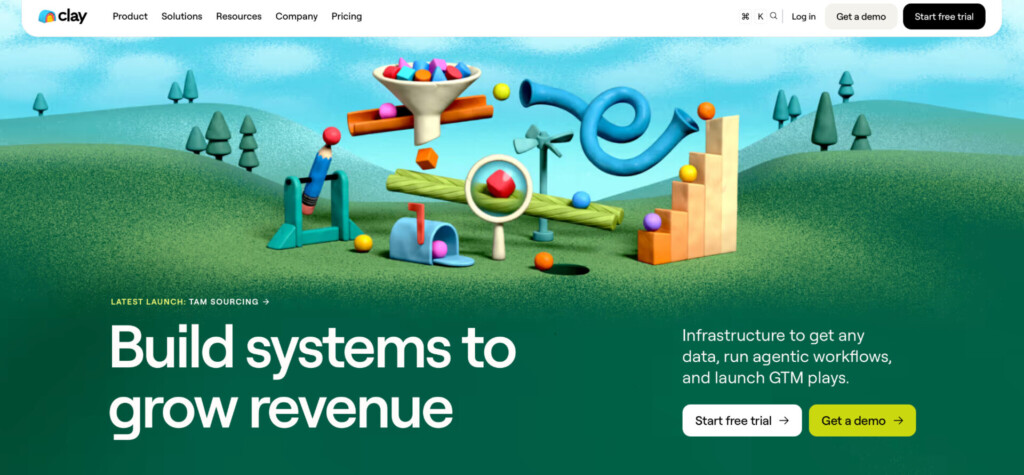
Clay is an AI sales tool that looks like a spreadsheet but works like a full fledged research team. You enter in a list of companies and each row is checked against one data provider after another until one of them comes back with the answer. The platform calls this waterfall enrichment and it is a massive reason for why it is able to find more emails and numbers. The platform also has its own AI Agent called Claygent. This agent is able to pull information that no database has on file such as whether a company runs its own warehouse.
Classification: data layer. Clay does have a built-in sequencer now, so it can send emails, but that is not why anyone buys it. Think of Clay as the tool that feeds your outbound rather than the one that runs it.
Pricing: the free plan gives you 100 data credits and 500 actions a month. Launch costs $185/mo, or $167 if you pay annually. Growth is $495/mo, or $446 annually. Enterprise is custom. Every plan comes with unlimited seats, so adding people to your team does not raise the bill.
Deliverability posture: indirect, but it matters more than people expect. Wrong email addresses bounce. Bounces damage your sender reputation. No sending tool can fix a list that was already broken when it arrived. Most teams blame the sequencer when the real problem started one step earlier.
Pros
- Match rates well above single-provider tools, because failed lookups roll to the next vendor
- Unlimited seats on every tier, so cost scales with usage rather than headcount
- Clay’s documentation states you are not charged when an enrichment returns nothing
Cons
- Credit burn during the learning phase is the loudest complaint in user reviews
- The learning curve runs weeks, not days
- Top-up credits carry a 30% premium once your monthly allocation runs dry
Best for: teams whose outbound underperforms because the list is wrong, not because the copy is.
- Lavender: The Email Coach
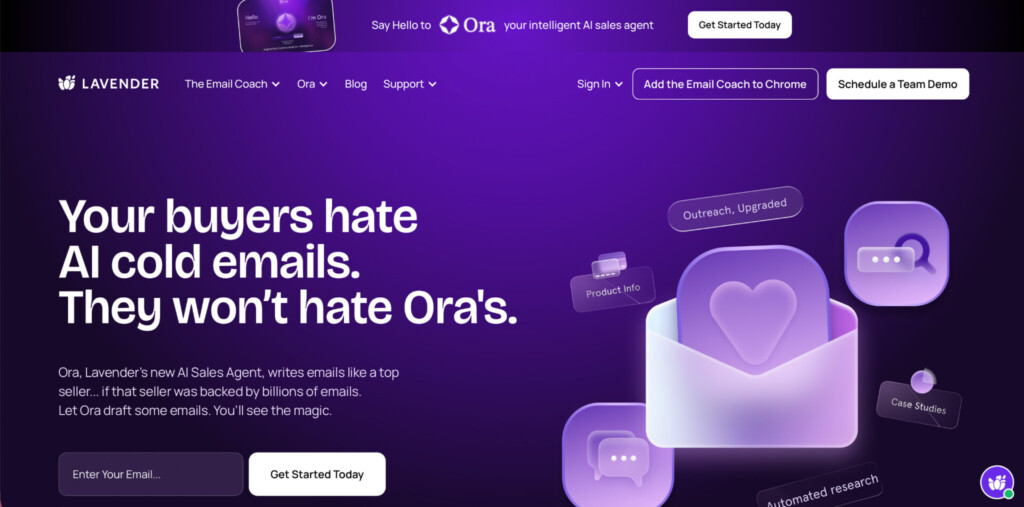
Lavender sits inside Gmail and Outlook as a sidebar and grades your email while you type. It scores 0 to 100 on length, tone, reading level, personalization, and how clear the ask is, then tells you which sentence is the problem. The scoring model was trained on real sales emails and their actual reply outcomes, which is why its suggestions land differently from a generic LLM rewrite.
Classification: pure copilot, and the safest purchase in this entire roundup. A human still presses send on every message, so there is no autonomous sending to go wrong.
Pricing: free tier covers 5 emails a month. Starter is $29/mo, Pro $49/mo, Teams $69 per user per month. Annual billing takes off roughly 20%. Ora, Lavender’s separate AI agent that writes cold emails rather than coaching them, runs $500 per agent per month and includes 1,000 sends.
Deliverability posture: structurally zero risk. Lavender never touches your domain, never rotates a mailbox, never sends anything. The only way it affects deliverability is by improving reply rates, which mailbox providers read as a positive engagement signal.
Pros
- The cheapest way to find out whether your copy or your list is the actual problem
- Works alongside whatever sequencer you already run, including Outreach, Salesloft, Apollo, and Smartlead
- Lavender’s own study of 231,818 cold emails found A-graded messages replied at 4.3% against 3.4% for the rest
Cons
- Email only, with nothing for LinkedIn or phone
- Chrome extension reliability comes up repeatedly in reviews
- The widely quoted 580% reply-rate lift is a single customer result, not a benchmark
Best for: a founder or small team writing their own outbound who wants the emails to stop sounding like everyone else’s.
- Regie.ai: AI Sequencing With Human Reps
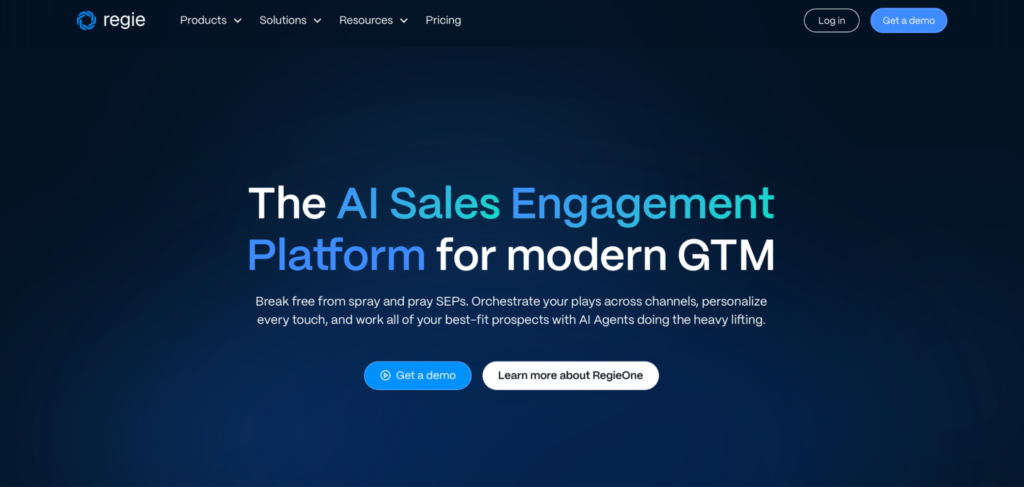
Regie.ai runs sequencing agents, a parallel dialer, and content generation inside one platform it calls RegieOne. The agents source prospects, draft messages, and prioritize who a rep should work next. The rep stays in the loop throughout, which is the design point.
Classification: hybrid, weighted toward copilot. The per-seat pricing gives away the model. A product genuinely replacing reps would not charge you per rep.
Pricing: AI SEP is $180 per user per month with a 10-seat minimum, putting the floor at $21,600 a year. Force Multiplier Rep is $499 per user per month with a 5-seat minimum, a floor of $29,940. Annual contracts only, no free tier. Add-ons for parallel dialing and mailbox rotation stack on top.
Deliverability posture: the strongest of the hybrid group. Force Multiplier includes 10 provisioned mailboxes with two months of warming built into the package, which is an unusually honest way to price the ramp period rather than hiding it.
Pros
- Mailbox provisioning and warming come inside the plan instead of arriving as a surprise line item
- The largest independent review base among AI-native tools here, reported at 4.6 across 1,486 G2 reviews
- Published per-seat pricing in a category that mostly refuses to publish anything
Cons
- The 10-seat minimum locks out any team under 10 SDRs entirely
- Reviewers consistently report the AI copy needs a human edit before it goes out
- Dialer and mailbox add-ons push the real per-rep cost well past the headline
Best for: an existing team of five or more reps you want to make faster, not smaller.
The Sending Infrastructure
4. Instantly: Volume Cold Email
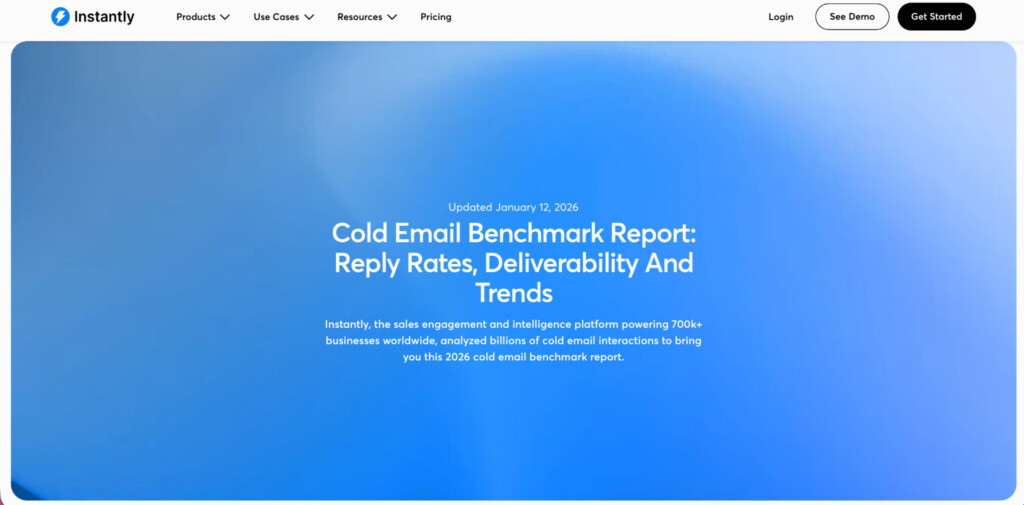
Instantly is the pipe, not the strategy. Connect unlimited mailboxes, upload a list, and it distributes sends across all of them so no single inbox or domain absorbs the whole load. Warmup, verification, a 450M-contact database, and a set of AI agents sit alongside it. Roughly 50,000 teams use it.
Classification: infrastructure. It automates sending, not judgment.
Pricing: the Outreach Growth plan is $47/mo, or $37.60 on annual billing, and includes unlimited email accounts and unlimited warmup. Hypergrowth is $97/mo, Light Speed $358/mo. Lead credits start at a separate $47/mo. Bundles combining both start at $94/mo.
Deliverability posture: this is the whole product, and it is also where the criticism lands. Instantly’s warmup network is a pool of accounts that email each other to build reputation. Users in 2026 have reported warmup scores above 90 while live campaigns were landing in spam 30% to 40% of the time, and a Reddit thread alleged the warmup pool itself got fresh domains flagged. Both accounts reach us through review roundups rather than firsthand, so treat them as reported rather than established.
Pros
- Unlimited mailboxes and warmup at $47/mo undercuts everything else at this volume
- The 2026 benchmark report is genuinely useful data, whatever you think of the framing
- Higher tiers rotate IPs automatically and swap out flagged ones
Cons
- Warmup scores and real inbox placement can diverge sharply
- Deliverability diagnostics are thin once something goes wrong
- Support and billing complaints recur across review sites
Best for: teams that have already proved their offer works and now need to run it at volume without burning domains.
The Autonomous AI SDRs
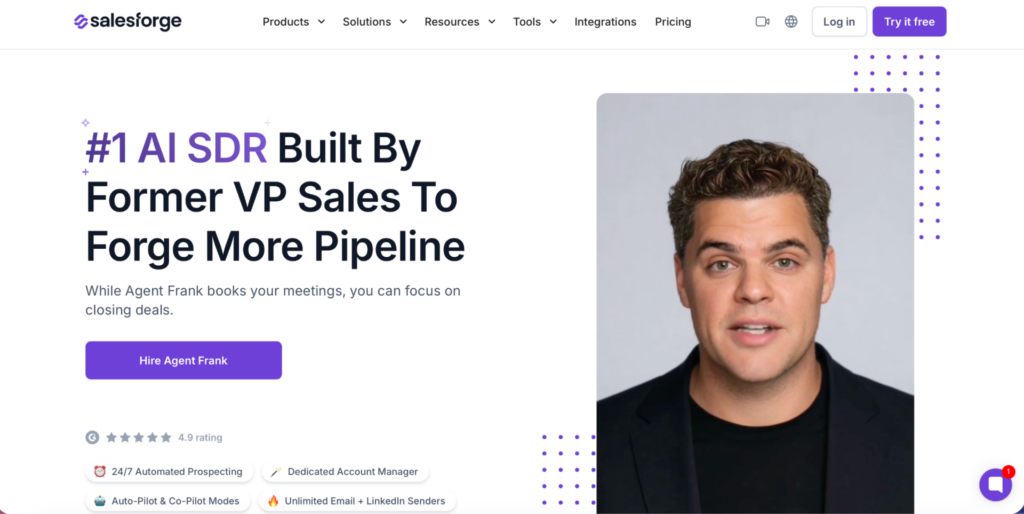
Agent Frank prospects from a 500M-contact search engine, writes personalized emails, sends across rotated inboxes, and handles follow-ups. What separates it is a switch. Auto-Pilot runs unsupervised. Co-Pilot holds every message for your approval before it leaves. Salesforge ships both and does not pretend the second one is a training-wheels mode you will outgrow.
Classification: autonomous, honestly labeled. Very few vendors here put the supervision toggle in the product rather than in the sales call.
Pricing: Agent Frank is $499/mo, billed quarterly or annually, covering 2,000+ contacts a month at 25 cents each. The Salesforge platform itself starts around $48/mo. Email infrastructure through Infraforge adds from $33/mo, which puts a realistic all-in figure near $532/mo. Activating Frank requires a demo call.
Deliverability posture: the most operationally honest in the group. Salesforge owns its sending infrastructure through Infraforge and its warmup through Warmforge, and it states plainly that new inboxes need about two weeks of warming before Frank sends anything. Full cold-start setup runs two to three weeks.
Pros
- The Co-Pilot toggle means you can supervise for a month and then decide, rather than committing to autonomy on day one
- Infrastructure and warmup live inside the same login as the agent
- A fraction of what 11x-class vendors quote for a comparable job
Cons
- Quarterly minimum commitment on Frank
- Thin independent review base, and much of the available coverage is written by competitors or by Salesforge itself
- Email-centric, with no buying-signal layer to tell Frank who is actually in market
Best for: a small B2B team that wants autonomous sending but is not willing to hand over the send button before watching it work.
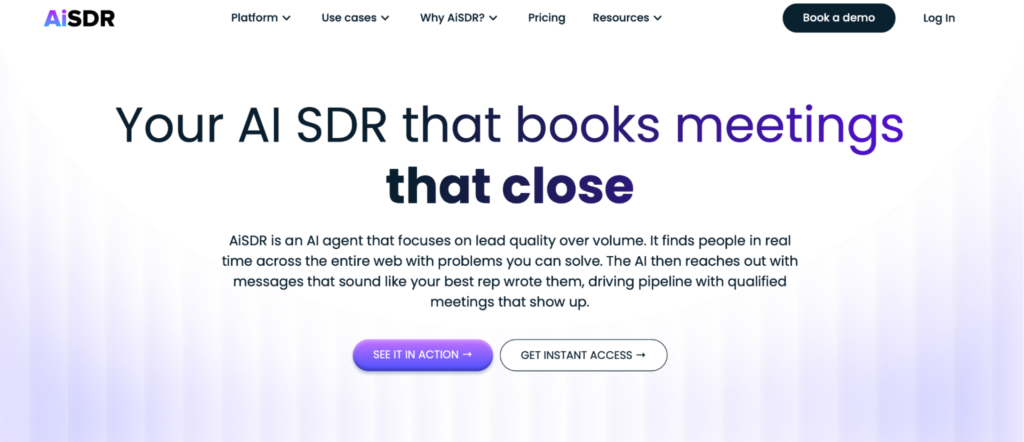
AiSDR is a fully autonomous AI SDR that can run email and outreach via LinkedIn by itself while assigning a human GTM engineer to each account. The tool goes for prospective clients by tracking website visits and social engagement.
Classification: It is a fully autonomous SDR with a very clear and transparent pricing structure.
Pricing: The tool is priced at three different levels. Solo which is catered for one user with a limit of 200 AI researched contacts per month is priced at $250 per month. Then there is Explore at $900 per month which comes with unlimited users 800 AI researched contracts per month and additional features like 24/7 slack support, dedicated GTM engineer onboarding and more. Finally, there is the scale plan at $2,500 per month with 2,500 AI researched contacts and with even more added features like native two-way Salesforce CRM sync.
Deliverability posture: standard for the category, with domain warmup running 30 to 60 days before output reaches steady state. Budget for a slow first month.
Pros
- Every tier published, which almost nobody else here does
- $250 gets you a real test without a quarterly commitment
- AiSDR publishes benchmark data that argues against half its own prospects buying
Cons
- Above Solo, you are committing $2,700 before you know whether it works
- Playbook-driven setup frustrates users who want to build something custom
Best for: a team that wants to try autonomous outbound without a sales call or an annual contract.
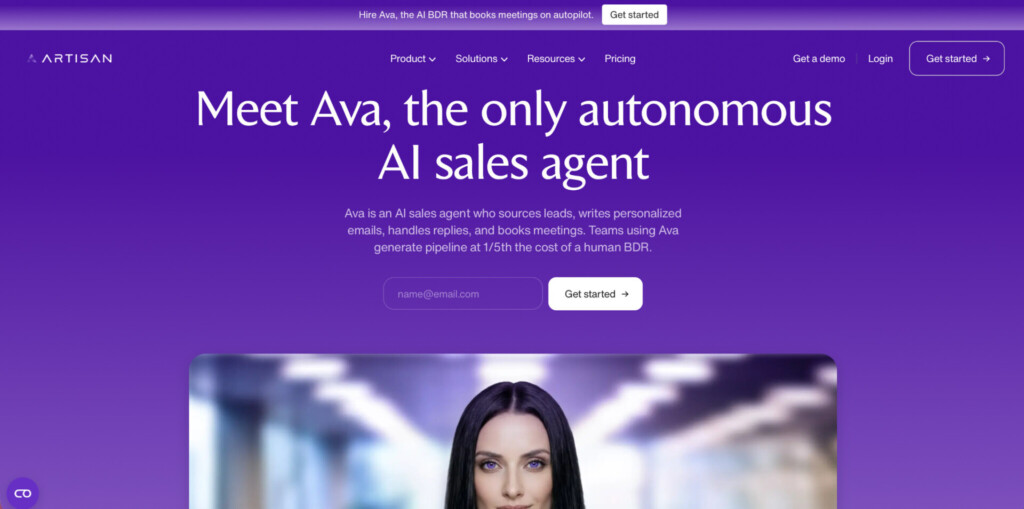
Ava sources leads from Artisan’s own contact database, researches them, and runs outbound across email and LinkedIn. Artisan is a Y Combinator graduate that raised a $25 million Series A led by Glade Brook Capital on April 9, 2025, with Y Combinator, HubSpot Ventures, and Day One Ventures joining. You have probably seen the billboards.
Classification: full autonomous BDR.
Pricing: demo-gated. Artisan has a pricing page, but it routes to a sales rep. Third-party estimates for the same product run from a few hundred dollars a month past $5,000, and several of the sources publishing those figures sell competing tools. Annual commitment is standard.
Deliverability posture: Artisan sends, but reviewers consistently report needing separate tooling for warmup and inbox health monitoring. Ask what is bundled before signing.
Disclosure: Three things a buyer should know, all TechCrunch-reported.
LinkedIn banned Artisan shortly before Christmas 2025. The reason was not spam. LinkedIn objected to Artisan using its name on the website and alleged the company was buying from data brokers who had scrapped the platform. Artisan removed the references, audited its data partners, and was reinstated after about two weeks.
The “Stop Hiring Humans” billboards were deliberate provocation. Carmichael-Jack told TechCrunch in April 2025 that he does not believe AI will replace people and the campaign was “mostly just for attention,” while the company was employing 35 people and hiring 22 more. Artisan retired the slogan in August 2026 and is now hiring its first human BDR.
Artisan ran subway ads using KC Green’s “This is fine” cartoon without permission. Green went public on May 3, 2026, and told followers to vandalize the ads. The two sides settled by May 31, with Artisan pulling the ads in New York and San Francisco.
Pros
- Genuinely large contact database with email and LinkedIn in one workflow
- Well funded and unlikely to disappear mid-contract
- Fast setup relative to building the same stack yourself
Cons
- No published price, so you cannot budget without a sales call
- Data accuracy thins noticeably outside North America
- “The emails feel AI-generated” is the single most repeated line in reviews
Best for: teams with budget who want one vendor for the whole outbound motion and can tolerate opacity on price.
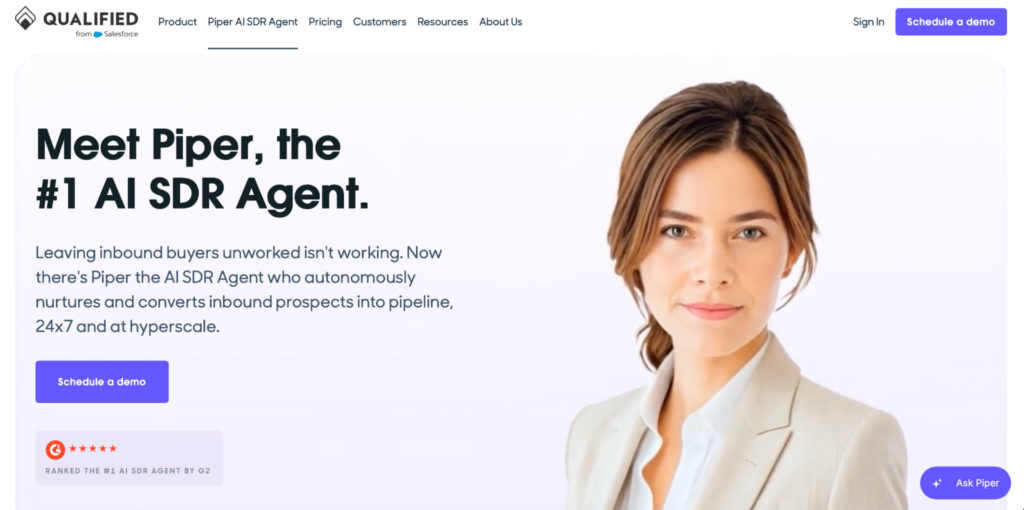
Piper is a tool that works on your website rather than other tools that can be seen as a cold list. It talks to people who are already browsing, it asks the questions a rep would usually ask, answers their queries and books any meeting directly into Salesforce. Therefore, every prospect it speaks to actually approaches you first.
Classification: autonomous, but inbound only. Piper sends nothing cold. If you clicked an ad promising an AI SDR that fills an empty calendar, this is not that product, and that is worth saying plainly before anyone compares features.
Pricing: demo-gated. Third-party Vendr data suggests typical contracts land between $40,000 and $68,000 a year, though that estimate comes from a competitor’s write-up. You also need Salesforce.
Deliverability posture: mostly beside the point. Piper replies to people who are already on your site instead of pushing into cold inboxes, so the bulk-sender rules never come into play.
The fact that matters most: Salesforce agreed to buy Qualified on December 17, 2025 and closed the deal on April 1, 2026, confirmed in its own filings. Piper is being folded into Agentforce. That tells you which half of this category convinced the biggest buyer in software. The inbound side got acquired. The cold outbound side is still arguing about reply rates.
Pros
- It does not depend on list quality or domain reputation
- Deep Salesforce integration, since it was built native to the platform
- It is the best reviewed product according to G2 at 4.9 out of 5 with over 1500 reviews.
Cons
- Enterprise pricing that rules out most startups outright
- Requires Salesforce, so HubSpot and Pipedrive shops are out
Best for: a Salesforce shop with meaningful website traffic and nobody responding to it fast enough.
What the 11x Saga Taught AI SDR Buyers
Three things to take from it. Ask for customer references you can call, not logos on a page. Treat ARR built from pilots with break clauses as what OnlyCFO called “Experimental Runrate Revenue,” because a customer who can leave at month three is not an annual contract. And discard any performance number that arrives without a stated methodology, including the ones in this article. A reply rate is meaningless until you know whether the list was cold or signal-triggered, how many messages the denominator holds, and who counted.
The Legal Basics
Cold email is legal in the United States. CAN-SPAM runs on opt-out, not opt-in, so you can email someone who never asked to hear from you. What you cannot do is hide. Every commercial message needs accurate header information, a subject line that matches the content, a valid physical postal address, and a working unsubscribe. Opt-out requests get honored within 10 business days.
Penalties attach per message. The FTC maximum is $53,088 per violating email, set in January 2025 and left unchanged for 2026, so a 5,000-address blast with a broken unsubscribe link is 5,000 violations on paper. Nobody pays the theoretical figure. Verkada settled the largest CAN-SPAM action on record in August 2024 at $2.95 million. Hiring a vendor to send on your behalf does not move the liability anywhere.
Europe inverts the whole arrangement. GDPR treats an email address as personal data, and B2B outreach there usually leans on legitimate interest under Article 6(1)(f). That is a real legal basis. It also requires a documented balancing test. You have to target people whose job actually relates to what you sell, and stop the moment someone objects. A scraped list of every EU contact you could find fails that test before you hit send.
Final Verdict: Buy the Copilot First, Earn the Autopilot
Start where the risk is lowest. Twenty-nine dollars a month for Lavender tells you inside two weeks whether your copy is the problem. A Clay plan tells you whether your list is. Between them you find out which half of your outbound is broken, and neither one can burn a domain while you look.
Autonomy is what you earn after something already works. AiSDR’s own data makes the argument better than any skeptic could: teams with a functioning outbound motion got two to three times more once AI came in, and teams without one got nothing at all.
If you do go autonomous, favor the vendors that publish a price and ship a supervision toggle. Salesforge and AiSDR both do. The ones that want a sales call before they will tell you the number have already told you something.