Bitcoin is the low-risk core position at $77,822 as Binance reopened withdrawals on Sunday, while Tron’s TRX is the higher-beta name to watch after it became the only top-10 coin up more than

Bitcoin is the low-risk core position at $77,822 as Binance reopened withdrawals on Sunday, while Tron’s TRX is the higher-beta name to watch after it became the only top-10 coin up more than 1% on the day. Ethereum trades at $2,261, and the total crypto market sits at $2.61 trillion with Bitcoin dominance back at 60.0%. Three assets, one exchange reopening, and a tape still deciding whether the post-hack dip is a floor or a step lower.
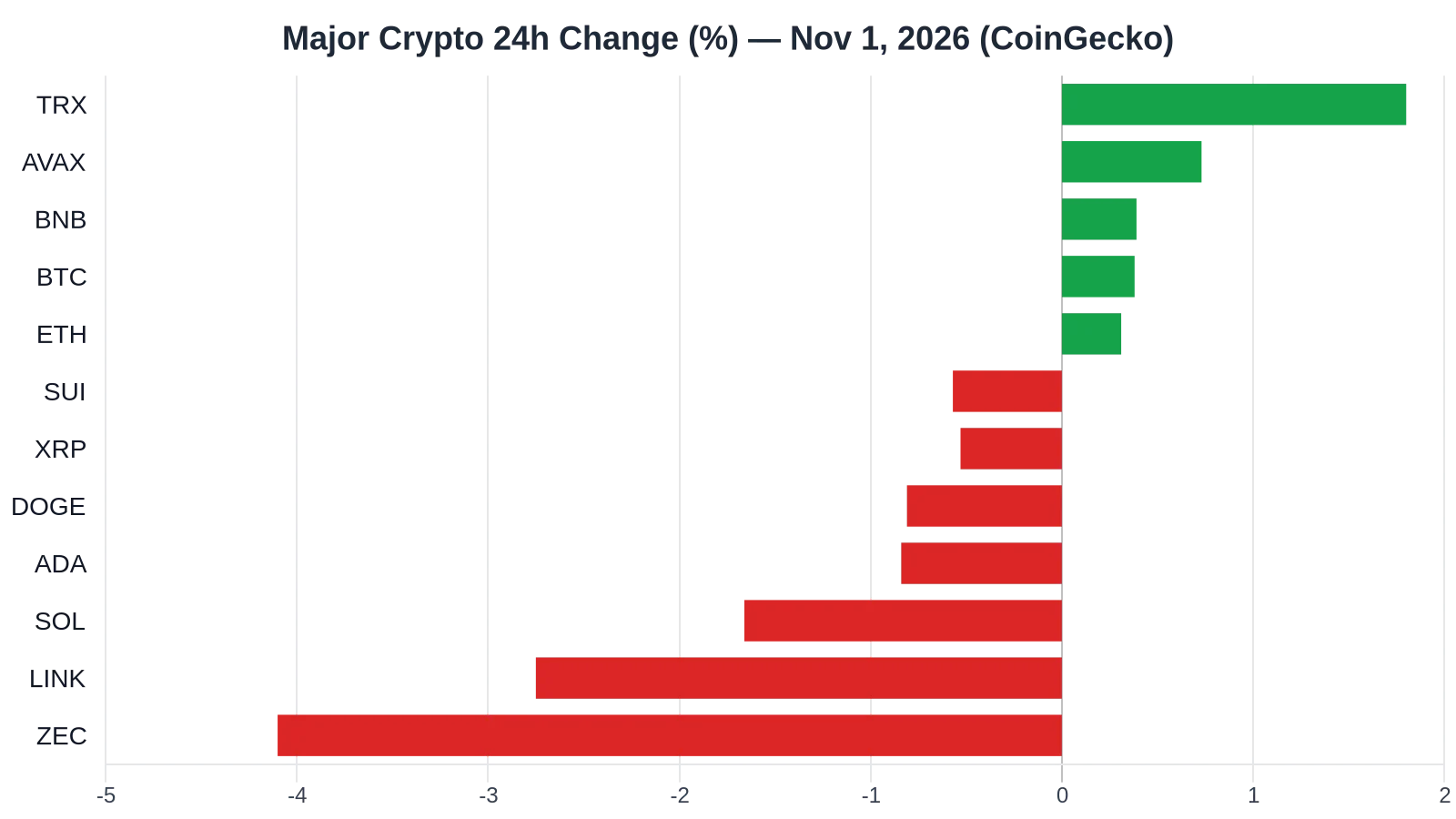
At the 18:53 UTC print on November 1, per CoinGecko, Bitcoin is up 0.37% over 24 hours, Ether 0.32% and BNB 0.39%, while Tron leads the top 10 at +1.63%. The rest of the large-cap tape is red: XRP down 0.53%, Solana 1.66%, Dogecoin 0.81%, Cardano 0.84%, Chainlink 2.75% and Zcash 4.10%. Averaging the twelve largest coins by market cap gives a decline of about 0.6% on the day — which is what makes TRX’s green candle stand out.
Bitcoin’s $77,000 Hold and the ETF Flow That Tests It
Bitcoin is up 0.37% over 24 hours but still down about 8.2% over the past 30 days, trading at $77,822 after spending late October defending the $76,500 six-week low that followed the Binance incident. The level that matters now is $77,500 — the October 30 session low that has acted as a shelf across the last two days — with the next observable support at the $76,300–$76,500 zone. A daily close below that opens the path toward the low-$75,000s, while a reclaim of $80,000 would have to absorb the supply of everyone who bought the October 24–28 range between $80,000 and $81,300.
The flow picture is the harder test. U.S. spot Bitcoin ETFs posted $643.2 million in net outflows on October 30 — the largest single-day exit since June — after four straight sessions of inflows, per Farside Investors. BlackRock’s IBIT accounted for $233.7 million of that, Fidelity’s FBTC $201 million and ARK 21Shares’ ARKB $129.5 million. Even so, IBIT still took in roughly $932 million across October as a whole, which is the quieter signal inside the headline: the largest ETF product kept attracting capital through a red month, even if the final session wiped out the week.
Bitcoin’s share of the total crypto market is back at 60.0% as of the November 1 print, and its $1.56 trillion market cap is about 5.7 times Ethereum’s $276 billion. That is the flight-to-quality arithmetic the market keeps re-running after every risk shock.
Ethereum at $2,261: The Discount That Hasn’t Caught a Bid
Ether is up 0.32% at $2,261, but it is the large-cap laggard on a multi-week basis: down roughly 15.8% over 30 days against Bitcoin’s 8.2%, and the ETH/BTC ratio has ground down to about 0.029 — one Ether buys less than 0.03 Bitcoin, a level that has marked underperformance floors more than once in prior cycles. Ether’s dominance has slipped to 10.57%, and U.S. spot Ether ETFs bled for eleven straight sessions through late October, per Farside.
The bear case is that Ether has no catalyst of its own right now — no near-horizon upgrade with a price impact, and spot ETF flows still negative — while the bull case is that the discount versus Bitcoin is unusually wide and staked ETH yields keep a floor under the largest DeFi base by total value locked. For a “best to buy” list, Ether is the value-trap question rather than the momentum play: it has underperformed for months, and catching that knife requires a catalyst the tape has not shown yet.
Tron Leads the Top 10 — $242 Million Laundered Through the Network in Two Days
Tron’s TRX is the one genuinely green large-cap on the board, up 1.63% to $0.3134, and it is the outlier because of the Binance aftermath rather than despite it. On-chain analyst SomaXBT, tracing the stolen funds, mapped the laundering over the weekend: “$628M was stolen on Tron (612.7M USDT + 46.4M TRX). Tether froze 378.7M USDT on day one, leaving ~$249M in $TRX for the attackers to move.” By Sunday the same thread put the two-day total at “$242M laundered in about 2 days.”
The Federal Bureau of Investigation attributed the theft to North Korea on Saturday, stating that the country “was responsible for the theft of more than $6 billion USD in virtual assets from cryptocurrency exchange Binance, on or about October 29, 2026.” The FBI is now urging THORNode operators, instant exchanges and DeFi services to block the flagged addresses.
Why is TRX higher while its network is the laundering corridor? Two readings. The first is that Tether’s 378.7 million USDT freeze showed the stablecoin rails on Tron work when it matters, capping the liquid portion of the theft on that chain. The second is that the network kept functioning — deposits, swaps and bridges processed hundreds of millions in flows without a halt — a resilience signal even if it is also the reason regulators will keep a closer eye on Tron-adjacent services. The gain is modest and the scrutiny is real; this is a relative-strength story, not a breakout.
The Math: $1,000 in Each
The three names trade at very different scales. At the November 1 print, $1,000 buys roughly 0.01285 BTC at $77,822, 0.4423 ETH at $2,261, or 3,191 TRX at $0.3134. For a $1,000 stake to double, Bitcoin has to reach about $155,644 — a move that would add roughly $1.56 trillion of new market value — while Ether has to reach $4,522 and TRX $0.6268. Smaller market caps move the needle with less capital, but the same leverage works against you on the way down, and TRX’s $29.8 billion market cap is less than 2% of Bitcoin’s.
That spread is the whole decision. Bitcoin is the position that needs the entire market to reprice higher. TRX is the position that needs only a continuation of its relative strength — or, on the downside, can be repriced quickly by the regulatory attention the laundering story brings. These are arithmetic ceilings, not forecasts.
Price Levels to Watch
For Bitcoin, support is $77,500 then the $76,300–$76,500 low, with resistance at $78,500 and $80,000; the invalidation for a bearish read is a daily close back above $81,800. For Ether, $2,240 is the October floor to hold, with $2,300 the first reclaim target. For TRX, $0.3100 is the near-term support that has held across the weekend, with $0.3200 the level that would confirm the relative-strength read and a drop back below $0.3000 invalidating it.
Frequently Asked Questions
What is the best crypto to buy right now?
Bitcoin is the lower-risk core position at $77,822 after the post-hack slide, with ETF demand still the underlying bid, while Tron’s TRX is the higher-beta relative-strength name up 1.63% to $0.3134. Ether at $2,261 is the large-cap discount but lacks a catalyst of its own right now.
Why is crypto down today?
The market is still repricing the $6.3 billion Binance hack and its aftermath. At the November 1 18:53 UTC print, Bitcoin is up 0.37% over 24 hours and Tron up 1.63%, but Solana, Chainlink, Cardano and Dogecoin are all lower, leaving the top-12 average down about 0.6% on the day.
Why is Tron (TRX) up today?
TRX is up 1.63% to $0.3134, the only top-10 coin above 1% on the day. On-chain analyst SomaXBT traced $242 million of the Binance loot moving through the Tron network in two days, with Tether freezing 378.7 million USDT on the chain — a resilience signal, though the laundering attention is also a regulatory headwind.
How much did Bitcoin ETFs lose on October 30?
U.S. spot Bitcoin ETFs posted $643.2 million in net outflows on October 30, the largest single-day exit since June, per Farside Investors. BlackRock’s IBIT led with $233.7 million, Fidelity’s FBTC $201 million and ARK 21Shares’ ARKB $129.5 million, even as IBIT still took in about $932 million across October as a whole.
What did Binance say about reopening withdrawals?
Binance announced the phased reopening on X on November 1: “Update: First batch network now opened in phase one of withdrawals is $BTC bitcoin network.” By 12:36 UTC the same day, withdrawals had resumed across all 15 networks and assets in the initial phase.