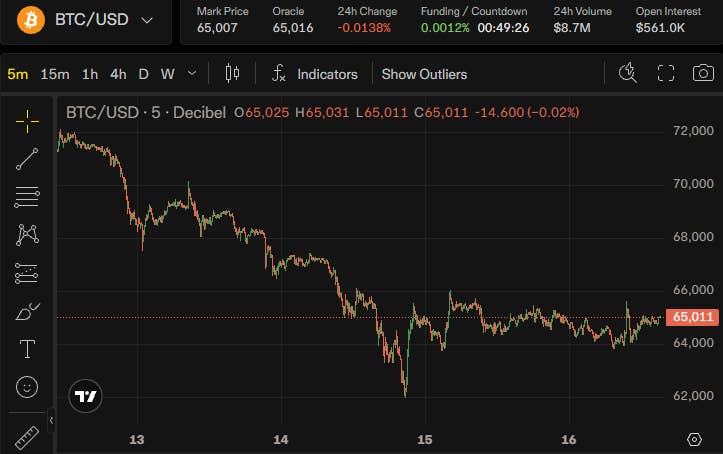
Bitcoin trades at $64,615 at 00:20 UTC on 17 November, and the two largest corporate buyers of the asset just told the market what they paid during the crash. Strategy Inc bought 485 bitcoin

Bitcoin trades at $64,615 at 00:20 UTC on 17 November, and the two largest corporate buyers of the asset just told the market what they paid during the crash. Strategy Inc bought 485 bitcoin for $33.4 million at an average of $68,887. Strive Inc bought 251 bitcoin at about $69,853 each. Blended, that is 736 coins at $69,203, or 7.1% above the live price. Both numbers come from Form 8-K filings submitted on the same morning, which means the cost basis of the corporate bid is now public to the dollar.
The short answer for anyone weighing a purchase this week is arithmetic rather than sentiment: the disclosed buyers are adding at prices 6.6% to 8.1% higher than spot, their combined weekly spend was $50.9 million, and Bitcoin’s 14-day daily RSI sits at 22.8 with price 11.3% below its 200-day average. That combination describes a market where the largest identified buyers are still paying above the market price while the market itself is oversold. What it does not describe is a floor.
Two filings, one blended price
Strategy’s 8-K covers the week of 9 to 15 November. The company reported 485 BTC purchased for an aggregate $33.4 million, an average of $68,887 including fees and expenses, against total holdings of 850,849 BTC. The same filing puts Strategy’s cumulative purchase price at $64.20 billion, which works out to an all-in average of $75,452 per coin.
That last figure matters more than this week’s tranche. At $64,615, Strategy’s treasury is carried at roughly $54.98 billion against a $64.20 billion cost, a paper gap of about $9.22 billion, or 14.4% below its average entry. The company’s own footnote language is precise about what the number includes: “Aggregate and average purchase prices are inclusive of fees and expenses.” Fees are a small share of $64.20 billion, but the disclosure is worth noting because it makes the average comparable with an exchange price.
This is not the first time Strategy has bought into a decline. It added 950 BTC in September after a summer pause, a purchase documented in our report on Strategy’s first purchase since August. The difference this week is scale of the drawdown: the September purchase landed while Bitcoin traded in the low $70,000s, and this one landed after a weekend slide to $62,612.
Where the money came from
Strategy did not fund the purchase from operating cash. The 8-K shows 2,087,040 Class A shares sold through its at-the-market programme for net proceeds of $244.7 million, and then allocates that money: $33.4 million to bitcoin, $206.3 million to repurchasing STRC preferred stock, and $5.0 million to USD Cash. In other words, 13.6% of last week’s equity raise became bitcoin, and 84.3% went to retiring a preferred instrument.
The repurchase details add a spread worth measuring. Strategy retired 2,282,510 STRC shares for $228.1 million, an average of $99.93 per share, while selling MSTR stock at roughly $117.25 per share. The company is issuing common equity above $117 and retiring preferred near $100. The filing also states that “$332.2 million aggregate purchase price of Strategy’s preferred stock remains available under its digital credit securities repurchase program,” so the buyback has room left, and $18.9 million of the USD Reserve went to preferred dividends during the week.
Remaining shelf capacity is large: $17,510.8 million on STRC and $18,092.4 million on MSTR as of 15 November. That capacity is the mechanism behind the bid. It is also the reason the bid is conditional: the purchases are funded by selling securities, not by retained earnings, so the pace depends on demand for Strategy’s equity and preferred stock rather than on conviction alone.
Strive spent more than it raised
Strive’s 8-K is a smaller version of the same trade with a funding gap inside it. The company reported that during 7 to 13 November it “purchased 251 bitcoin at an average price of approximately $69,853 per bitcoin, inclusive of fees and expenses.” At that price the outlay was about $17.53 million.
Its at-the-market sales over the same window raised $10.02 million from 104,478 SATS preferred shares, an average of roughly $95.91. The remainder came from the balance sheet: cash and equivalents fell $22.3 million to $465.3 million between 6 and 13 November. Strive now holds 43,404 BTC, worth about $2.80 billion at the current price, plus 505,000 STRC shares valued at $50.5 million.
The company has been the most aggressive mid-cap treasury in this cycle, adding 6,182 BTC for $511 million in late October on the way to 43,000 coins, as we reported in Strive’s 43,000 BTC milestone. This week’s purchase is the smallest since that run, and it is the first one where the disclosed funding mix shows a cash draw rather than full coverage from security sales.
The 14 days the filings sit inside
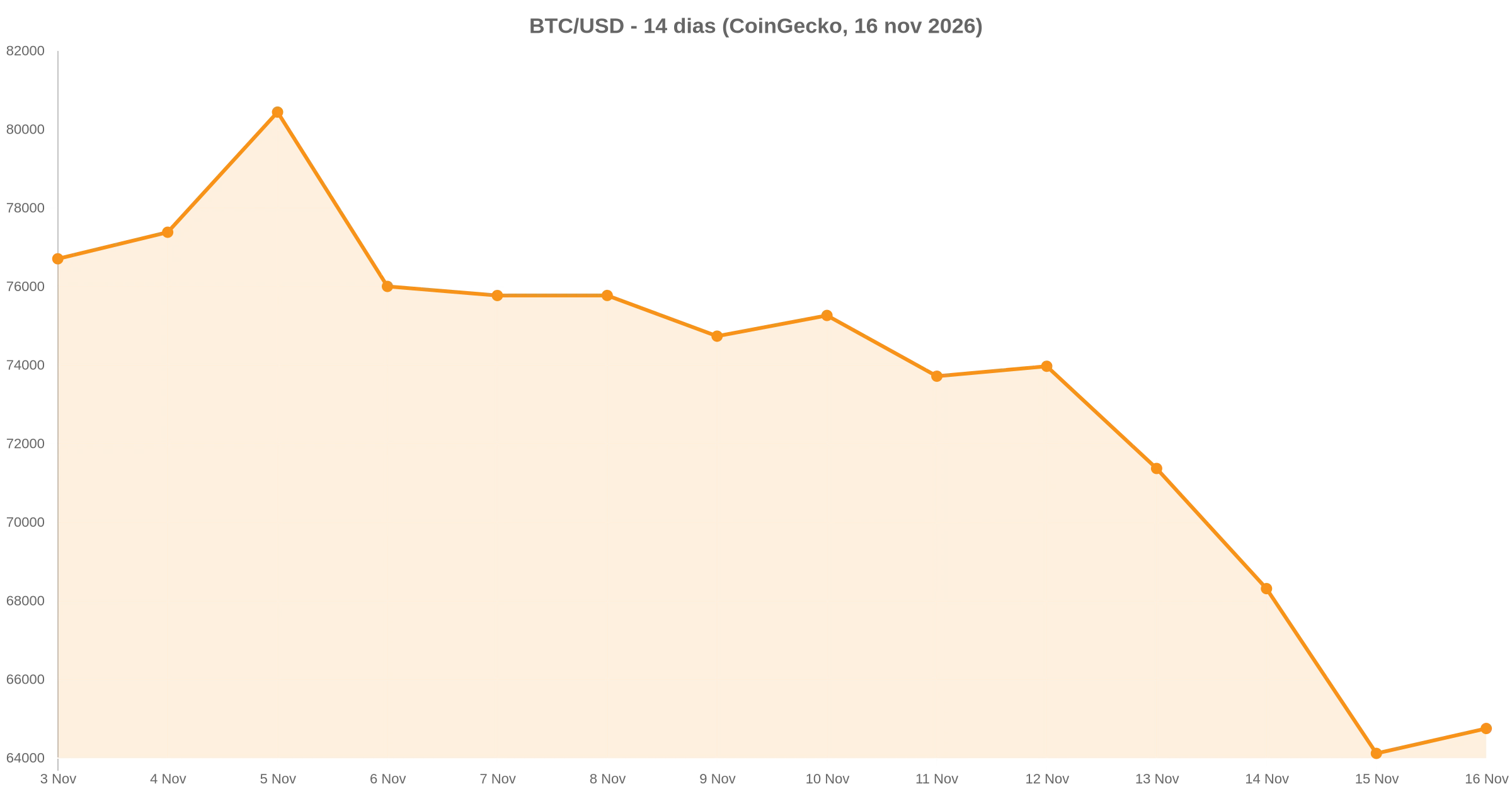
CoinGecko’s daily series shows Bitcoin at $76,709 on 3 November, a local peak near $80,443 on 5 November, then a steady slide through $73,721 on 11 November, $68,314 on 14 November and $64,120 on 15 November, before a marginal rebound close at $65,305 on 16 November. The lowest hourly print in the last seven days was $62,612, recorded at 02:00 UTC on 15 November; the seven-day high was $75,267 on 10 November. The seven-day change is -13.72%.
Both companies bought inside that window. Strategy’s $68,887 average implies it was buying as price crossed from the high $60,000s into the mid $60,000s; Strive’s $69,853 implies a slightly earlier or higher-weighted set of fills over 7 to 13 November. Neither filing discloses individual trade dates or venues, so the intraweek timing cannot be reconstructed from public data.
Indicators: RSI 22.8 and a price 11.3% under the 200-day
Using CoinGecko’s daily closes for the past 365 days and a standard 14-period Wilder calculation, Bitcoin’s daily RSI reads 22.8. The 20-day simple average is $74,286, the 50-day is $79,382 and the 200-day is $72,872. Price is 13.0% below the 20-day, 18.6% below the 50-day and 11.3% below the 200-day. Bitcoin is 33.3% below its 365-day high of $96,899 and 10.3% above its 365-day low of $58,566.
Strategy’s $75,452 average cost now sits above all three averages. Anyone tracking the treasury trade as a proxy for informed buying should register that: the largest holder’s break-even is 16.8% above spot, and the moving averages that would normally act as resistance on a recovery sit below that break-even, at $72,872 to $79,382.
The cross-coin scoreboard
CoinGecko prices at 00:20 UTC on 17 November, with seven-day changes and market capitalisations, put the drawdown in context:
- Bitcoin: $64,615, -13.72% over seven days, $1,299.6 billion market cap. A doubling implies $129,230 and about $2.60 trillion.
- Ethereum: $1,816.23, -14.69%, $222.0 billion. A doubling implies $3,632.46 and roughly $444 billion.
- Solana: $71.51, -17.55%, $42.3 billion. A doubling implies $143.02 and about $84.6 billion.
- XRP: $0.9527, -13.58%, $60.5 billion.
- BNB: $589.97, -14.39%, $77.6 billion.
- TRON: $0.3052, -3.84%, $29.0 billion.
The dispersion is the useful part. Solana has lost 17.6% in a week against Bitcoin’s 13.7%, which widens the beta gap that has defined this cycle; TRON, at -3.8%, is the only major that barely moved. For a buyer whose thesis is that corporate treasuries keep absorbing supply, Bitcoin is the asset with the disclosed, dated bid. For a buyer looking for the deepest discount to a recent high, Solana and Ethereum offer more of it, with no comparable disclosure of who is buying.
What has to be true for the cost-basis trade to work
Three levels come directly from this week’s filings and carry no interpretation. Strategy’s weekly tranche breaks even at $68,887, which requires a 6.6% rally. Strive’s tranche breaks even at $69,853, or 8.1% higher. Strategy’s full position breaks even at $75,452, or 16.8% higher.
The invalidation is equally concrete. A daily close below $62,612, the seven-day low, would put both companies’ newest tranches deeper under water and would mark the first lower low since the slide began on 5 November from $80,443. The bullish case needs a reclaim of $68,887 to show that the treasury bid is absorbing supply rather than merely averaging down.
What cannot be known from these filings is the pace of the next purchase. Strategy’s capacity depends on how much MSTR equity and preferred stock it can sell, and last week it directed 84% of that money to preferred repurchases instead of bitcoin. If that allocation repeats, the weekly bitcoin bid stays in the tens of millions rather than the hundreds. For scale, 736 coins is about 1.6 days of protocol issuance at 3.125 BTC per block and roughly 144 blocks a day, so two buyers can absorb a week of new supply only if they keep buying at this size.
That is the honest framing of the “best crypto to buy” question this week: the largest disclosed buyers paid 7.1% above spot, the market is oversold on daily measures, and the funding mechanism behind the bid is equity issuance rather than cash flow. Those are three measurable facts, not a forecast.
Frequently Asked Questions
Is Bitcoin a good buy at $64,615?
That depends on the thesis, not the price alone. The measurable inputs are that Bitcoin trades 7.1% below the $69,203 blended price Strategy and Strive paid this week, 14.4% below Strategy’s $75,452 all-in average, and 11.3% below its 200-day average of $72,872 with a daily RSI of 22.8. Nothing in those figures establishes a floor.
What is Strategy’s average bitcoin purchase price?
$75,452 per coin across 850,849 BTC, for an aggregate purchase price of $64.20 billion, inclusive of fees and expenses, as reported in the 8-K filed on 16 November 2026.
How much bitcoin did Strategy and Strive buy this week?
Strategy bought 485 BTC for $33.4 million at an average of $68,887. Strive bought 251 BTC at about $69,853, roughly $17.53 million. Combined, 736 BTC for $50.93 million at a blended $69,203.
What price does Bitcoin need to reach for Strategy to break even?
$75,452, its all-in average cost, which is 16.8% above the $64,615 price recorded at 00:20 UTC on 17 November 2026.
How far is Bitcoin below its moving averages?
Price is 13.0% below the 20-day simple average of $74,286, 18.6% below the 50-day of $79,382 and 11.3% below the 200-day of $72,872, calculated from CoinGecko daily closes over the past 365 days.
Did either company say where it bought the bitcoin?
No. Both filings disclose only weekly totals, average prices and holdings. Neither names venues, trade dates or counterparties, so the intraweek execution cannot be reconstructed from public filings.
Data: CoinGecko, SEC EDGAR.
The post Best Crypto to Buy Now: Strategy and Strive Paid $69,203 for Their Bitcoin. Spot Is $64.6K appeared first on BlockchainReporter.