Best Crypto Under $1: Price, Pros, and Cons Compared A dollar does not go far in most markets, but in crypto it can still buy a meaningful stake in coins ranked among the top 25 by market cap
Best Crypto Under $1: Price, Pros, and Cons Compared
A dollar does not go far in most markets, but in crypto it can still buy a meaningful stake in coins ranked among the top 25 by market cap.
Four of them, Dogecoin, Cardano, Stellar, and Hedera, are trading under $1 right now, and each comes with a different mix of strengths and weaknesses worth understanding before adding any of them to a watchlist.
This guide walks through each coin one at a time, starting with today's price and then breaking down the case for and against holding it, so the comparison is based on fundamentals rather than price tag alone.
Dogecoin Overview: Price, Market Cap, and Momentum
Dogecoin started in 2013 as a meme-inspired fork of Litecoin, built on a proof-of-work blockchain.
It has no fixed max supply, and its network is best known for fast block times and low transaction fees rather than smart contract features.
Source: CoinMarketCap official website
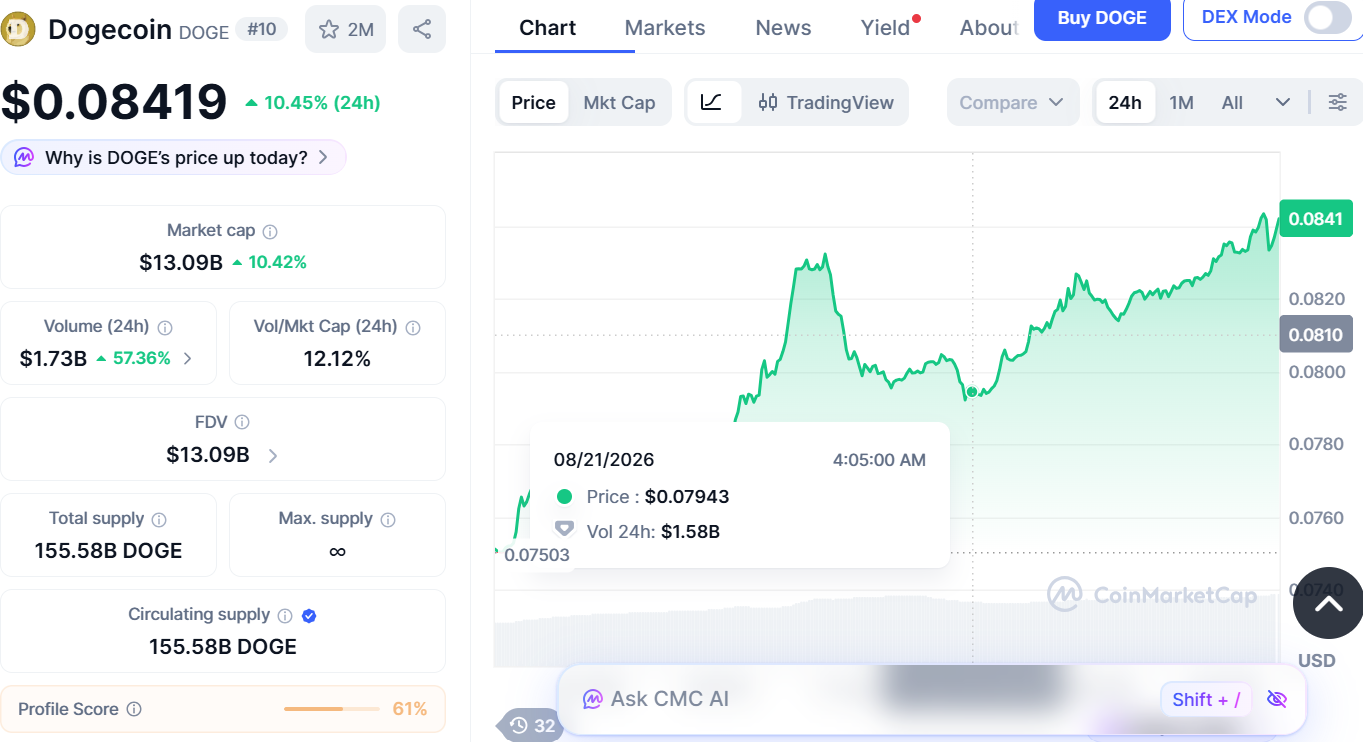
Dogecoin, ranked tenth by market cap, is trading near $0.084, up 10.45 percent in the past 24 hours.
Its market cap sits around $13.09 billion, the largest of any coin on this list, with 24-hour volume near $1.73 billion.
Circulating supply stands at roughly 155.58 billion DOGE against an uncapped max supply, meaning new tokens continue entering circulation with no fixed ceiling.
What Are Dogecoin's Pros?
Largest market cap and deepest liquidity among coins under $1 on this list
Wide exchange availability and strong brand recognition beyond crypto-native audiences
High trading volume makes entering and exiting positions easier during active sessions
What Are Dogecoin's Cons?
Uncapped max supply means ongoing token issuance can pressure price over time
Price movement is often driven by social media sentiment rather than network fundamentals
Limited smart contract functionality compared to newer Layer One platforms
Less differentiated technical roadmap compared to competing large-cap altcoins
Cardano Overview: Price, Market Cap, and Momentum
Cardano is a proof-of-stake blockchain launched in 2017, developed with a peer-reviewed, research-driven approach.
It supports smart contracts and decentralized apps through its Ouroboros consensus protocol, with an active developer ecosystem building on top of it.
Source: CoinMarketCap official website
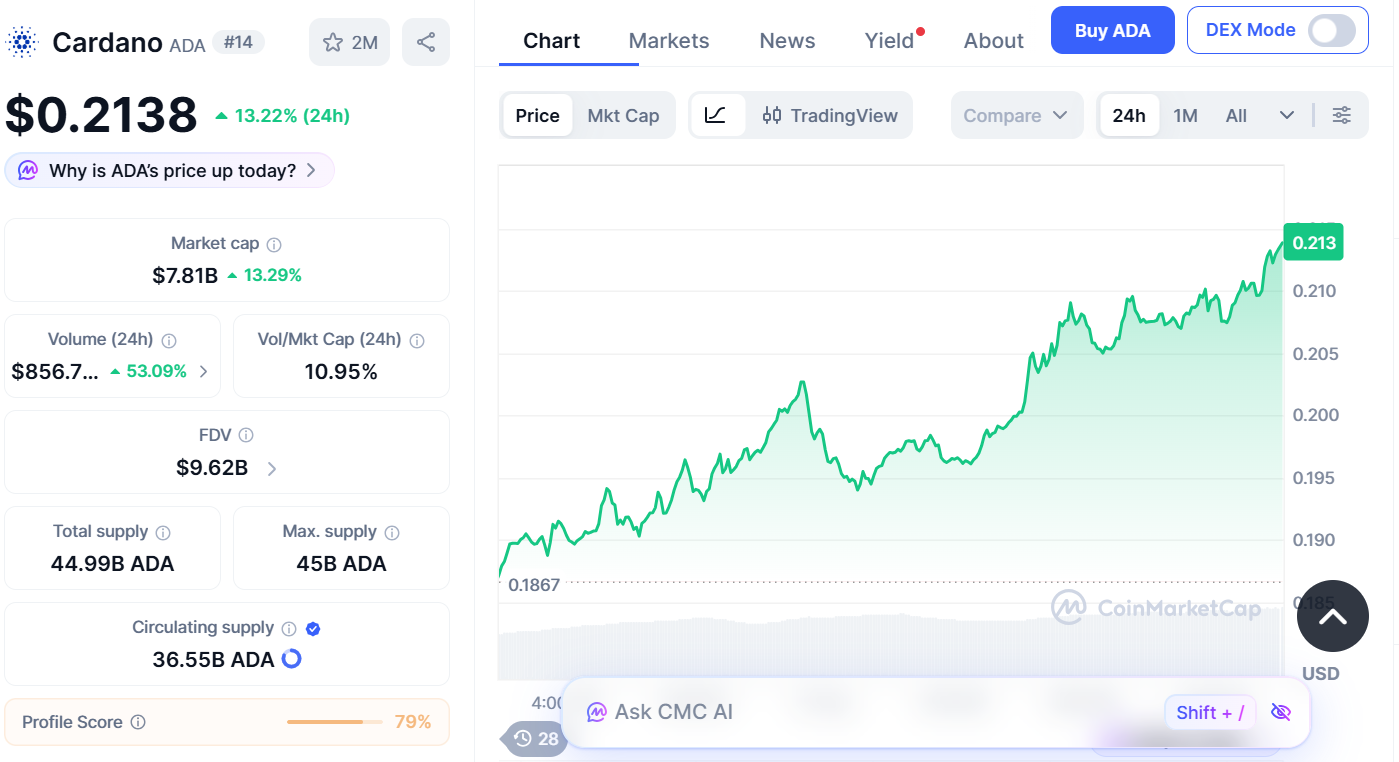
Cardano is trading near $0.214, up 13.22 percent today, the strongest gainer on this list. Its market cap has reached roughly $7.81 billion, with 24-hour volume around $857 million.
With 36.55 billion ADA in circulation against a 45 billion max supply, Cardano still has a meaningful share of its total supply left to enter the market.
What Are Cardano's Pros?
Smart contract platform with an active developer ecosystem and ongoing protocol upgrades
Peer-reviewed development approach that emphasizes formal verification and academic research
Strongest percentage gainer among these four coins today, with volume rising alongside price
What Are Cardano's Cons?
Historically slower feature rollout compared to some competing smart contract platforms
Remaining token issuance ahead of full circulating supply could add future sell pressure
Ecosystem adoption metrics still trail some rival Layer One networks in total value locked
Price can be more sensitive to broader altcoin sentiment than payments or enterprise-focused peers
Stellar Overview: Price, Market Cap, and Momentum
Stellar is a blockchain built specifically for fast, low-cost cross-border payments and asset transfers.
It uses the Stellar Consensus Protocol instead of traditional mining, and its network connects banks, payment providers, and individuals for currency exchange.
Source: CoinMarketCap official website
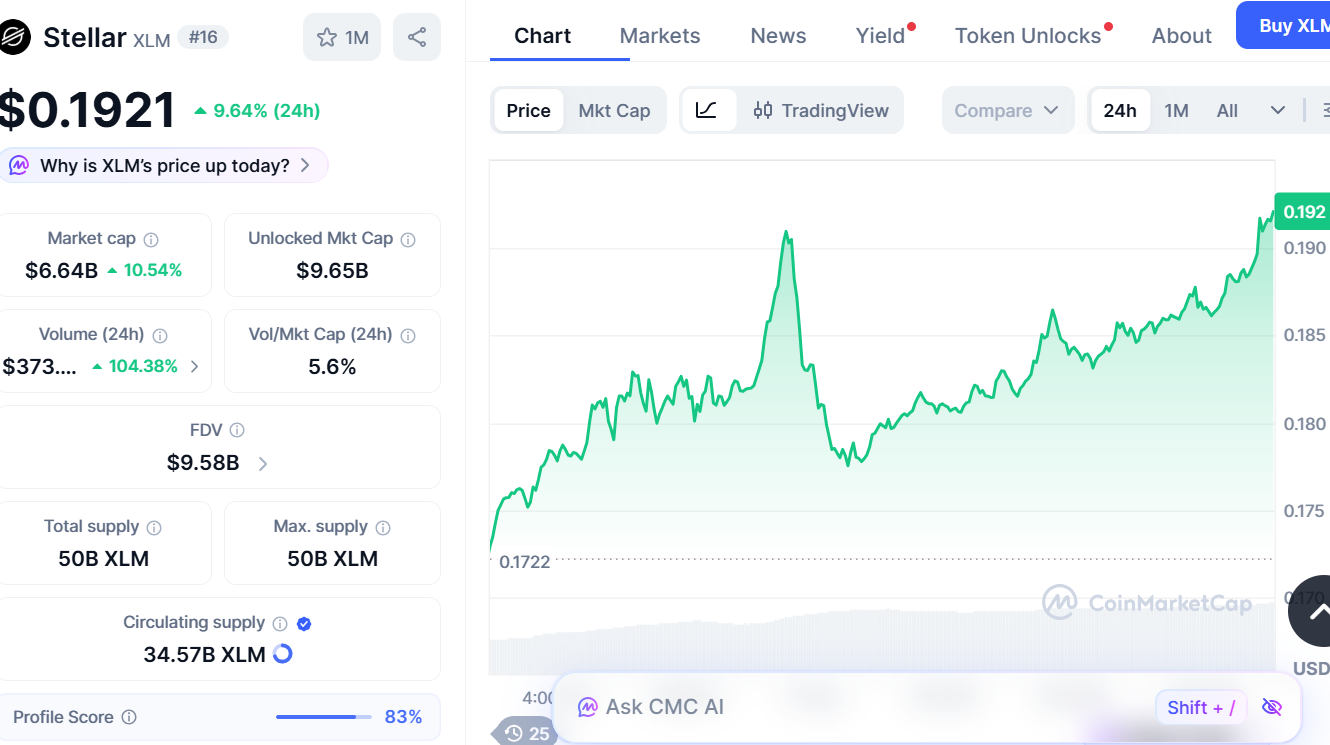
Stellar is trading near $0.192, up 9.64 percent today.
Market cap sits around $6.64 billion, and 24-hour volume more than doubled, rising over 104 percent to roughly $373 million.
A circulating supply of 34.57 billion XLM is already a large share of its 50 billion max supply, leaving comparatively less future dilution ahead than some peers.
What Are Stellar's Pros?
Built specifically for fast, low-cost cross-border payments and asset transfers
Circulating supply is already close to max supply, limiting future dilution pressure
Today's volume surge, more than doubling in 24 hours, points to renewed trader interest
What Are Stellar's Cons?
Payments-focused use cases face competition from both crypto and traditional fintech rivals
Price has historically shown sharp reversals following volume-driven spikes like today's move
Smaller developer ecosystem compared to general-purpose smart contract platforms
Hedera Overview: Price, Market Cap, and Momentum
Hedera runs on hashgraph, a distributed ledger technology distinct from traditional blockchain architecture, offering high throughput and fast finality.
It is governed by a council of established global companies rather than a single founding team, giving it an enterprise-focused structure.
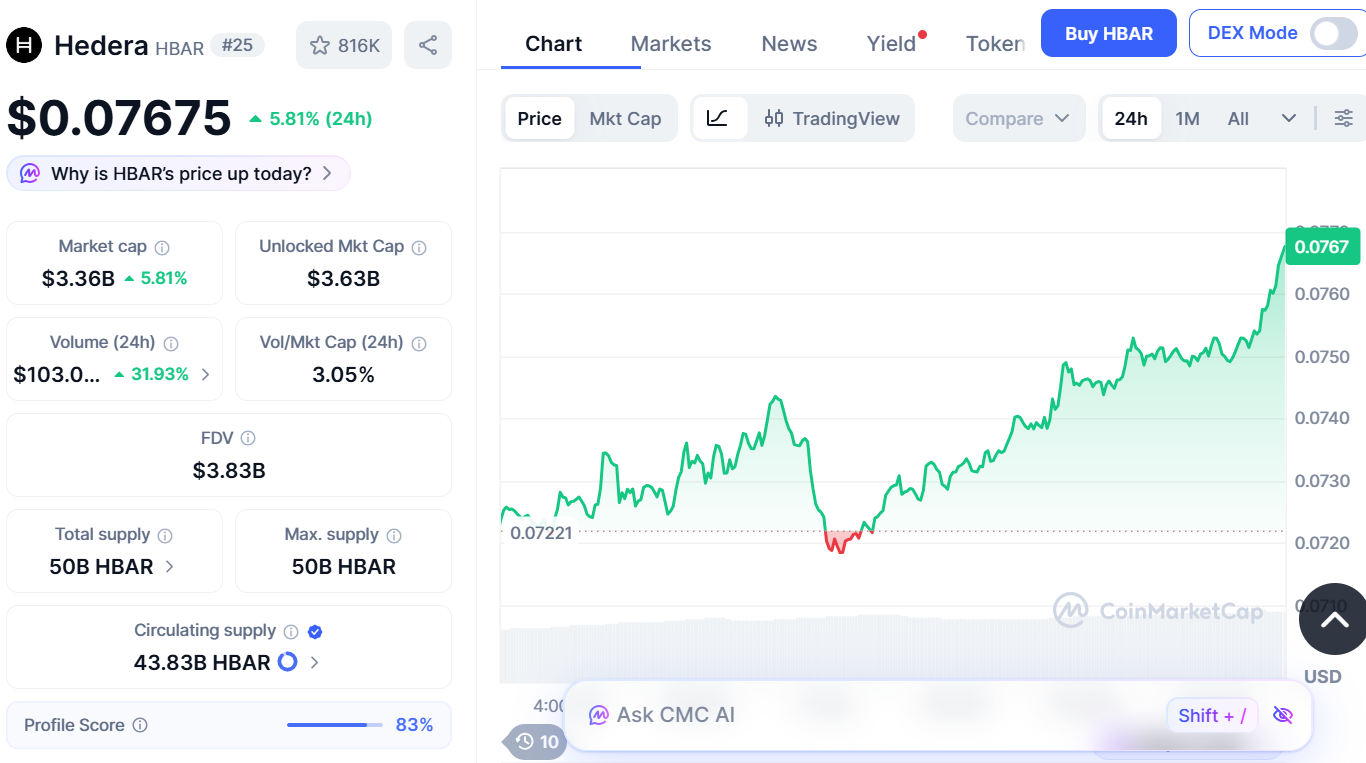
Hedera, ranked 25th by market cap, is trading near $0.0768, up 5.81 percent today.
Market cap is roughly $3.36 billion, the smallest of the four, with 24-hour volume near $103 million.
The circulating supply of 43.83 billion HBAR sits close to its 50 billion max supply, meaning most of its total token issuance has already occurred.
What Are Hedera's Pros?
Enterprise-focused network with established corporate and institutional partnerships
Circulating supply near max supply limits how much future dilution can weigh on price
Governance structure built around a council of established global companies
What Are Hedera's Cons?
Smallest market cap and lowest 24-hour gain among the four coins covered here
Less retail brand recognition compared to DOGE or longer-established altcoins
Enterprise adoption narratives can take longer to translate into visible price action
How Do These Four Coins Compare Side By Side?
Coin
Price
24h Change
Market Cap
24h Volume
Circulating Supply
Dogecoin (DOGE)
$0.08419
+10.45%
$13.09B
$1.73B
155.58B
Cardano (ADA)
$0.2138
+13.22%
$7.81B
$856.7M
36.55B
Stellar (XLM)
$0.1921
+9.64%
$6.64B
$373M
34.57B
Hedera (HBAR)
$0.07675
+5.81%
$3.36B
$103.0M
43.83B
Dogecoin wins on size and liquidity.
Cardano wins on today's percentage gain and development activity.
Stellar wins on payments, utility, and volume acceleration.
Hedera wins on capped future dilution and enterprise backing.
Looking at the table as a whole, no single coin leads on every column, which is the clearest sign that price alone was never going to settle which one deserves a spot on a watchlist.
Why Do Circulating Supply And Total Supply Matter Here?
Circulating supply is how many tokens are actively trading right now, while max supply is the ceiling on how many will ever exist.
The gap between the two numbers tells you how much future dilution a coin still has ahead of it.
Dogecoin has no max supply cap at all, so new tokens enter circulation indefinitely.
Cardano's 36.55 billion circulating ADA against a 45 billion cap leaves a meaningful gap still to be issued.
Stellar and Hedera are both much closer to their respective caps, at roughly 69 percent and 88 percent of max supply already circulating.
A smaller remaining gap generally means less future sell pressure from new token issuance alone, though it says nothing about demand-side factors like adoption or trading interest.
What Is The Best Crypto Under $1 Based On These Factors?
The best crypto under $1 depends on what an individual buyer is optimizing for.
Dogecoin suits buyers who prioritize liquidity and brand recognition.
Cardano suits buyers focused on smart contract development activity.
Stellar suits buyers interested in payments infrastructure.
Hedera suits buyers who value limited future dilution and enterprise partnerships.
Framing the question this way turns best crypto under $1 into a matching exercise rather than a single ranked answer.
No single coin wins on every measure, which is exactly why pros and cons matter more than a single ranked pick. A coin's strength on one metric, such as DOGE's liquidity, often comes paired with a weakness elsewhere, such as its uncapped supply.
How Should You Use This Pros And Cons Guide?
None of the four coins covered here is a universal best pick.
Someone prioritizing liquidity above all else will read DOGE's profile differently than someone focused on smart contract development, payments infrastructure, or limited future dilution.
The more useful exercise is matching each coin's listed strengths against your own priorities, then checking whether its listed weaknesses are ones you can tolerate.
A buyer comfortable with DOGE's uncapped supply because they value its liquidity is making a different, and equally valid, decision than a buyer who rules it out for that same reason.
Revisiting this comparison periodically also matters, since today's price and volume figures will shift, even if the underlying pros and cons of each project's design stay largely the same.
Expert Opinion
Market analysts generally view coins with defined utility narratives, such as Cardano's smart contract ecosystem or Hedera's enterprise partnerships, as better positioned for sustained interest than coins whose momentum leans more on social sentiment, such as DOGE.
That said, its liquidity and market depth remain difficult for smaller-cap alternatives to match, which keeps it relevant despite thinner fundamental utility.
Stellar's position is viewed as more use-case specific, tied closely to how much traction its payments infrastructure gains against both crypto-native and traditional fintech competitors.
Analysts note that today's coordinated gain across all four coins likely reflects broader market risk appetite rather than a shared project-specific catalyst, and caution that pros and cons should be weighed against an individual buyer's own goals rather than treated as a ranked list with one clear winner.
When narrowing down the best crypto under $1 from this group, analysts generally recommend checking which weaknesses matter least to your own goals rather than searching for a coin with no drawbacks at all, since every project on this list carries some structural trade-off alongside its strengths.
Disclaimer
This article is for informational purposes only and is not financial advice. Cryptocurrency markets are highly volatile, and prices can change sharply within short periods. All figures reflect live market data at the time of writing and may have changed by the time you are reading this. Always do your own research and consult a qualified financial advisor before making any investment decisions