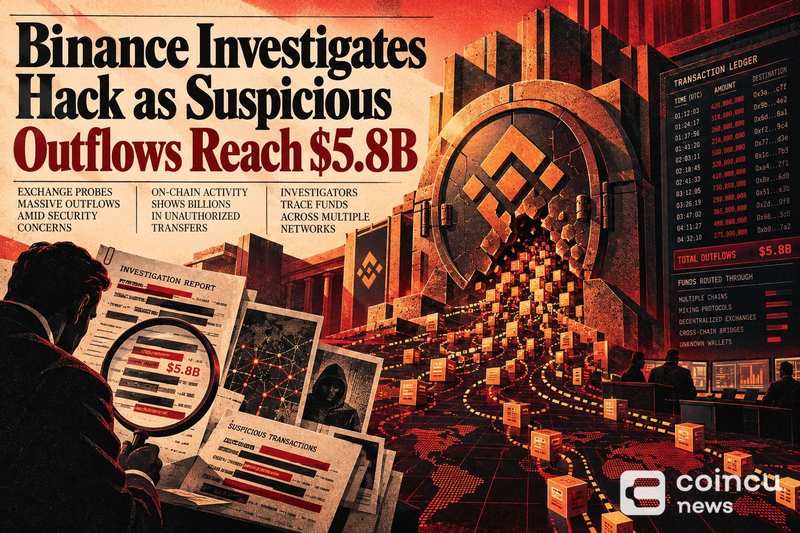
Binance is investigating reports of a potential hack after suspicious outflows reportedly reaching up to $5.8 billion were detected on the exchange, according to reporting published October 2
Binance is investigating reports of a potential hack after suspicious outflows reportedly reaching up to $5.8 billion were detected on the exchange, according to reporting published October 29, 2026. No breach has been confirmed, and the figures represent an upper-end estimate circulating as the investigation unfolds, leaving the scale, cause, and impact on customer funds unresolved as of this writing.
Binance investigates reports of suspicious outflows
The world's largest centralized crypto exchange by volume is examining what multiple outlets are characterizing as anomalous outflow activity, per reporting from The Block on October 29, 2026. The reported upper estimate of up to $5.8 billion in suspicious outflows has drawn immediate market attention, though Binance has not confirmed either the volume or the mechanism behind the movements. For related coverage, see WSOT 2026 Is Live: Registration Opens for Bybit's World Series of Trading, With a Prize Pool of Up to 10 Million USDT Across Crypto, Stocks, and AI.
The distinction between "suspicious outflows" and confirmed unauthorized withdrawals is material. Large-scale outflows can reflect user panic, coordinated institutional withdrawals, internal wallet restructuring, or actual exploit activity; without on-chain attribution or an official statement from Binance specifying wallet addresses and transaction hashes, no causal determination is possible. This article treats the investigation status as reported and the outflow figure as an unverified upper estimate, consistent with how the primary source frames it. Context on this theme: Top Value myXRP Review 2026: A Public Door Into XRP Rewards, With a 100 FXRP Welcome Gift.
Binance has not, as of publication, released a public incident report, a list of affected assets, or confirmation of unauthorized access. The exchange's security team is actively reviewing the situation, per available reporting. Users watching for updates should expect that the picture will clarify materially once Binance completes initial triage and issues an official communication. More on this in Artificial intelligence summit –Indonesia 2026.
The $5.8 billion figure represents the upper bound of reported suspicious outflow estimates tied to this investigation, not a verified loss total. Outflow data at this scale, if confirmed, would represent a significant single-day movement for any centralized exchange, though Binance routinely processes tens of billions in daily volume, meaning even large nominal outflows require careful interpretation against baseline activity.
Crucially, suspicious outflow volume does not establish the cause of those movements. In prior exchange security incidents across the industry, on-chain forensic analysis has revealed that initial estimates of compromised amounts frequently differed substantially from final confirmed figures, both above and below early reports. The specific blockchains involved, the assets affected, the destination wallets, and the timeframe of the alleged movements have not been independently verified from primary on-chain sources as of this publication.
Exchange outflow spikes can be a leading indicator of user confidence stress even when no hack has occurred. Separately, Ethereum exchange outflows hit a four-month high of 169,770 ETH in a prior episode this year, illustrating how quickly withdrawal activity can accelerate across the industry when a major exchange enters a negative news cycle, regardless of the underlying cause.
Without a verified transaction hash, a confirmed wallet address, or an official statement from Binance specifying the amount, the $5.8 billion figure must be treated as an unconfirmed estimate. Reporting it as a settled fact at this stage would overstate what the evidence currently supports.
What Binance needs to clarify as the investigation develops
Several operational questions remain open and will determine the actual severity of this event for users, counterparties, and regulators. The most immediate is whether unauthorized access to Binance's systems actually occurred, or whether the outflows reflect other activity such as internal hot-wallet rebalancing, user withdrawals driven by rumor, or a combination of factors. Until Binance specifies the mechanism, the word "hack" in widespread reporting should be read as an allegation under investigation, not an established fact.
A second unresolved question is whether customer funds were directly affected. Centralized exchanges maintain complex multi-wallet architectures, including hot wallets for liquidity, cold storage for reserves, and operational wallets for internal transfers. Movement of funds between these layers can generate outflow signals on blockchain explorers without reflecting any loss of customer assets. Conversely, if a hot wallet was compromised, the affected portion of customer funds would depend on how much liquidity was held there at the time of the incident.
Regulators and institutional counterparties will also be watching whether Binance has contained or traced the suspected outflows. In documented exchange security incidents, the speed at which an exchange can freeze suspicious destination addresses, coordinate with blockchain analytics firms, and engage law enforcement correlates directly with the probability of fund recovery. The downstream effects on DeFi users when Binance faces significant balance sheet events have been documented, underscoring why clarity on whether funds have been secured matters beyond the exchange itself.
Additional open questions include whether Binance has halted or restricted withdrawals in response to the investigation, whether any security advisory or guidance has been issued to users, and whether third-party blockchain analytics firms have been engaged to trace the alleged outflows. None of these has been confirmed in available reporting as of October 29, 2026.
How users should approach a developing exchange security report
When a major exchange enters a public investigation without confirmed details, users face a practical information gap that bad actors routinely exploit. Phishing campaigns mimicking official Binance communications, fake "emergency withdrawal" pages, and impersonator accounts on social platforms typically spike within hours of a major security headline. Users should verify any communication they receive by navigating directly to Binance's official domain rather than following links from emails, social posts, or messaging apps.
Official Binance status updates, when issued, will appear on the exchange's verified social channels and its official blog. Third-party aggregators and social media accounts purporting to relay official statements should be treated with caution until the content can be confirmed from the primary channel. Security guidance issued by an exchange during an active investigation is time-sensitive; users who act on unofficial versions of that guidance risk making decisions based on inaccurate or deliberately falsified information.
This article does not advise any specific action regarding asset withdrawal or account management. The investigation is active, the facts are incomplete, and any response should be calibrated to verified developments rather than to the current uncertainty. Users with material balances on any centralized exchange should already have familiarity with the withdrawal process and two-factor authentication settings as a baseline precaution that applies independent of this specific event.
FAQ about the reported Binance suspicious outflows
Is Binance confirmed to have been hacked?
No. As of October 29, 2026, the situation is described as an active investigation into suspicious outflows, not a confirmed breach. The word "hack" appears in reporting based on the circumstances under examination, not on an official determination by Binance or an independent security auditor. A confirmed hack requires evidence of unauthorized system access, which has not been established in available reporting.
How much was reportedly involved in the suspicious outflows?
Reports cite suspicious outflows reaching up to $5.8 billion, framed as an upper-end estimate. This figure is unverified and has not been confirmed by Binance. It should be read as the ceiling of a range, not as a confirmed loss amount. Prior industry incidents have shown that early outflow estimates frequently diverge significantly from final confirmed figures after forensic analysis is completed.
Are Binance customer funds confirmed to be affected?
This cannot be concluded from the information currently available. Outflow activity, even at large scale, does not by itself establish that customer funds have been lost or that withdrawal access has been impaired. Whether the alleged outflows originated from hot wallets holding customer assets, from internal operational wallets, or from some combination remains undetermined. An official incident report from Binance would be the authoritative source for this determination.
What assets or blockchains are reportedly involved?
Available reporting does not specify which assets or blockchain networks are implicated in the suspicious outflow activity. Without named assets, transaction hashes, or wallet addresses, the scope of the alleged incident cannot be independently assessed from on-chain data. When Binance provides an official update, it would be expected to include this information if an unauthorized incident is confirmed.
Where should users look for verified updates?
Official Binance communications channels, including the exchange's verified accounts and its official news blog, are the authoritative sources for updates. Credible independent reporting from established outlets that cite named Binance representatives or official documents provides a secondary verification layer. Users should be skeptical of unattributed claims circulating on social platforms, even when they appear detailed, until the information can be traced to a primary official source.
What to watch as this situation develops
The next concrete trigger is an official statement from Binance, which would be expected to address whether unauthorized access occurred, the scope of any affected assets, the status of platform withdrawals and operations, and any steps taken to secure or recover the alleged outflows. The absence of such a statement as the investigation proceeds will itself be informative to markets.
Regulatory engagement represents a secondary catalyst. Major exchange security incidents typically trigger inquiries from financial regulators in the jurisdictions where the exchange operates, and the speed and transparency of Binance's response would influence both the regulatory posture and user confidence trajectory. Institutional counterparties, including custodians and market makers with bilateral exposure to Binance, are likely conducting their own risk assessments in parallel.
On-chain analysts and blockchain intelligence firms will almost certainly publish wallet tracing if the suspicious outflows involved identifiable addresses, which would provide an independent verification layer regardless of what Binance officially states. Those findings, when available from credible on-chain sources, would materially sharpen the picture of what actually occurred and whether any recovery is possible. Readers tracking this story should prioritize updates that include verifiable transaction hashes or block explorer references over those that rely solely on unnamed sources or social media signals.
Additional source references: source document 1.
Disclaimer: This article is for informational purposes only and does not constitute financial or investment advice. Cryptocurrency and digital asset markets carry significant risk. Always do your own research before making decisions.
The post Binance Investigates Hack as Suspicious Outflows Reach $5.8B was initially published on Coincu.