Binance said it is rolling out a new “Pay Later” spending feature for eligible users in Argentina and Mexico, offering them up to 1,000 USDC in transaction credit without forcing a sale of th
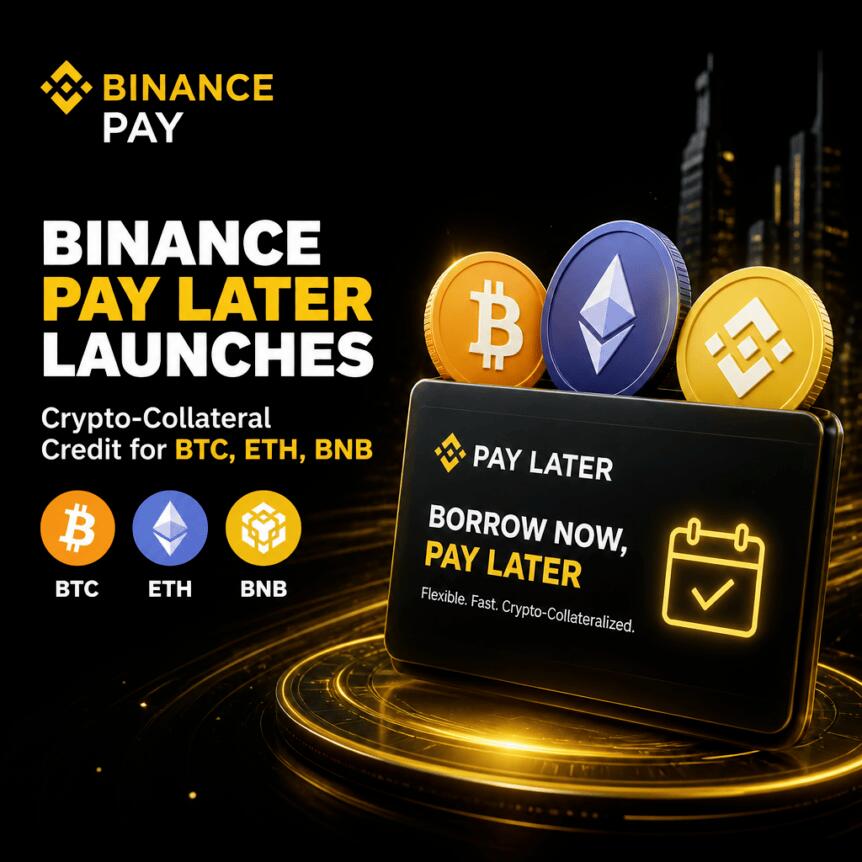
Binance said it is rolling out a new “Pay Later” spending feature for eligible users in Argentina and Mexico, offering them up to 1,000 USDC in transaction credit without forcing a sale of their crypto. The program is positioned as asset-backed consumer credit that uses cryptocurrency holdings as collateral.
According to Binance, Pay Later lets users draw up to 50% of the value of qualifying collateral in the form of spending power denominated in USDC. Binance also said the credit is supported by holdings of Bitcoin (BTC), Ether (ETH), and BNB, meaning users can spend against their crypto balances rather than convert them beforehand.
Key takeaways
- Binance will initially offer Pay Later credit of up to 1,000 USDC to eligible users in Argentina and Mexico.
- Borrowing capacity is capped at 50% of eligible collateral value, so $2,000 in BTC would be needed for a maximum $1,000 credit line.
- The product is framed as interest-free until a repayment deadline at the start of the following month, subject to Binance’s FAQ terms.
- Binance can liquidate collateral if the loan reaches 90% of its value, even before the repayment date.
How Binance’s Pay Later credit works
Binance’s announcement, shared with Cointelegraph, describes Pay Later as a way for users to access up to 1,000 USDC in spending power. The credit is intended to be used for purchases while the underlying collateral—held in BTC, ETH, or BNB—remains unsold.
The mechanics also include a straightforward borrowing limit: Binance said users can borrow only up to half the value of their eligible collateral. In practical terms, Binance stated that an example of $2,000 worth of BTC would be required to access a maximum $1,000 credit line.
This structure matters because it effectively turns crypto volatility into risk management math. Users are not simply taking a fixed-size loan; their available credit depends on the collateral valuation that Binance tracks as market prices move.
Repayment terms and what happens if balances run overdue
Binance said purchases made through Pay Later are interest-free until the repayment deadline on the first of the following month. Beyond that deadline, Binance’s published FAQ reportedly includes additional conditions, including:
- a one-day grace period for overdue balances, and
- interest of 0.1% per day on overdue amounts, compounding daily.
For users, the key takeaway is that the feature is designed to work like a short-cycle credit window. If repayment is missed, the cost profile can change quickly because interest compounds daily rather than remaining flat.
Collateral liquidation risk: the 90% trigger
While the product aims to let users spend without selling, Binance also highlighted a risk control designed to protect the loan exposure. If the value dynamics move unfavorably, Binance said it can liquidate collateral when the outstanding loan reaches 90% of its value, even if the repayment date has not yet arrived.
That means the cost of using Pay Later is not only about repayment discipline; it also depends on how the underlying collateral performs. A decline in crypto prices could reduce the collateral value relative to the outstanding loan, pushing the account toward Binance’s liquidation threshold.
For users evaluating the feature, the practical question is whether they can tolerate the collateral risk during the credit window—especially if they are taking credit denominated in USDC while holding volatile assets like BTC or ETH.
Limited launch and gradual expansion
Binance said Pay Later will initially launch for eligible users in Argentina and Mexico. The company also indicated that the rollout will be gradual for additional markets, though it did not specify which countries will come next in the announcement shared with Cointelegraph.
The regional approach signals Binance is testing a consumer-credit workflow in environments where crypto holders may want a way to use digital assets without triggering immediate sales—potentially avoiding taxable events in some jurisdictions or simply reducing friction for everyday spending. However, the liquidation and interest terms underscore that this is not “free money”; it is structured credit with clear failure points.
Why this matters for crypto payments
Pay Later reflects a broader push across the crypto industry to connect on-chain or crypto-backed balances with more familiar payment behaviors—effectively trying to make crypto function like a funding source rather than something users must actively convert each time they want to spend. By using USDC as the spending denomination and crypto holdings as collateral, Binance is attempting to bridge the gap between volatile asset storage and stable transactional value.
At the same time, Binance’s liquidation mechanism makes the product’s risk profile more similar to margin-style exposure than to conventional unsecured credit. That distinction will likely determine who adopts it: users comfortable with collateral volatility may see it as a way to maintain exposure while covering purchases, while more risk-averse users may prefer simpler buy-and-sell flows.
As the feature expands beyond Argentina and Mexico, the next watch item for users and observers will be how quickly Binance rolls out eligibility and whether additional regions receive different collateral or credit parameters—alongside whether the company adjusts repayment or liquidation terms based on early usage patterns.
This article was originally published as Binance Pay Later Launches Crypto-Collateral Credit for BTC, ETH, BNB on Crypto Breaking News – your trusted source for crypto news, Bitcoin news, and blockchain updates.