Binance now requires sellers writing stock put options on its platform to hold full USDC reserves equal to the position's potential purchase obligation, making every short put a fully cash-se
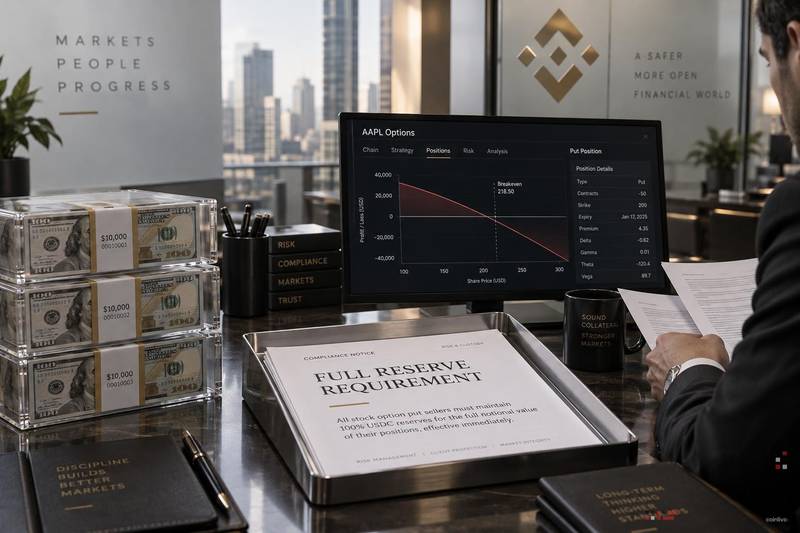
Binance now requires sellers writing stock put options on its platform to hold full USDC reserves equal to the position's potential purchase obligation, making every short put a fully cash-secured trade. The rule eliminates partial collateral arrangements for put writers and directly limits available leverage on these positions.
What Full USDC Reserves Mean for Put Writers
A stock put option gives the buyer the right to sell shares at a fixed strike price. The seller, or writer, takes the other side, accepting a possible obligation to purchase those shares if the option is exercised. Under Binance's requirement, sellers must lock full USDC reserves covering that purchase obligation before a position can be opened. For related coverage, see EPIC and QUICK Fall After Binance Delisting Announcement.
The requirement applies to the writing side only. Put buyers pay a premium and face no assignment risk, so the reserve rule does not affect them. The change converts every open short put into a cash-secured structure rather than a margin-backed one. For related coverage, see XRP Whale Activity on Binance Nears August Outflow Gap.
USDC serves as the collateral currency because it is a dollar-pegged stablecoin that can be held and released without currency conversion risk at settlement. Binance's broader platform already relies heavily on USDC across multiple product lines, as seen in its expanding payment infrastructure.
How the Collateral Mechanics Work in Practice
The required reserve is tied to the strike price multiplied by the contract's share exposure. For example, if a hypothetical contract covers 10 shares at a $150 strike, the seller would need to lock $1,500 in USDC before writing the put. The premium collected reduces the net cost basis if assigned, but it does not reduce the reserve requirement itself.
At expiry, two outcomes are possible. If the underlying stock closes above the strike, the put expires worthless and the seller keeps the premium; the locked USDC is released. If the put is exercised, the reserved USDC is used to fulfill the purchase obligation at the agreed strike price.
Capital Commitment Up, Leverage Down
Full-reserve backing means a put writer must commit the entire notional value of the potential assignment before opening the trade. That is a significant increase in capital per position compared to partial margin structures, and it directly caps how many concurrent positions a trader can carry.
The trade-off is reduced counterparty risk: the exchange holds sufficient collateral to settle any exercise without relying on a margin call cycle. For traders accustomed to margin-based options writing, position sizing will need to be adjusted accordingly.
Downside risk does not disappear with full reserves. If the underlying stock falls sharply below the strike and the put is exercised, the seller takes ownership of shares at above-market cost, and the USDC collateral has already been exchanged for that position. Market and assignment risk remain fully intact. Traders should verify current contract specifications, eligible stock tickers, and collateral calculation methods directly in Binance's platform documentation before writing any puts under this structure. Separately, Binance continues to face scrutiny on its compliance posture, as covered in reporting on DOJ oversight of its 2023 settlement, which is broader context traders may want to monitor. For those tracking stablecoin developments, Circle's USDC regulatory progress in the EU adds further backdrop to how USDC is being positioned as a settlement-grade asset on major platforms.
Additional source references: source document 1.
Disclaimer: This article is for informational purposes only and does not constitute financial or investment advice. Cryptocurrency and digital asset markets carry significant risk. Always do your own research before making decisions.
Read original article on coinlive.me