Binance has started reopening withdrawals after the largest crypto hack on record, and a widely watched blockchain tracker shows billions of dollars on the move. DefiLlama recorded about $3.7
Binance has started reopening withdrawals after the largest crypto hack on record, and a widely watched blockchain tracker shows billions of dollars on the move.
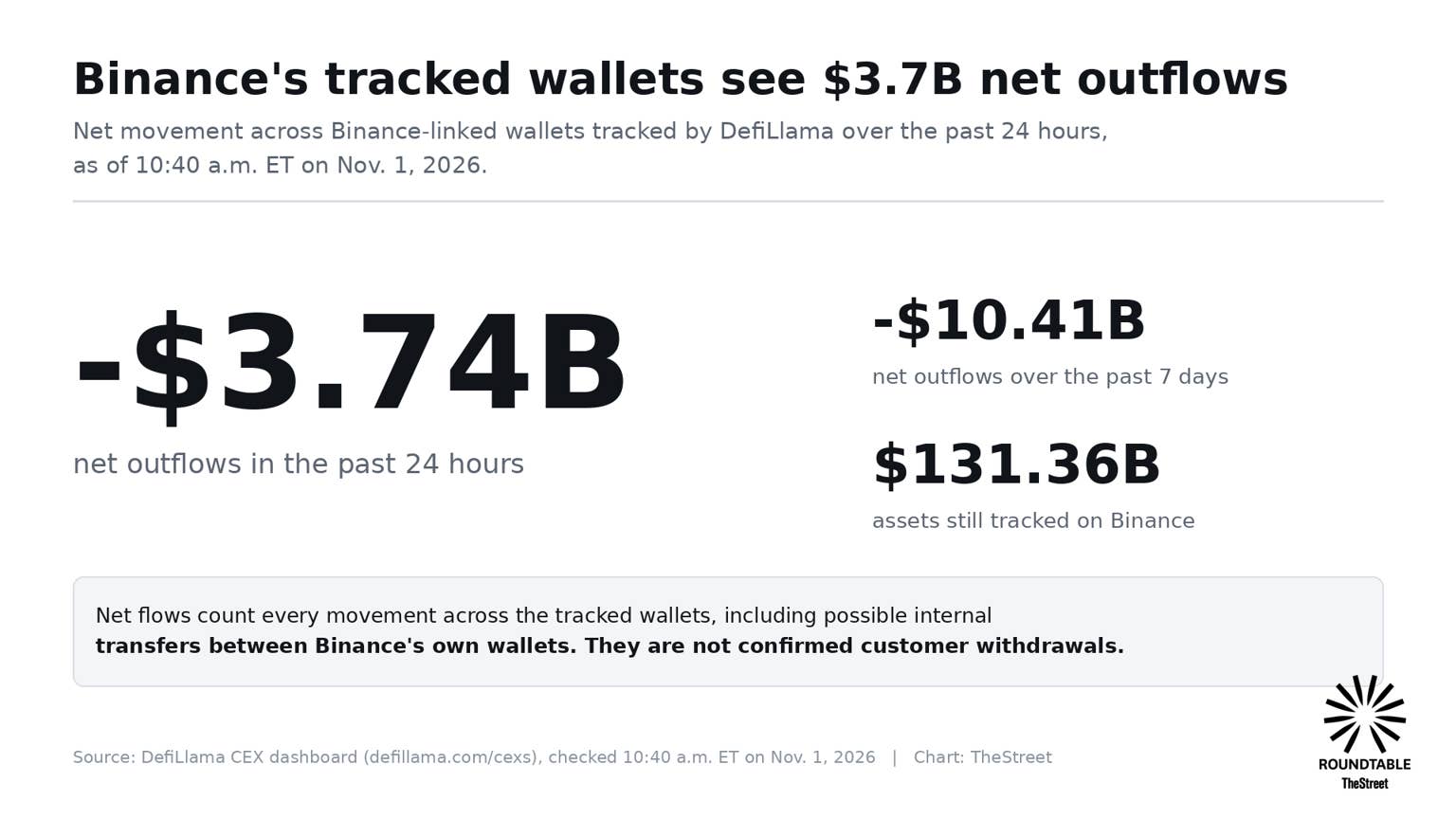
DefiLlama recorded about $3.74 billion in net outflows from Binance-linked wallets over the past 24 hours, as of 10:40 a.m. ET on Sunday. The tracker still shows roughly $131.36 billion in assets on the exchange.
TheStreet has covered the fallout since Binance first disclosed the breach on Thursday, including this op-ed on the hack.
The exchange says attackers used a compromised employee laptop to submit unauthorized withdrawal transactions. It estimates the total impact at about $6.3 billion and says roughly $3 billion was frozen on-chain within hours.
The FBI has named North Korea's TraderTraitor group as the actor behind the theft and asked the crypto industry to block addresses tied to the attacker.
The exchange covered the 7,000 bitcoin stolen in its 2019 hack from its emergency insurance fund, known as SAFU. This time it has reserved $6.34 billion of company funds and says none of the loss will fall on users.
What the tracker actually shows
A net outflow means more money left a set of wallets than came in over a given period. It is a net figure, so $3.74 billion in net outflows can sit on top of a much larger total moving in both directions.
DefiLlama tracks wallets that Binance discloses through its proof-of-reserves system, an attestation that customer assets are backed by real holdings, plus wallets backing Binance-pegged tokens. It does not see Binance's internal customer ledger, so the reading cannot say who moved funds or why.
Some of the movement was large enough to be flagged in real time. Whale Alert, a service that tracks big blockchain transfers, recorded a single transfer of 2,000 bitcoin worth about $156 million from a Binance wallet to an unknown wallet at 1:28 a.m. ET on Sunday.
An unknown wallet is simply an address the tracker cannot label. It is not proof that the transfer came from a customer rather than Binance itself.
The 24-hour outflow equals about 2.8% of the $131.36 billion in assets DefiLlama tracks on Binance. Over the past seven days, a stretch that includes the hack and the withdrawal pause, the tracker shows roughly $10.41 billion in net outflows.
Net flows across Binance-linked wallets tracked by DefiLlama as of 10:40 a.m. ET on Nov. 1, 2026. Net flows count every movement, including possible internal transfers, and are not confirmed customer withdrawals. Source: DefiLlama | Chart: TheStreet
DefiLlama
Withdrawals reopen in phases
Binance began phase one of its reopening early Sunday, between 1:00 a.m. and 4:00 a.m. ET. The first phase covers major networks including Bitcoin, Ethereum, BNB Chain, Solana, XRP, Dogecoin, Tron, Polygon, Arbitrum, Base, Optimism, Avalanche, Toncoin and Sui, along with the largest stablecoins.
By 7:36 a.m. ET, the exchange said withdrawals had been re-enabled for ZEC, TON and SUI, adding to networks restored earlier in the rollout.
The company warned of temporary delays during the initial rollout because of heavy traffic. Deposits have worked normally throughout the incident.
Binance also said it has now covered about 95% of the amount impacted by the hack, up from roughly 90% on Saturday. The rest sits in less liquid tokens outside the ten largest assets, which take longer to buy back at scale.
All BTC, ETH, USDT, BNB, SOL, USDC, XRP, USD1, RLUSD and ZEC balances are fully backed, according to the exchange. A new proof-of-reserves snapshot was completed at 8 p.m. ET on Friday, and the full cryptographic verification of the snapshot is expected Tuesday.
Binance says some outflows may be internal
Binance co-CEO Yi He pushed back on the tracker readings early Sunday. She wrote that it looks like the bot counted some of Binance's new hot wallet addresses as outflows and advised users to compare several tracking tools.
A hot wallet is a wallet connected to the internet that an exchange uses for day-to-day transfers. Exchanges routinely shuffle funds between their own hot and cold wallets, and automated trackers can mistake those moves for customers pulling money out.
Her comment is a caveat about the data, not a full explanation. Binance has not published its own figure for how much of the $3.74 billion reflects internal transfers rather than customers leaving.
The $3.75 billion claim going around
A viral post from market news account WatcherGuru claimed at 10:15 a.m. ET that more than $3.75 billion was withdrawn from Binance within ten hours of withdrawals resuming. The post names no dataset and shows no methodology.
TheStreet could not verify the figure or the ten-hour window. The number appears to trace back to tracker readings like DefiLlama's, which measure net flows across labeled wallets rather than confirmed customer withdrawals.
Gross withdrawals, net wallet changes and actual customer withdrawals are three different measures. A bank-run headline needs a gross customer figure, and no public dataset offers one right now.
Where things stand
Withdrawals are live in phases across major networks, and Binance says more will be added as security checks finish. The company says about 95% of the impacted amount is covered and the ten largest assets are fully backed.
The next milestone is the full zero-knowledge proof of reserves, a cryptographic check that verifies customer assets without exposing the underlying data. Binance says it is expected by Tuesday.
Whether the tracked outflows slow as more networks reopen is the next signal to watch, though the same wallet-labeling caveats apply to any future reading. For now, withdrawals are processing and Binance says user funds remain safe.
Popular on TheStreet Roundtable
Binance says 90% of hack impact now covered
FBI names who took $6B+ from Binance
Binance cites $1B SpaceX stake after Elon Musk mocks hack
Disclaimer: This article is for informational purposes only and does not constitute financial advice.
Cryptocurrency investments are highly volatile and risky. Always conduct your own research before making any investment decisions.Binance has started reopening withdrawals after the largest crypto hack on record, and a widely watched blockchain tracker shows billions of dollars on the move.