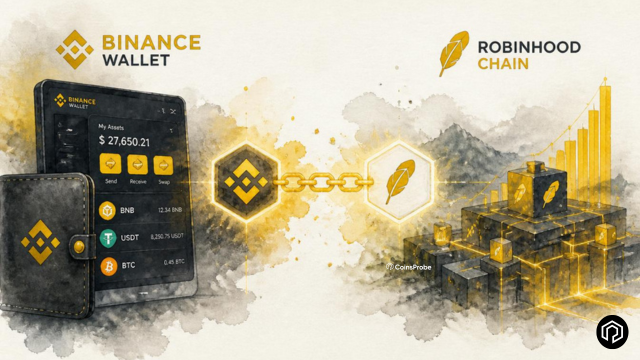
Key Highlights Binance Wallet has integrated Robinhood Chain, enabling users to manage and trade its assets without manual setup. Users need Binance Wallet Extension v1.14.0 or later to acces
Key Highlights
- Binance Wallet has integrated Robinhood Chain, enabling users to manage and trade its assets without manual setup.
- Users need Binance Wallet Extension v1.14.0 or later to access the new functionality.
- The integration exposes Robinhood Chain to millions of Binance Wallet users, significantly lowering adoption friction.
- The move comes just 11 days after Robinhood Chain's launch, during which it surpassed BNB Chain in DEX volume and generated $1B+ in cumulative DEX volume.
Robinhood Chain just got significantly more accessible. Eleven days after launch — and with its early momentum already outpacing established chains by multiple metrics — Binance Wallet has added native Robinhood Chain support, removing one of the last meaningful friction points for the broader crypto trading community to engage with the chain.
What Changed — What Users Can Now Do
Before this integration, Binance Wallet users who wanted to interact with Robinhood Chain needed to manually configure the network — adding RPC endpoints, chain IDs, and other technical parameters that represent a meaningful barrier for less technical users.
That barrier is now gone.
With the integration live, Binance Wallet users can:
Access and manage their Robinhood Chain assets directly within the Binance Wallet interface — the same way they manage assets on Ethereum, BSC, Base, or any other natively supported chain.
Trade tokens on Robinhood Chain with the full multi-chain functionality Binance Wallet provides — including seamless switching between chains without leaving the wallet environment.
Explore trending tokens and markets on Robinhood Chain through Binance’s Web3 market interface at web3.binance.com/en/markets/trending — providing direct visibility into the chain’s most active tokens.
Requirement for extension users: Binance Wallet browser extension users need to update to version 1.14.0 or later to access Robinhood Chain functionality — a straightforward update for existing users.
 Binance Wallet Integrated Robinhood Chain/Source: @BinanceWallet (X)
Why This Integration Matters — Three Dimensions
Accessibility at scale
Binance Wallet serves millions of users globally — many of whom use it as their primary or sole Web3 wallet. For this cohort, native Robinhood Chain support means the barrier to engaging with the chain’s tokens, DeFi applications, and tokenized RWA offerings drops to essentially zero. No manual setup, no technical configuration — just a wallet update and direct access.
In the current memecoin and DeFi trading environment — where speed of access often determines who benefits from early opportunities — reducing this friction to near-zero is a meaningful structural change in who can easily participate in Robinhood Chain activity.
Validation of the chain’s relevance
Major wallet providers do not rush to integrate every new chain that launches. Integration decisions reflect an assessment that the chain has sufficient user demand and long-term viability to justify the development resources required. Binance Wallet’s decision to integrate Robinhood Chain just 11 days after launch — while the chain is still in its earliest stages — signals that Binance’s Web3 team views Robinhood Chain as a chain worth prioritising rather than a speculative project to monitor from a distance.As we documented in our Robinhood Chain beats BSC in daily DEX volume article — the chain overtook Binance Smart Chain in 24-hour rankings within its first week, producing the kind of verifiable, data-backed traction that makes wallet integration decisions straightforward rather than speculative.
Accelerating the chain’s growth trajectory
Robinhood Chain has already produced extraordinary first-week metrics — but its user base has largely come from crypto-native traders who are comfortable manually configuring networks. The Binance Wallet integration opens the chain to a broader segment: the millions of users who rely on wallet providers to abstract away network configuration complexity.
This is the same dynamic that drove significant growth for Base, Arbitrum, and other L2s when major wallets added native support — the transition from “chain for technical users” to “chain for everyone” typically happens at this exact inflection point.
Quick Background — Robinhood Chain in Context
For readers coming to this story without the prior context — here is where Robinhood Chain stands as of today:
MetricDataLaunch dateJuly 1, 2026Chain typePermissionless Arbitrum Layer-2Gas tokenETHBlock time100 millisecondsFirst-week DEX volume$1 billion+Current global DEX volume rank#4 (above BSC)TVL~$250 millionActive addresses (first week)~350,000
The chain launched with a stated focus on tokenized real-world assets — including tokenized NVIDIA and Google shares available to non-US users — and institutional onchain finance. What actually drove its first-week metrics was a meme coin explosion led by $CASHCAT — which reached a $200M market cap on the back of a +3,759% weekly run and Robinhood CEO Vlad Tenev’s endorsement that the chain “works great for memes too.”
The Binance Wallet integration arrives as the chain transitions from its initial meme coin surge phase into what its builders hope will be a broader, more sustained growth period.
The Web3 Interoperability Trend — What This Reflects
Binance Wallet’s Robinhood Chain integration is also a data point in a broader trend worth noting: major wallet providers are increasingly moving quickly to support high-performance new chains rather than waiting for chains to prove themselves over months or years.
This shift reflects the competitive dynamics of the wallet market — where being the first wallet to natively support a high-growth new chain can meaningfully increase user engagement and transaction volume. For chains, it creates a positive feedback loop: strong early metrics attract wallet integrations, which attract more users, which produce stronger metrics.
Robinhood Chain’s combination of institutional brand recognition, genuine technical performance (100ms block times), and explosive early retail adoption made it a relatively straightforward integration decision for Binance Wallet — and the speed of that decision, 11 days post-launch, reflects how clearly the chain’s early traction registered.
Bottom Line
Binance Wallet’s integration of Robinhood Chain removes the last significant access barrier for millions of existing Binance Wallet users — bringing a chain that has already produced $1 billion in first-week DEX volume and surpassed BSC in 24-hour rankings within direct reach of one of the largest wallet user bases in Web3.
For Robinhood Chain, this is the kind of infrastructure validation that marks the transition from early adopter phase to mainstream accessibility. For Binance Wallet users — update to version 1.14.0 and the chain is now a single tap away.
Disclaimer: The views and analysis presented in this article are for informational purposes only and reflect the author’s perspective, not financial advice. Technical patterns and indicators discussed are subject to market volatility and may or may not yield anticipated results. Investors are advised to exercise caution, conduct independent research, and make decisions aligned with their individual risk tolerance.
Read Also: Robinhood Chain Beats BSC in Daily DEX Volume as Meme Coins Drive Early Growth