The cryptocurrency market could see a new turning point if major institutions strengthen their confidence in digital assets. Kevin O’Leary therefore believes that bitcoin could one day reach
The cryptocurrency market could see a new turning point if major institutions strengthen their confidence in digital assets. Kevin O’Leary therefore believes that bitcoin could one day reach 1 million dollars, but he associates this trajectory with a specific condition: lifting doubts around quantum computing. During an interview on The Rollup podcast, the investor also detailed his vision of tokenization, blockchains, and infrastructures necessary for the digital economy.
In brief
- Kevin O’Leary believes that bitcoin could reach 1 million dollars under certain conditions.
- According to him, quantum computing represents one of the main risks to network security.
- The tokenization of assets could accelerate the use of blockchains in traditional finance.
- O’Leary revises his strategy by prioritizing infrastructures rather than a single blockchain or model.
- Energy, uranium, and small modular reactors occupy an increasing place in his vision of the digital economy.
A 1 million dollar target conditional for Bitcoin
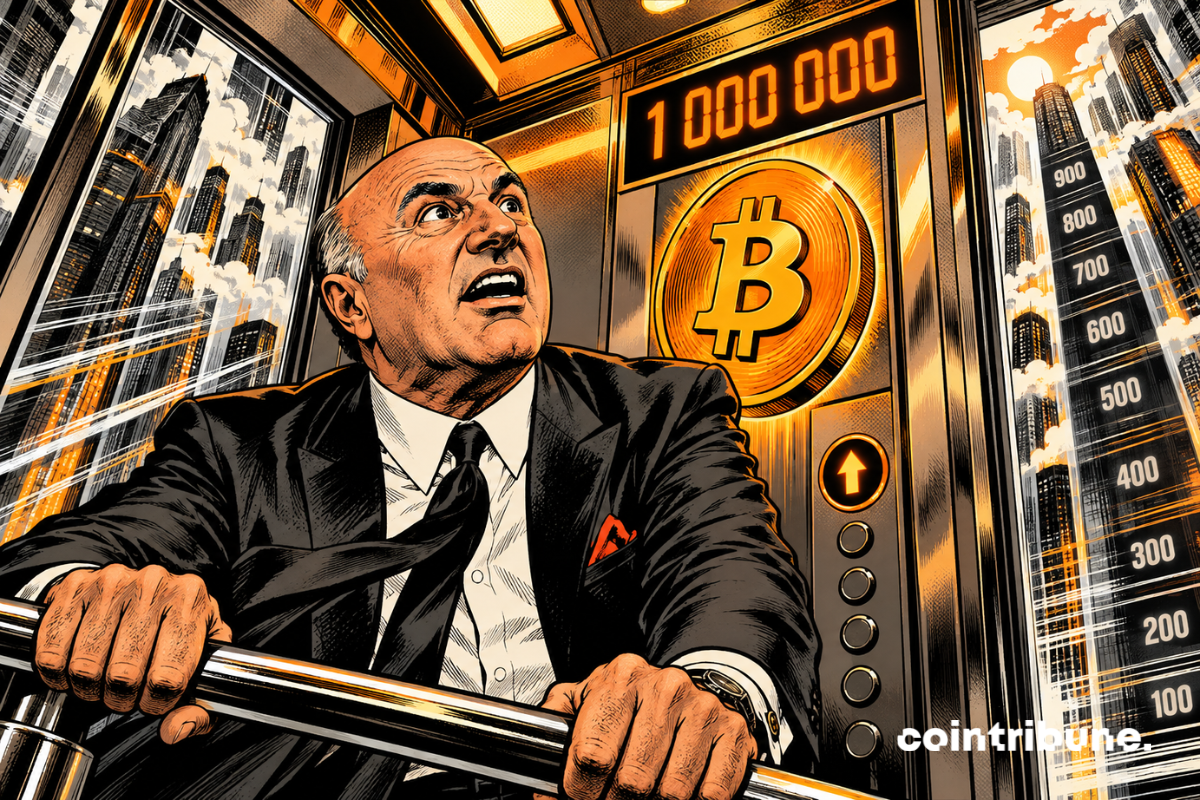
Kevin O’Leary therefore does not dismiss the hypothesis of a bitcoin at 1 million dollars. However, he does not present this level as a mere consequence of increased demand. According to him, institutions must first be able to exclude a threat linked to advances in quantum computing.
This issue directly concerns the security of digital networks. A sufficiently powerful quantum computer could, in theory, attack cryptographic mechanisms used to protect wallets. For O’Leary, this uncertainty still prevents some institutional players from considering the asset as a central component of their portfolios. This caution explains why price remains secondary in his analysis. For him, bitcoin must first clear the security debate before joining institutional allocations.
The investor thus believes that solving this problem could change market perception. As long as the risk remains difficult to measure, large funds can limit their exposure and maintain a cautious approach. He therefore links the prospect of a high valuation to a technological evolution far beyond the cryptocurrency market alone.
Start your crypto adventure safely with MEXCThis link uses an affiliate program.
Quantum computing at the heart of concerns about Bitcoin
The quantum risk mentioned by O’Leary is based on a theoretical possibility. A powerful enough computer could one day decipher certain cryptographic mechanisms and forge digital signatures that secure wallets. The industry uses the term “Q-Day” to designate this potential moment, even though no current device allows such an attack.
Estimates remain very different regarding the arrival of a machine capable of performing an operation of this magnitude. Some projections mention the early 2030s, while others do not give any precise deadline. However, this uncertainty is enough to fuel the debate about the long-term security of digital infrastructures. So the subject does not only concern bitcoin’s value. It also affects trust in signatures, wallets, and infrastructures that ensure transactions.
O’Leary also observes the emergence of a market around this issue. Some investors fund companies developing software related to quantum computing. This approach means betting on solutions capable of enhancing security while benefiting from a technological evolution that could become an important part of the digital value chain.
Tokenization changes his reading of the market
During the Avalanche summit in New York, O’Leary also came to defend a broader vision of blockchain. He held a unique card of Shohei Ohtani, acquired by his group of collectors for 11 million dollars. For him, this object illustrates a possible evolution: collectible assets could also join digital registers.
This reflection accompanies the American regulatory evolution mentioned during the interview. The SEC published its ” Innovation Exemption “, which allows authorized platforms to trade tokenized stocks. These tokens represent listed securities and circulate on a blockchain, rather than only going through traditional markets.
O’Leary then considers cryptocurrencies and digitization as a transversal sector. According to his presentation, this industry could serve other market sectors rather than operate in isolation. His allocation illustrates this caution: he normally limits a single stock to 5% and a sector to 20%, while cryptocurrencies have reached up to 23% of his portfolio over the past seven years. In this scenario, bitcoin would no longer be analyzed alone but as a component of a digital system. Its place would depend on network security and its adoption.
From Ethereum to blockchains chosen by sector
Eighteen months ago, O’Leary defended a different approach. He believed that buying bitcoin and Ethereum allowed capturing a large part of market volatility, with the idea that Ethereum adoption would eventually prevail. This hypothesis ultimately did not materialize as expected, which led him to revise his reasoning.
Now, he envisions an organization where each sector would choose the blockchain corresponding to its needs. Sports collectibles could thus use Avalanche, while exchange platforms could opt for another infrastructure. In this reading, competition no longer plays only between digital assets, but between networks capable of supporting different uses.
O’Leary, moreover, does not think Ethereum will necessarily keep this place. He especially considers that its speed and security do not, according to him, meet all future requirements. This evolution could also change the way investors evaluate bitcoin. They should follow cryptography advances and protection solutions. His scenario relies more on the adoption of infrastructure by a large tokenization platform, which could potentially increase the value of the token associated with the chosen network.
AI, energy and infrastructures at the center
O’Leary also applies this infrastructure logic to his approach to artificial intelligence. Rather than choose a specific model, he prefers to invest in the resources necessary for their operation. According to him, AI depends directly on energy, which places land, networks, and electrical capacities at the center of his strategy.
His portfolio includes BitZero, a former bitcoin mining company turned energy company listed on Nasdaq. It notably owns land, fiber optic infrastructure, and permits in Norway and Finland. O’Leary also holds private power plant projects in Alberta and Utah, as well as exposure to uranium.
He is finally interested in small modular reactors, designed as more compact nuclear units. He believes these facilities could meet the needs of American data centers. In his reasoning, uranium thus becomes a strategic resource, on par with infrastructures necessary for the development of artificial intelligence.
This approach reflects a will to bet on the tools rather than on a single winner. It joins his idea that infrastructures could capture a significant share of the value created by digital transformation. Within this framework, bitcoin remains linked to a broader issue: that of the security and utility of the networks that support this new economy.
The trajectory towards 1 million dollars therefore depends, in the vision presented by Kevin O’Leary, on several technological and institutional conditions. The quantum question occupies a central place, while tokenization, energy infrastructures, and blockchain evolution complete his analysis. He also believes that American regulation will play a role in this evolution, especially around the Clarity Act, which he does not expect to be adopted before the midterm elections. The debate thus remains open between growth potential and security constraints.