The cryptocurrency market is going through a different phase than previous cycles. While Bitcoin strengthens its dominant position, altcoins struggle to regain the momentum observed during pa
The cryptocurrency market is going through a different phase than previous cycles. While Bitcoin strengthens its dominant position, altcoins struggle to regain the momentum observed during past upswings. This development shows a shift in capital allocation, with investors more focused on major assets and projects capable of demonstrating real utility.
In brief
- Bitcoin is strengthening its dominance as capital becomes increasingly concentrated in the leading crypto market assets.
- The traditional rotation toward Altcoins is slowing sharply, ending the usual pattern of previous “altcoin seasons.”
- Altcoin sell-offs are reaching high levels, with persistent selling pressure observed across exchanges.
- Investors are now favoring projects with real utility, especially those linked to DeFi, tokenized assets, and real-world assets.
- The crypto market is entering a more selective phase, where project growth increasingly depends on adoption and strong fundamentals.
Your 1st cryptos with KuCoinThis link uses an affiliate program.Bitcoin Confirms Its Dominance Against a More Selective Market
For several years, the market followed an almost automatic scenario. Bitcoin rose first, then gains moved to ether before reaching smaller projects. This dynamic now contrasts with the concentration of capital on Bitcoin, which gradually changes the crypto market’s functioning. The rotation that previously favored widespread growth of digital assets now seems much more limited, as investors favor the main cryptocurrencies more.
Ki Young Ju, founder of Cryptoquant, estimates that this rotation mechanism between different digital assets has slowed down significantly. The movement of capital from Bitcoin to other tokens, which previously fueled altcoin seasons, no longer produces the same effects. He writes in a post on X :
Bitcoin-to-altcoin asset rotation that once fueled alt seasons has basically disappeared. BTC-pair altcoin volume has collapsed since 2021. The era of “alts pumping just because BTC pumps” may be over.
Ki Young Ju, founder of Cryptoquant. Source: X/@ki_young_ju.
According to the on-chain data he published, this evolution appears in trade volumes. Transactions between BTC pairs and other assets have dropped significantly since 2021, reducing Bitcoin’s movement impact on the entire market.
Moreover, the same data also shows significant selling pressure on secondary assets. Altcoin sales on exchange platforms have reportedly reached their highest level in several years, with a prolonged period of net outflows.
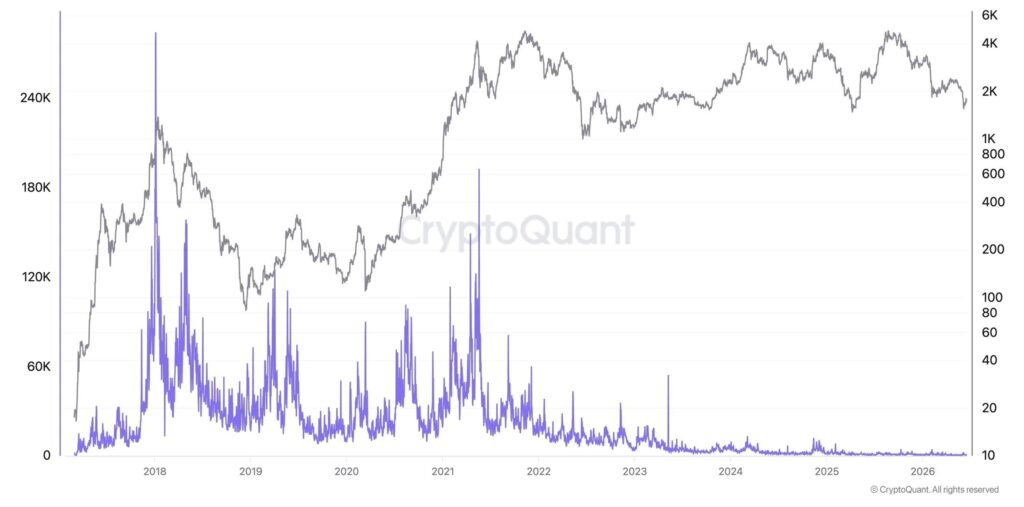 Total altcoin trading volume for pairs quoted in BTC, Source: X/@ki_young_ju.
In this context, Bitcoin absorbs a large portion of new capital coming from traditional finance. ETFs and certain corporate treasury strategies increasingly direct flows towards this asset, reinforcing its weight in the crypto ecosystem.
Altcoins Under Pressure After the End of Traditional Rotation
Altcoins are going through a more complex period as the dynamic supporting their collective rise seems to have changed. In previous cycles, a strong market rise often led to broad token growth. Today, this trend is much less present.
The “Altcoin Season” index illustrates this situation. With a recently set level of 49 on BlockchainCenter at the time of writing, it stands at 47. Thus, it remains below the 75% threshold generally needed to confirm a true altcoin season. Meanwhile, Bitcoin’s market share remains high.
Ki Young Ju estimates that “the number of projects capable of resisting this new phase should be greatly reduced and that 99.9% of altcoins should be eliminated.” Assets linked to companies developing tokenized markets, decentralized finance protocols generating real revenues, and projects associated with stablecoins or real-world assets are among the strongest categories.
This selection marks a break with past periods where many tokens could see strong gains without concrete adoption. Now, investors place more importance on revenues, real use, and development of a functional product.
Thus, altcoin performance becomes more dependent on each project’s fundamentals. Their evolution no longer automatically follows BTC, which reduces collective movements seen in previous cycles.
A Structural Change in Crypto Market Functioning
Several factors explain this new market organization. First, institutional capital entering the ecosystem via Bitcoin ETFs mainly targets major assets. Investors seek fewer speculative opportunities that dominated some previous phases.
Next, the multiplication of available tokens increases competition. With a growing number of projects, capital is divided more difficultly among market players.
This situation strengthens selection around projects with measurable activity. Bitcoin thus retains a central place, while other assets must demonstrate their ability to meet specific needs.
The crypto market appears to be entering a phase where growth depends more on fundamental criteria. Adoption, generated revenues, and concrete uses become important factors to differentiate projects.
This transformation could permanently alter upcoming cycles. If flows remain concentrated on main assets, Bitcoin could continue to maintain strong dominance. Meanwhile, altcoins will likely have to rely on solid use cases to regain a significant place in the market.