Key Highlights Bitcoin ETFs logged +1,359 BTC ($108.91M) on Oct. 27 — reversing 56.6% of the prior seven-day $192.3M outflow in a single session BlackRock's IBIT added 1,381 BTC on the day —
Key Highlights
Bitcoin ETFs logged +1,359 BTC ($108.91M) on Oct. 27 — reversing 56.6% of the prior seven-day $192.3M outflow in a single session
BlackRock's IBIT added 1,381 BTC on the day — accounting for 101.6% of total Bitcoin ETF net inflow; all other products were flat or negative
Ethereum ETFs shed 38,303 ETH ($89.07M) on Oct. 27, representing 46.8% of the full seven-day $190.12M outflow in one session
Combined seven-day net outflows across Bitcoin and Ethereum ETFs totaled $382.42M as of Oct. 27
BREAKING
Bitcoin spot ETFs recorded a net inflow of 1,359 BTC — worth $108.91 million — on October 27, according to data published by Lookonchain. At the same moment, Ethereum spot ETFs registered the opposite: a single-day net outflow of 38,303 ETH, equivalent to $89.07 million leaving the product category.
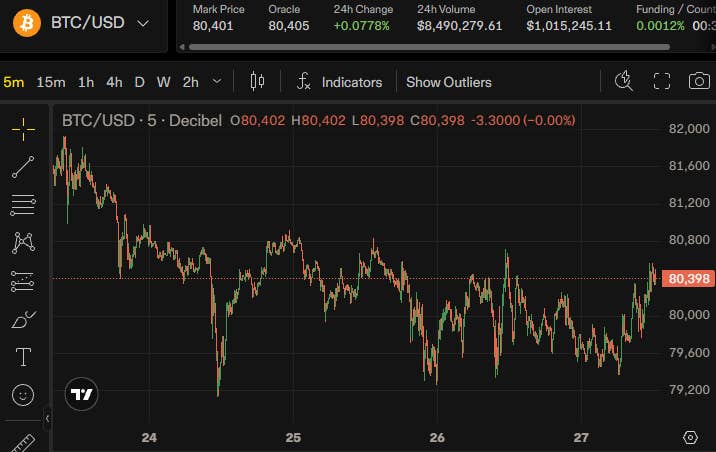
At the time of writing, Bitcoin is trading at approximately $79,971, up 0.10% over the past 24 hours.
The October 27 inflow of $108.91M is a reversal in isolation — but the seven-day picture tells a different story. Over the prior week, Bitcoin ETFs collectively shed 2,399 BTC ($192.3 million), per Lookonchain. That means the single day’s inflow recovered roughly 56.6% of the seven-day outflow in BTC terms ($108.91M ÷ $192.3M), not a full reset.

Bitcoin ETFs Pull $108.91M in a Day While Ethereum Bleeds $8 | Source: @lookonchain (Telegram)
On the fund-level breakdown from the chart data, BlackRock’s IBIT drove the day’s positive print, adding 1,381 BTC on October 27 — accounting for 101.6% of the total daily net inflow of 1,359 BTC. Every other major product was flat or negative: Grayscale (GBTC + BTC) shed 16 BTC, while Fidelity’s FBTC, Bitwise’s BITB, and ARK 21Shares’ ARKB each posted zero flows on the day. The remaining funds collectively lost 6 BTC.
The concentration is stark: IBIT alone carried the entire Bitcoin ETF category on October 27. Without BlackRock’s 1,381 BTC purchase, the day would have printed a net outflow of approximately 22 BTC across all other products.
Over seven days, the divergence between IBIT and the rest widens further. IBIT added only 45 BTC on a net seven-day basis, while ARK 21Shares’ ARKB lost 1,229 BTC — the steepest seven-day outflow among named funds. Fidelity’s FBTC shed 500 BTC and Bitwise’s BITB lost 233 BTC over the same window. Total Bitcoin ETF holdings across all products stood at 1,276,550 BTC ($102.31 billion) as of October 27.
Ethereum ETFs offered no comparable bright spot. The 38,303 ETH daily outflow ($89.07M) sits inside a seven-day outflow of 81,754 ETH ($190.12 million) — meaning October 27 alone accounted for 46.8% of the entire week’s Ethereum ETF redemptions in ETH terms.
At the fund level, BlackRock’s ETHA was the dominant source of selling pressure, losing 45,243 ETH on October 27. That figure alone exceeds the total net Ethereum ETF outflow for the day (38,303 ETH), which means other funds provided partial offsets: Fidelity’s FETH added 7,020 ETH on the day, and Grayscale’s combined products (ETHE + ETH) shed only 79 ETH. Total Ethereum ETF holdings across all products stood at approximately 5,537,104 ETH based on the chart-reported fund-level data.
The seven-day Ethereum picture shows ETHA alone responsible for 102,251 ETH of outflows — more than the total category’s seven-day loss of 81,754 ETH — again offset partially by Fidelity’s FETH gaining 16,283 ETH and Grayscale’s combined products gaining 3,481 ETH over the week.
Combining both asset classes, spot ETF products across Bitcoin and Ethereum generated a combined single-day net flow of approximately +$19.84 million ($108.91M Bitcoin inflow minus $89.07M Ethereum outflow). Over seven days, combined net flows were deeply negative: Bitcoin’s $192.3M outflow plus Ethereum’s $190.12M outflow totals $382.42 million in net seven-day redemptions across both categories.
The October 27 data reflects a single session where institutional demand was concentrated in one fund (IBIT) and one asset (Bitcoin), while Ethereum ETF products continued a week-long redemption trend with no fund reversing it on a meaningful scale. Whether IBIT’s daily inflow represents the start of a sustained Bitcoin ETF re-accumulation phase — or a one-day reversion within a broader outflow trend — will be answered by the flow data in sessions ahead. Watch FBTC and ARKB seven-day flow direction as the secondary confirmation: both remained net negative over the week ending October 27.
Disclaimer: The views and analysis presented in this article are for informational purposes only and reflect the author’s perspective, not financial advice. Technical patterns and indicators discussed are subject to market volatility and may or may not yield the anticipated results. Investors are advised to exercise caution, conduct independent research, and make decisions aligned with their individual risk tolerance.
Also Read: Bitcoin UTXO Age Bands Signal Incoming Rally — Here’s the On-Chain Proof