Nvidia CEO Jensen Huang’s departure adds uncertainty to technology stocks already facing valuation and geopolitical concerns. Bitcoin has lost all three major daily moving averages, leaving t
- Nvidia CEO Jensen Huang’s departure adds uncertainty to technology stocks already facing valuation and geopolitical concerns.
- Bitcoin has lost all three major daily moving averages, leaving the $71,000–$70,000 support area under scrutiny.
- Forced liquidations accelerated sharply, with bullish positions accounting for most of the losses.
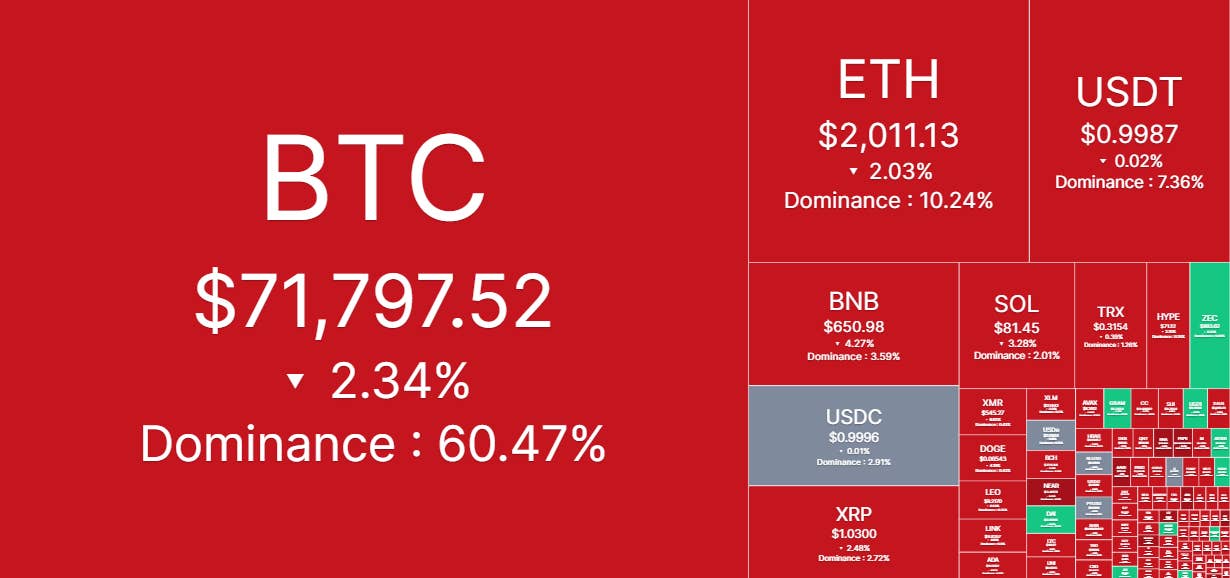
Bitcoin fell below $72,000 on November 12 as Nvidia’s sudden leadership shake-up intensified uncertainty across U.S. technology stocks and cryptocurrency markets.
The largest cryptocurrency traded at $71,526.04 on Coinbase, down 3.25% on the daily candle.

Bitcoin approaches oversold territory as selling pressure pushes prices toward key support.
Chart by Alexander Zdravkov, TradingView.
The decline pushed Bitcoin beneath its 200-day moving average, a closely watched long-term trend indicator, while Ethereum slipped below $2,000.
The selloff followed several days of institutional fund withdrawals and heavy derivatives losses. Nvidia’s governance crisis introduced another source of market uncertainty, although the timing alone does not establish that it triggered the cryptocurrency decline.
Nvidia’s Leadership Crisis Deepens the Technology Selloff
Nvidia confirmed that co-founder Jensen Huang had resigned as president, chief executive and board member with immediate effect. The company appointed Chief Financial Officer Colette Kress as interim CEO and Harvey C. Jones as board chairman.
The announcement followed a widening controversy involving Huang’s personal relationships and potential U.S. national-security concerns. According to Reuters, reports concerning Alice Huang, a businesswoman suspected by U.S. authorities of links to Chinese intelligence, and a separate relationship with a senior Nvidia employee preceded his departure.
Nvidia’s board had already opened an independent investigation on November 8 into whether Huang had been targeted by a foreign intelligence operation. At that stage, directors said they had no reason to believe company secrets or national security had been compromised.
The market reaction was substantial. Nvidia shares fell more than 12% during Thursday’s trading, threatening to erase approximately $500 billion in market capitalization, according to Reuters.
The implications extend beyond the loss of a chief executive. Huang helped coordinate Nvidia’s relationships with semiconductor suppliers, cloud operators and AI developers, while playing a prominent role in U.S. discussions over advanced-chip exports to China. His departure introduces execution and policy uncertainty at a company central to the artificial intelligence investment cycle.
Bitcoin Breaks Three Major Moving Averages
Bitcoin’s daily chart shows a deterioration that began well before the latest Nvidia announcement. After approaching $87,000 in late September and early October, the cryptocurrency established a sequence of lower highs and repeatedly failed to sustain recoveries.
The latest decline has carried prices beneath the 50-day simple moving average at $80,863.38 and the 100-day average at $77,696.37. Bitcoin has now also lost the 200-day average at $73,080.63.
At the chart’s reference price, BTC stood approximately 2.1% below its 200-day average and 11.5% beneath its 50-day average. The widening gap reflects the severity of the recent decline rather than a single isolated trading session.
The daily candle reached $71,199 before recovering slightly. That places the immediate test near $71,000, followed by the psychological $70,000 level. A sustained breakdown through that area would expose the next marked support region around $66,600–$67,000, with a lower historical zone near $64,000.
The 14-day relative strength index fell to 30.06, compared with its moving average of 37.26. Momentum is approaching conventional oversold territory, but the indicator has not yet established a bullish reversal.
A recovery above the 200-day moving average would be an initial improvement. The higher moving averages remain more distant obstacles to rebuilding the previous trend.
Crypto Liquidations Reach $707 Million
The derivatives market registered an unusually concentrated wave of forced selling as prices declined.
CoinGlass reported $707.25 million in liquidations over 24 hours, affecting 125,798 traders. Long positions accounted for $593.26 million, compared with $113.99 million in shorts, producing a long-to-short liquidation ratio of approximately 5.2 to one.
Bitcoin contributed $276.59 million and Ethereum another $125.70 million, together representing 56.9% of the reported total. The largest individual liquidation was a $31.09 million BTC-USD position on Hyperliquid.
The pace of the selloff is particularly revealing. Approximately $466.92 million in liquidations occurred within four hours, equivalent to 66% of the daily total. Of that shorter-window figure, 93.6% involved long positions, showing that the most recent phase was even more heavily concentrated against bullish traders.
The latest one-hour window accounted for another $182.70 million in liquidations. That figure forms part of the overlapping four-hour and 24-hour totals and should not be added to them.
Outstanding derivatives open interest declined just 1.03% to $342.59 billion, while reported 24-hour trading volume reached $820.72 billion. The relatively small change in aggregate open interest, compared with the scale of liquidations, indicates that substantial leveraged exposure remained in the market despite the forced closures.
Institutional Withdrawals Preceded the Nvidia Shock
Bitcoin’s weakness was already visible in exchange-traded fund flows. U.S. spot Bitcoin ETFs recorded approximately $299.9 million in net withdrawals on November 11, extending a five-session outflow streak to roughly $1.44 billion.
The preceding week also saw Bitcoin lose its 50-week moving average, according to The Block, accompanied by more than $1 billion in cryptocurrency liquidations on November 9.
These earlier developments complicate the interpretation of Thursday’s decline. Nvidia’s leadership crisis coincided with a market already facing reduced institutional demand, weak momentum and repeated leveraged-position closures.
CoinMarketCap’s Fear and Greed Index stood at 23, while the Altcoin Season Index registered 39. The broader market’s decline extended across large-cap cryptocurrencies rather than remaining concentrated in AI-related assets.
Crypto Market Performance
Selected assets | November 12, 2026
Asset
Price
24h
7d
BNB
$651.88
-4.23%
-7.36%
XRP
$1.02
-2.94%
-20.12%
Solana
$81.01
-3.67%
-13.32%
TRON
$0.3152
-0.41%
-0.77%
HYPE
$70.67
-2.87%
-12.37%
Zcash
$972.37
-0.61%
-23.79%
Monero
$546.44
-6.58%
-13.28%
Dogecoin
$0.06506
-4.60%
-12.79%
Source: CoinMarketCap.Prices and percentage changes reflect the captured market snapshot and may differ from subsequent trading.
What Traders Are Watching Next
- Bitcoin’s support structure: Whether buyers defend the current daily low and prevent a deeper move through the $70,000 area.
- ETF flows: Whether U.S. spot funds record another net withdrawal after the recent selling streak.
- Nvidia’s market reaction: Whether the leadership transition produces sustained pressure on technology equities or stabilizes as investors assess the company’s succession plans.
Bitcoin’s technical breakdown and derivatives positioning now provide more immediate evidence of market stress than any single corporate headline. A sustained recovery would require improvement in spot demand alongside a reduction in forced selling.
The post Bitcoin Falls Below $72,000 as Nvidia Crisis Hits Crypto appeared first on ETHNews.