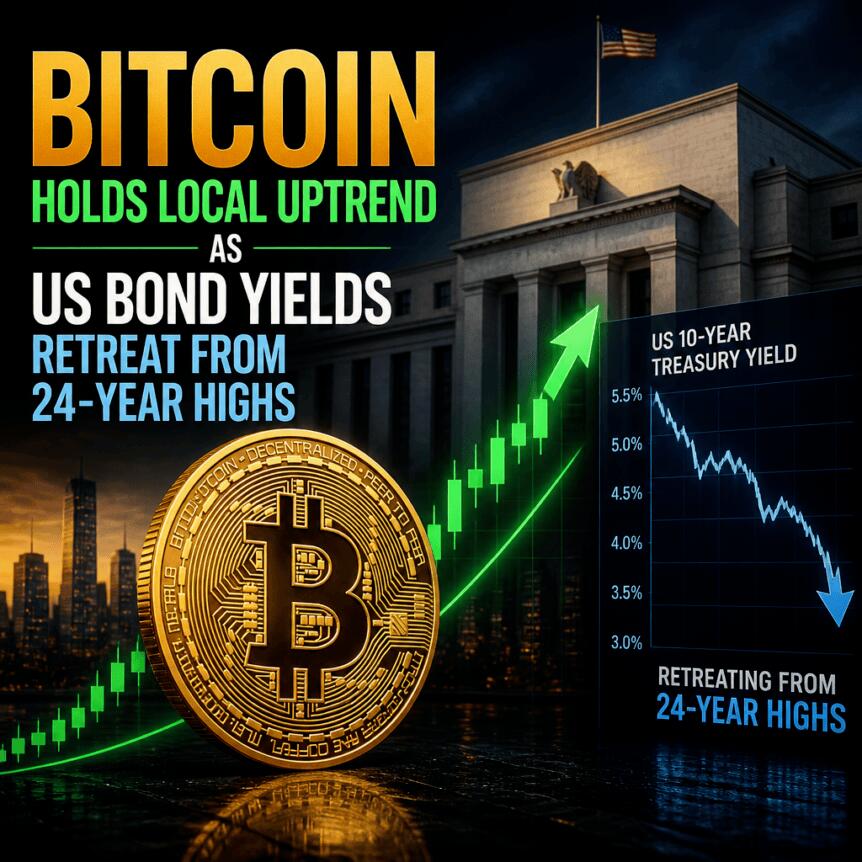
Bitcoin pushed above $84,000 during the early hours of the latest Wall Street session, riding a brief easing in U.S. bond yields after they printed fresh multi-decade highs. The move keeps th
Bitcoin pushed above $84,000 during the early hours of the latest Wall Street session, riding a brief easing in U.S. bond yields after they printed fresh multi-decade highs. The move keeps the market focused on whether BTC can establish reliable support before a likely deeper pullback tests prior demand zones.
At the same time, macro forces remain the dominant driver: the 10-year Treasury yield reached 5.342%—its highest level since April 2002—before slipping to around 5.251% as trading began. Analysts point to investor concern over public debt costs and inflation credibility, with rate expectations still sensitive to bond-market signals.
Key takeaways
- BTC traded above $84,000 near the start of the U.S. session, while traders watch for follow-through and “higher low” structure on intraday charts.
- U.S. yields fell from fresh highs after the 10-year Treasury briefly hit 5.342%, last seen in April 2002.
- CoinGlass data highlights nearby liquidity targets around $84,500 and $82,900 that may influence short-term price behavior.
- Rekt Capital expects a support retest near $82,500, noting it “could get messy” before any next directional move.
- Even with the softer inflation print referenced by Cointelegraph’s prior coverage, analysts say the broader bond-market sell-off is not resolved.
Bitcoin steadies above $84,000 as bond pressure eases
TradingView data cited in the report showed BTC/USD holding a pattern of higher lows on hourly time frames, up about 0.6% on the day at the time of writing. That matters because “higher lows” during a period of macro-driven volatility often signal short-term dip buyers are still defending key levels rather than letting price cascade.
Still, the market’s ability to sustain gains appears tightly linked to the bond complex. Both the 30-year and 10-year yields set new macro highs, with the 10-year reaching 5.342% before dropping to 5.251% in the early Wall Street session. The rapid shift from a fresh peak underscores how quickly risk sentiment can change when rates move.
According to Mahmood Pradhan, a former deputy director of the European department at the International Monetary Fund, markets have been “very nervous” about rising public debt and the associated interest-cost burden. In an interview with The New York Times, he also argued that the Middle East conflict has altered the macro picture, with higher oil prices already appearing in inflation data.
That view aligns with broader trading behavior over recent weeks: when yields rise quickly, it typically tightens financial conditions, which can pressure risk assets including crypto. Even a brief retracement in yields can prompt short-term relief rallies—but it doesn’t necessarily change the underlying narrative.
Inflation data softens, but analysts flag the bond-market “revolt”
The report referenced Cointelegraph coverage that the August U.S. Personal Consumption Expenditures (PCE) inflation reading came in below expectations at 3.4% year on year. While markets reportedly reacted little to the softer number, analysts attributed much of the decline to changes in how PCE is calculated.
Crypto analyst Benjamin Cowen added to that interpretation in a post on X, warning that the bond market’s selling pressure reflects lingering concerns about whether the Federal Reserve is taking inflation seriously enough. Cowen wrote: “Well the bond market has revolted, and until the Fed gets a proper handle on inflation, this will likely continue.”
For traders, this kind of commentary matters because it frames why BTC’s correlation with yields may persist. If investors believe the Fed cannot stabilize inflation expectations, yields can resume pushing higher—forcing crypto back into “rates-driven” volatility rather than allowing a clean technical trend to form.
Where liquidity is likely to concentrate: $84,500 and $82,900
Beyond macro drivers, near-term BTC price action appears shaped by where traders have clustered positions. CoinGlass data cited in the report pointed to $84,500 and $82,900 as key areas of interest at the time of writing, levels that can act like magnets when liquidations and crowded positioning pull price toward them.
The report also noted liquidations totaling $25 million over the past 24 hours, with both long and short positions contributing to a range-bound feel. That combination—clear magnet zones plus balancing liquidations—often leads to “choppy trend” behavior: price may advance, pause, and then retrace toward the next liquidity pocket rather than move in a straight line.
For investors, the practical takeaway is that support and resistance may not behave like fixed textbook levels. Instead, liquidity dynamics can cause abrupt wicks, fast rotations, and brief trend reversals even when the broader structure remains intact.
Rekt Capital points to a likely $82,500 retest
Technically, the report highlights a forecast from Rekt Capital suggesting BTC is due for a dip toward roughly $82,500. In his post on X, he cautioned that a retest “could get messy,” adding that traders should focus on one level at a time rather than projecting too far ahead.
Rekt Capital previously emphasized that bulls’ ability to hold $82,500 as support would be a deciding factor for Bitcoin’s broader rebound. Taken together, the implication is straightforward: even if BTC is able to trade above $84,000 now, the market may still need to validate deeper support before any sustained trend continuation.
That framework also helps explain why the $84,000 breakout may not instantly translate into a sustained rally. When analysts expect a “support retest,” the initial advance can simply be the first leg—followed by a pullback designed (by liquidity positioning) to test whether the market truly flipped that support level from resistance to demand.
Going forward, the key variable to watch is whether BTC can hold its near-term structure while yields stabilize or reverse again. If the bond-market volatility returns, traders may see the anticipated $82,500 test arrive quickly; if yields continue easing, BTC may spend more time consolidating above $84,000 instead of accelerating toward deeper liquidity pockets.
This article was originally published as Bitcoin Holds Local Uptrend as US Bond Yields Retreat From 24-Year Highs on Crypto Breaking News – your trusted source for crypto news, Bitcoin news, and blockchain updates.