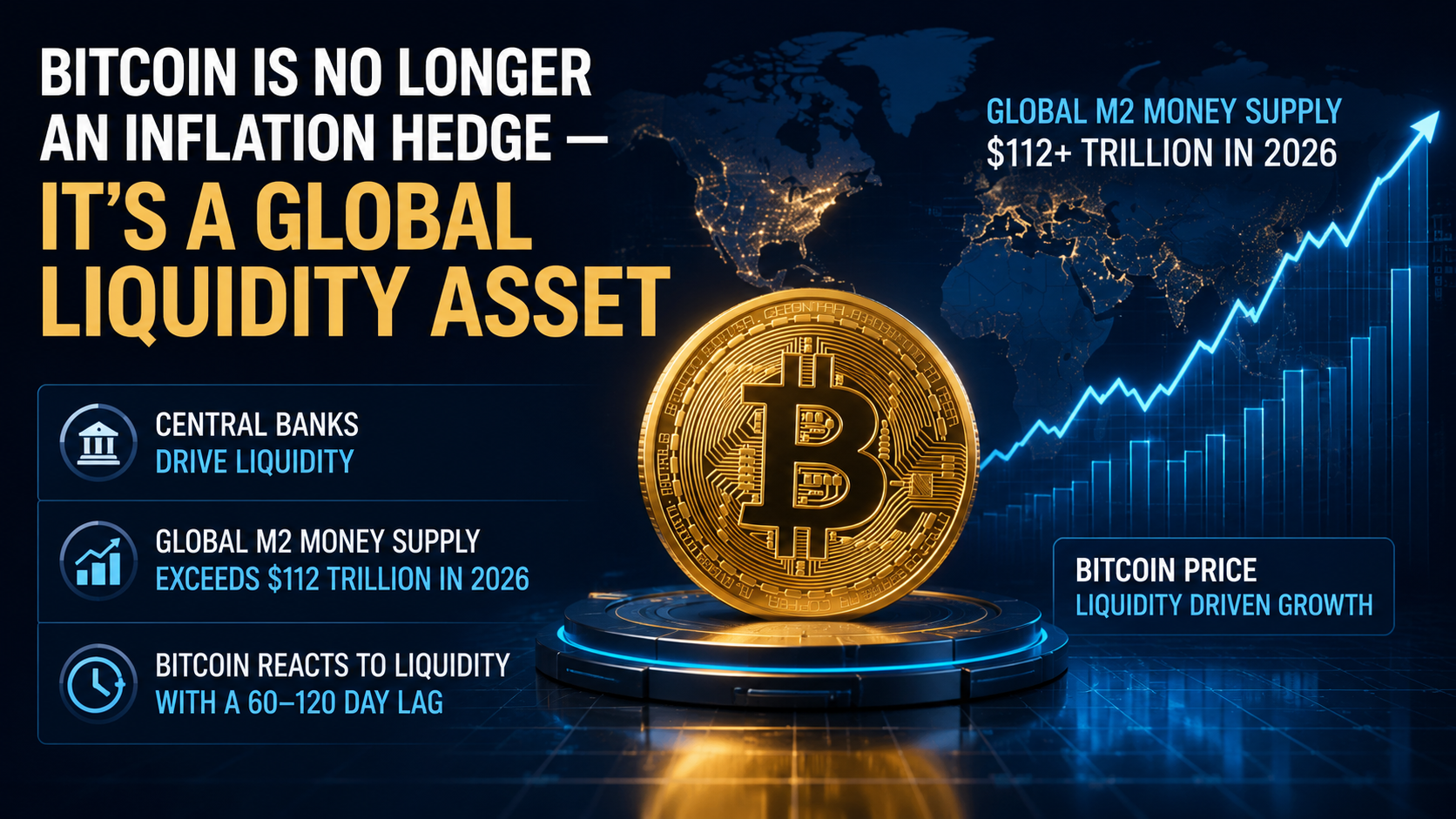
Bitcoin Is No Longer an Inflation Hedge — It’s a Global Liquidity Asset in 2026 For years, Bitcoin was promoted as “digital gold” — a decentralized asset designed to protect investors against
Bitcoin Is No Longer an Inflation Hedge — It’s a Global Liquidity Asset in 2026
For years, Bitcoin was promoted as “digital gold” — a decentralized asset designed to protect investors against inflation, currency debasement, and reckless central bank money printing.
But by 2026, market behavior is telling a completely different story.
Instead of reacting directly to inflation data, Bitcoin is increasingly moving in response to one dominant macroeconomic force:
Global Liquidity.
From Federal Reserve monetary policy to worldwide M2 money supply expansion, Bitcoin now behaves more like a liquidity-sensitive macro asset than a traditional inflation hedge.
And for investors, traders, and institutions, this changes everything about how Bitcoin should be analyzed.
The “Bitcoin as an Inflation Hedge” Narrative Is Fading
The inflation hedge narrative exploded during the COVID-era stimulus cycle.
Between 2020 and 2021:
- The U.S. Federal Reserve injected trillions into financial markets
- Global money supply surged aggressively
- Inflation reached multi-decade highs
- Bitcoin rallied from under $10,000 to nearly $69,000
At first glance, this looked like undeniable proof that Bitcoin was the perfect inflation hedge.
But then came the reality check.
What Happened in 2022–2023?
Despite inflation remaining historically elevated across the United States and Europe:
- Bitcoin collapsed over 70%
- Nasdaq and tech stocks crashed
- Crypto liquidity evaporated
- Risk assets suffered across the board
If Bitcoin truly behaved like gold, it should have strengthened during persistent inflation.
Instead, BTC traded almost exactly like a high-beta risk asset.
This forced institutional investors and macro analysts to rethink the entire Bitcoin thesis.
The Real Driver of Bitcoin in 2026: Global Liquidity
By 2026, a growing number of macro analysts believe Bitcoin’s price is primarily driven by global liquidity conditions — not inflation itself.
The key metric behind this thesis is:
Global M2 Money Supply
Global M2 includes:
- Cash in circulation
- Bank deposits
- Liquid financial assets
- Broad monetary expansion across major economies
According to multiple macroeconomic studies published throughout 2025 and 2026, Bitcoin has maintained an exceptionally high correlation with global liquidity trends over the past decade.
Some institutional models estimate Bitcoin’s correlation with global liquidity at nearly:
0.90–0.95
between 2014 and 2025.
That is an unusually powerful relationship for an asset originally designed to operate outside traditional financial systems.
Bitcoin Reacts to Liquidity With a Time Lag
One of the most important discoveries in modern Bitcoin macro analysis is delayed liquidity reaction.
Research from several market analysts suggests:
- Bitcoin often reacts to liquidity expansion 60–120 days later
- Central bank easing today may impact BTC months afterward
- Liquidity cycles increasingly predict major Bitcoin trends
This delayed response is now heavily monitored by institutional traders, hedge funds, and macro investors.
Instead of watching CPI releases alone, sophisticated market participants now track liquidity flows globally.
Why Central Banks Matter More Than Inflation Reports
Inflation data like CPI is backward-looking.
Central banks control the actual liquidity environment inside financial markets.
When institutions such as:
- The Federal Reserve
- European Central Bank (ECB)
- People’s Bank of China (PBoC)
- Bank of Japan (BoJ)
inject liquidity into the system, several things typically happen:
- Bond yields become less attractive
- Financial conditions loosen
- Risk appetite increases
- Capital rotates into equities and crypto
Bitcoin historically performs extremely well during these environments.
However, when central banks tighten monetary policy through:
- Higher interest rates
- Quantitative tightening (QT)
- Liquidity withdrawal
risk assets usually suffer — including Bitcoin.
This explains why BTC crashed during aggressive Federal Reserve tightening cycles despite elevated inflation.
The market responded to shrinking liquidity, not inflation itself.
Bitcoin Now Trades More Like Nasdaq Than Gold
One of the clearest structural changes in recent years is Bitcoin’s increasing correlation with technology stocks.
During major liquidity expansion cycles, Bitcoin behaves more similarly to:
- Nasdaq
- Growth equities
- AI-related speculative assets
- High-risk macro trades
than traditional safe-haven assets like gold.
In early 2026:
- Bitcoin traded above $120,000
- Markets priced in potential global rate cuts
- Liquidity conditions improved significantly
- Risk appetite returned across financial markets
At the same time:
- Global M2 liquidity continued expanding
- China increased economic stimulus efforts
- Central banks faced slowing global growth
The alignment between liquidity growth and Bitcoin price acceleration became increasingly difficult to ignore.
The 2026 Macro Environment Is Supporting Bitcoin
Several major macroeconomic conditions are currently supporting Bitcoin’s liquidity-driven rally.
Key 2026 Trends Include:
1. Expected Federal Reserve Rate Cuts
Markets increasingly expect central banks to shift toward looser policy as economic growth slows.
2. Rising Global Debt Levels
Governments continue expanding debt burdens, increasing pressure for long-term monetary accommodation.
3. Expanding Global M2 Supply
Global liquidity levels are estimated to have exceeded $112 trillion in 2026.
4. China Liquidity Injection
China continues introducing stimulus measures to stabilize economic growth and financial markets.
5. Slowing Global Growth
Weaker economic conditions are forcing policymakers toward more accommodative financial conditions.
Historically, these environments have strongly benefited Bitcoin and other liquidity-sensitive assets.
Is Bitcoin Still Digital Gold?
The answer is more nuanced in 2026.
Bitcoin still possesses several characteristics supporting the digital gold thesis:
- Fixed supply capped at 21 million coins
- Decentralized monetary structure
- Scarcity-based economics
- Resistance to fiat debasement
- Long-term store-of-value potential
However, short- and medium-term price behavior increasingly suggests Bitcoin currently behaves more like:
A Global Liquidity Asset
than a pure inflation hedge.
In simple terms:
Bitcoin reacts faster to central bank balance sheets than consumer inflation data.
This does not weaken Bitcoin’s long-term value proposition.
Instead, it changes how investors should interpret macro cycles, monetary policy, and crypto market timing.
What Smart Bitcoin Investors Monitor in 2026
Modern Bitcoin analysis is no longer focused only on inflation headlines.
Professional investors increasingly monitor:
- Federal Reserve balance sheet expansion
- Global M2 money supply growth
- Quantitative easing (QE)
- Treasury market stress
- Bond market liquidity
- Central bank liquidity injections
- Interest rate expectations
- Dollar liquidity conditions
Liquidity data is becoming one of the strongest leading indicators for Bitcoin price cycles.
Why This Shift Matters for Crypto Investors
Understanding Bitcoin as a liquidity-driven asset changes investment strategy completely.
Instead of asking:
“Will inflation rise?”
macro investors now ask:
“Will global liquidity expand?”
That distinction is critical.
Because liquidity expansion often drives:
- Risk-on behavior
- Institutional capital flows
- ETF inflows
- Crypto market rallies
- Speculative growth cycles
Bitcoin is increasingly positioned at the center of this global liquidity system.
Final Thoughts
Bitcoin’s role in the financial system is evolving rapidly.
The old narrative:
“Bitcoin rises because inflation rises”
no longer fully explains market behavior.
Instead, evidence across 2025 and 2026 increasingly shows that Bitcoin is deeply connected to global liquidity cycles driven by central banks and monetary expansion.
Inflation still matters because it influences policy decisions.
But financial markets care far more about how central banks respond than inflation itself.
In 2026, Bitcoin is increasingly behaving like a macro liquidity instrument — one that reflects the expansion and contraction of global monetary conditions.
And this may be the single most important evolution in Bitcoin’s modern market structure.