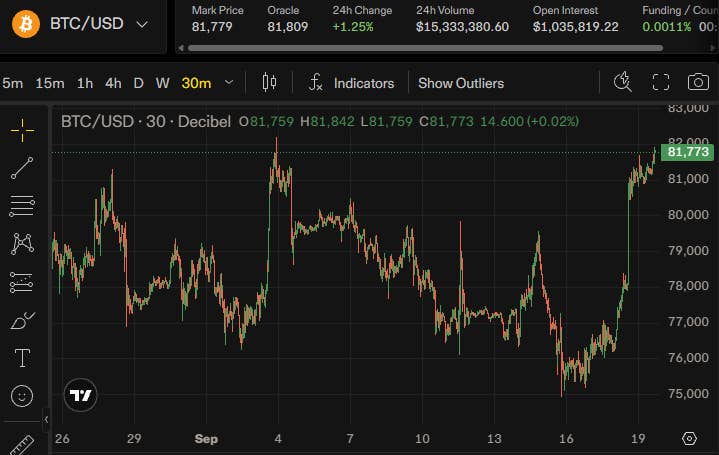
Bitcoin returned around 80,000 dollars on Friday, but Jason Calacanis does not see it as a comeback. The American investor believes that the asset has lost a good part of its appeal with the
Bitcoin returned around 80,000 dollars on Friday, but Jason Calacanis does not see it as a comeback. The American investor believes that the asset has lost a good part of its appeal with the general public after 17 years of existence. Michael Saylor replied with a figure: 1,600 billion dollars of capitalization. For the executive chairman of Strategy, Bitcoin does not need to become the next universal means of payment. Its main use would now be the preservation of wealth over the long term.
In brief
- Jason Calacanis believes that Bitcoin has not found the general public use promised at its beginnings.
- Michael Saylor opposes him with a capitalization of about 1,600 billion dollars.
- Strategy held 845,050 BTC after its last announced purchase at the end of August.
BTC at $80,000, but Calacanis is still not convinced
The rebound of Bitcoin was enough to revive an old debate. On Friday, as the BTC reached 80,000 dollars, Jason Calacanis compared the movement to the rebound of an asset he already considers outdated. However, the investor has followed Bitcoin since its early years. He now believes that the user experience remains complicated, that the network has not become a reference for payments or smart contracts, and that public enthusiasm has faded.
His comparison is deliberately harsh: Bitcoin now reminds him of the CD in the era of Spotify or the DVD compared to Netflix. Calacanis mainly attacks the idea of mass adoption. According to him, if Bitcoin were to find an essential use case for the general public, 17 years should have already been enough.
The market, however, tells a broader story. Bitcoin remains valued around 1,600 billion dollars and continues to be accumulated by listed companies. Strategy is the most visible example. At the end of August, Michael Saylor’s company bought an additional 4,603 BTC for 369.7 million dollars, bringing its reserves to 845,050 BTC.
The Bitcoin defended today by Saylor thus looks quite different from the one sold as a daily means of payment fifteen years ago.
Your 1st cryptos with BinanceThis link uses an affiliate program.
Saylor defends Bitcoin as digital capital
Michael Saylor’s response is summed up in a few lines. He first recalls that Calacanis has been observing Bitcoin since 2011. Since then, the asset has reached about 1,600 billion dollars in capitalization and remains, according to him, the leading digital asset in the world.
Then he shifts the debate completely. For Saylor, Bitcoin’s major application is “digital capital.” He therefore does not seek to respond point by point to criticism about smart contracts or payments. His thesis is different: preserving wealth over several generations would be a sufficiently important use to justify the existence of the network.
And he finishes with a much shorter answer: “The orange tie stays.” The orange tie refers to the image that Calacanis had just mocked: that of a past Bitcoin movement, according to him, from rebellious early users to institutional investors in suits.
Saylor embraces this transformation. He has indeed been defending for several months the idea that Bitcoin no longer obeys as strongly its former four-year cycle. In his view, ETFs, companies and large capital flows take the place that only halvings and miners previously occupied more.
The disagreement with Calacanis ultimately also concerns this: what should be expected from Bitcoin in 2026? A consumer product used every day, or an asset held for years?
Strategy itself has changed its way of managing its bitcoins
Saylor’s speech remains very favorable to Bitcoin. Strategy’s management has become, itself, more flexible. The company has long been associated with a simple policy: raise capital, buy BTC and hold. This mechanism still exists, but it is no longer absolute.
In 2026, Strategy sold part of its bitcoins, strengthened its dollar reserves, then started buying again when its financing conditions improved. At the end of August, it held 845,050 BTC for a cumulative cost of about 63.73 billion dollars. Its average acquisition price was around 75,400 dollars per bitcoin.
Saylor even opened the door to a one-time monetization of Strategy’s Bitcoin reserves to meet certain financial needs. This does not really look like the abandonment described by Calacanis. Bitcoin still worth about 80,000 dollars. Strategy owns hundreds of thousands of them. ETFs and company treasuries have changed the profile of its buyers. Its initial role, however, continues to be debated. Calacanis sees a product that never found its “Spotify” moment. Saylor sees 1,600 billion dollars of digital capital and no reason to take off his orange tie.