Bitcoin miners weighed down the spot market after transferring another 19,560 BTC to Binance. This is the fourth-largest BTC inflow to the exchange since February, showing the current price r
Bitcoin miners weighed down the spot market after transferring another 19,560 BTC to Binance. This is the fourth-largest BTC inflow to the exchange since February, showing the current price range is putting pressure on mining companies.
Bitcoin miners accelerated their exchange deposits in June, with another deposit of 19,560 BTC. The recent wave of deposits follows an inflow of 23,000 BTC earlier this month.
According to Cryptoquant analyst Amr Taha, the recent inflows go beyond routine transfers and are a significant on-chain event. Miners strongly prefer Binance, with minimal inflows to Coinbase, HTX, OKX, Kraken, Bybit, Gemini, or other exchanges.
The inflows happened as BTC hovered just under $60,000. Later, the coin recovered to $60,019.25, with a dominance of 55.8%. According to F2Pool, one of the biggest miners, BTC conditions worsened notably in the past week.
The transfer to exchanges does not mean that the coins are sold. It may mean that miners may take advantage of the spot market if prices are favorable. The two large-scale inflow events in June suggest miners are still actively managing their reserves.
For now, it remains uncertain if the miner inflows will persist, while BTC aims to stabilize and recover to a higher price range. The exchange reserves will also be watched for signs of spot selling. In the past two weeks, spot whale trading accelerated, suggesting some miners may be part of the downward trading pressure.
Which miners are the most active sellers?
The miner inflows in the past month came from specific pools. On June 2, Antpool and several others made significant deposits. Antpool also deposited BTC on June 28 and 29.
The most active depositor was BTC.com, which operates 0.46% of the Bitcoin hashrate. Larger block producers like F2Pool, Binance Pool, Antpool, and others are still holding their coins.
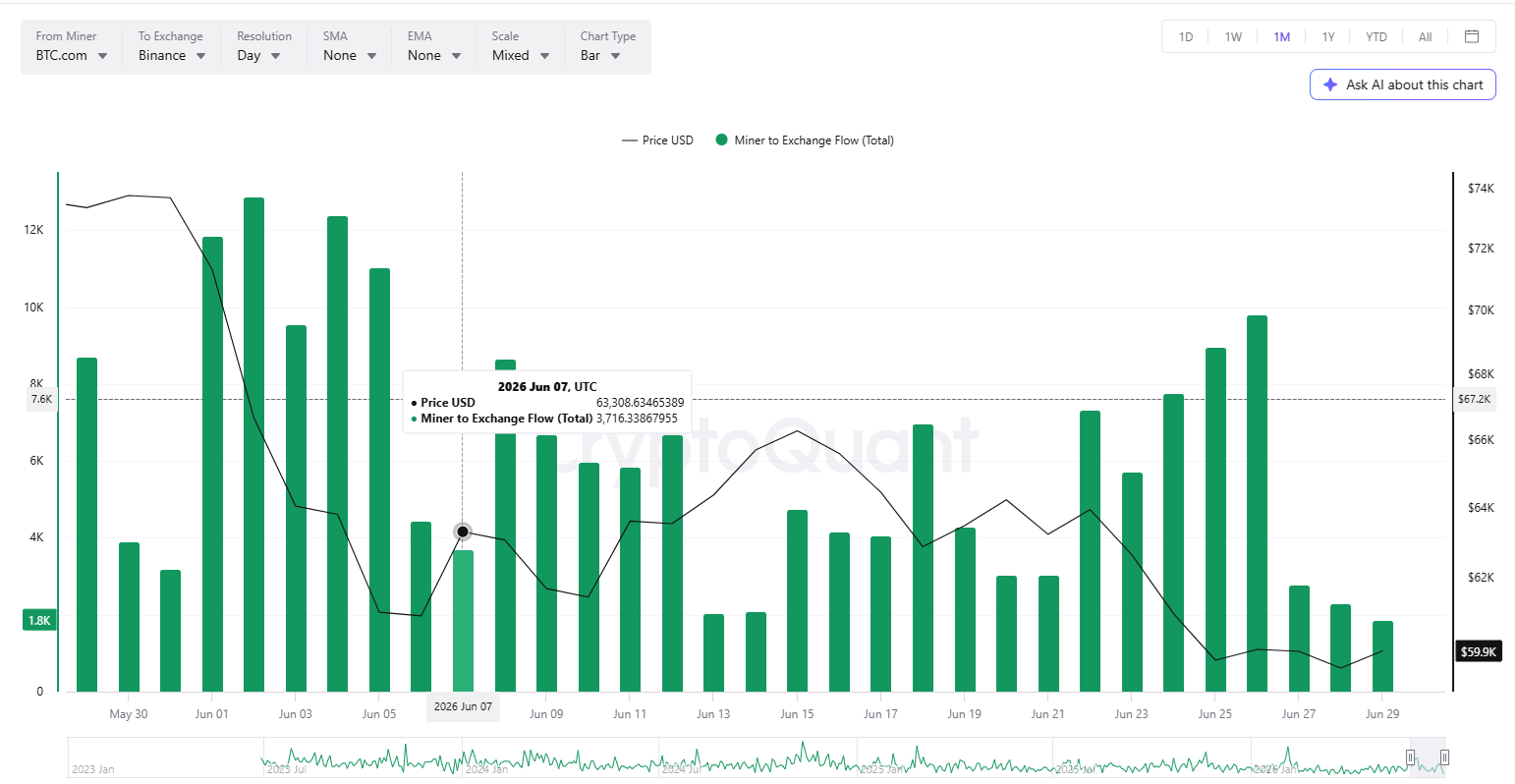
BTC.com was among the most active sellers on Binance, while larger pools still kept their rewards as reserves. | Source:
CryptoquantAll BTC miners operate under distress conditions, based on the hash ribbon indicator. However, individual costs vary, depending on access to electricity and available mining centers. Bitcoin’s network has not shown a spiral of capitulation and is within its usual range of seasonal fluctuation.
Miners are not the biggest source of spot selling pressure, as spot retail and older whales are among the most active sellers. Despite this, miners are more closely watched for overall BTC sentiment and its long-term outlook. Miner selling is still strategic, compared to the recent retail selling of 55,000 BTC at a loss.
Will BTC mining stocks recover?
Most BTC mining stocks are in the green for the past month and the year to date. The stocks may be supported by the still active mining sites, which are seen as prime locations for AI compute and data centers.
Iren (Nasdaq:IREN) is among the biggest losers for the past month, erasing 25.70% of its value. IREN has slid more than some of the pure mining companies, finally vindicating the short sellers.
Miners also seem dedicated to protecting the BTC network, even at their expense. Even some of the most advanced mining machines are barely making a profit, so the key difference is access to cheap electricity contracts and infrastructure.
Miners are also showing some conviction in continuing their operations despite the latest rise in BTC difficulty on June 29.
Don’t just read crypto news. Understand it. Subscribe to our newsletter. It's free.