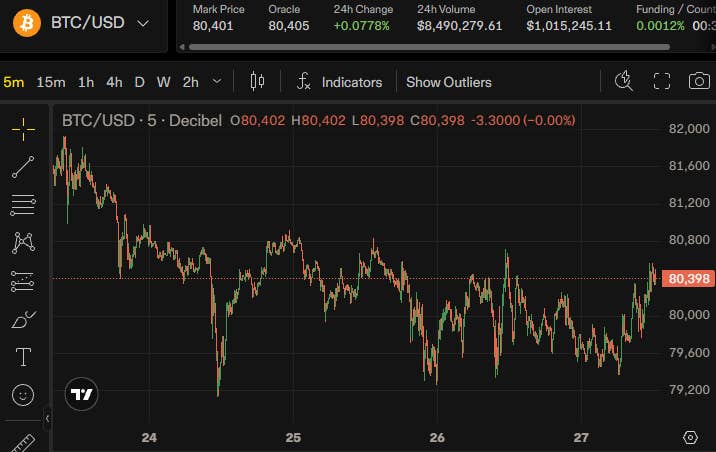
On October 27, the cryptocurrency market saw a sharp increase in short positions, with total open interest in Bitcoin derivatives reaching $28.18 billion while Bitcoin’s spot price hovered ne
On October 27, the cryptocurrency market saw a sharp increase in short positions, with total open interest in Bitcoin derivatives reaching $28.18 billion while Bitcoin’s spot price hovered near $79,756. This spike in activity coincided with a narrowing trading range and aggressive bets against the spot market.
Stablecoin race: Hyperliquid challenges XRP Ledger
The competition for dominance in real-world asset (RWA) tokenization has intensified. Data from the RWA Foundation, citing Token Terminal, indicated that three leading blockchain ecosystems attracted $99.6 million in net stablecoin inflows over 24 hours, fueling growth for emerging tokenized platforms.
Current figures show that XRP Ledger remains slightly ahead in daily stablecoin inflows at $34.4 million, with decentralized protocol Hyperliquid closing in at $34.1 million. Arc follows in third with $31.1 million, highlighting a fiercely competitive landscape.
Platform
24h Stablecoin Inflow
XRP Ledger
$34.4 million
Hyperliquid
$34.1 million
Arc
$31.1 million
Venture capital continues to support both XRP Ledger and Hyperliquid. However, Hyperliquid’s rapid expansion has led to increased risk on its margin markets. Notably, the largest single crypto market liquidation of the day took place on Hyperliquid, with a $1.85 million Bitcoin short position closed.
Mini dictionary: Hyperliquid is a decentralized derivatives exchange known for supporting a wide range of perpetual futures and incorporating on-chain risk management, gaining prominence in institutional DeFi trading.
Ripple’s regulatory milestone and Kraken’s DeFi expansion
In a major regulatory development, the Office of the Comptroller of the Currency (OCC) granted final approval to Ripple for the launch of Ripple National Trust Bank. This bank, designed to manage reserves of Ripple’s RLUSD stablecoin and provide custody to corporate clients, positions Ripple with a significant legal advantage as it strengthens institutional trust in the XRP Ledger ecosystem.
Ripple also broadened its collaboration with BNY, integrating custody solutions and tokenized trade finance into the XRP Ledger. The partnership leverages BNY’s institutional capabilities alongside RLUSD, XRP, and XRP Ledger technology, increasing competitive pressure on rival platforms.
Meanwhile, Kraken introduced the first Commodity Futures Trading Commission (CFTC)-regulated perpetual futures markets for U.S. users through an integration with Hyperliquid. The setup, which also involves Bitnomial and NinjaTrader, was enabled by the recent HIP-3 update that established on-chain whitelists for enhanced compliance. Following this, the HYPE token jumped to $78.50.
Mini dictionary: Ripple is a technology company that develops global payment solutions, primarily through the XRP Ledger, a decentralized blockchain designed for fast, low-cost cross-border transactions. BNY refers to The Bank of New York Mellon, the largest custodian bank in the world.
CFTC-regulated futures offer additional safeguards to institutional investors, and the regulatory focus now includes the use of artificial intelligence in algorithmic trading, according to CFTC insider Eleanor Terrett.
Bitcoin faces “wall of fear” ahead of Fed decision
Bitcoin continues to trade within a tight range, with dominance steady at 60.06% and capital shifting from altcoins into major stablecoins such as USDT and USDC. Ethereum dropped to $2,311.16 amid this shift.
CoinGlass reported that 66,287 positions worth $140.79 million were liquidated in 24 hours, with 56.9% of losses in long positions. BTC and ETH futures accounted for the bulk of margin calls. At the same time, a previously inactive whale withdrew 11,330 Bitcoin (about $903 million) from Binance to new cold storage addresses, reducing supply on exchanges—a trend confirmed by Glassnode’s on-chain metrics.
XRP futures saw a notable deleveraging, with open interest on Binance dropping 28% from autumn highs to $445 million, below its 180-day average. A local price decline of 17% triggered substantial margin calls among retail traders.
Market observers noted, “The growth of open interest alongside a decline in Bitcoin’s spot price creates significant tension, suggesting the potential for a sharp breakout depending on upcoming U.S. macroeconomic data.”
Historically, such washouts have preceded price rallies. In August, XRP rose 72% after a similar event; in September, it gained 32%. If Bitcoin holds above $80,000 following the U.S. Federal Reserve’s decision, analysts see a potential path to $85,000. A drop below $79,000, however, could open new downside targets at $75,000.
Fed rate decisions, U.S. GDP data for Q3, the Core PCE inflation index, and business activity readings will all play pivotal roles in shaping the market’s next significant move. Brian Armstrong, CEO of Coinbase, emphasized the uniqueness of Bitcoin’s 21 million supply cap, contrasting it with the synthetic creation of gold.
“Stabilization of the token above $1.30 could provide XRP with a technical base for recovery,” several technical analysts observed, referencing previous price action in similar conditions.
The post Bitcoin open interest hits $28.18 billion as Ripple gets OCC green light for trust bank appeared first on COINTURK NEWS.