Bitcoin options stayed expensive through August even as spot trading drifted sideways, with 30-day implied volatility running near two-thirds above what the market actually delivered. The per
Bitcoin options stayed expensive through August even as spot trading drifted sideways, with 30-day implied volatility running near two-thirds above what the market actually delivered. The persistent premium shows traders kept paying up for protection and optionality despite one of the quietest summer stretches of the year.
Bitcoin spent most of August consolidating between $63,000 and $65,000, and options-market implied volatility slipped to a year-to-date low during the seasonal lull, Deribit said in its week-33 derivatives report. Yet put options continued to trade at premiums even while spot barely moved. For related coverage, see JPMorgan Boosts Bitcoin, Ether ETF Positions in Q2 Filing.
Bitcoin changed hands around $63,547 with a 24-hour move of roughly 0.94%, underlining just how muted the tape has been. For related coverage, see Cboe Files With SEC to List 3x Bitcoin and Ether ETFs.
Bitcoin spot backdrop $63,547 24h change: +0.94% CoinGecko's public Bitcoin market page provides the quiet spot-market context behind the article's argument that options stayed pricey even while outright trading remained calm.
Why Bitcoin options still look expensive in a quiet market
The contradiction at the heart of this market is simple: prices are calm, but the cost of insuring against a move is not. Options look "expensive" when implied volatility, the market's forward-looking estimate of price swings, sits well above realized volatility, the swings that have actually occurred.
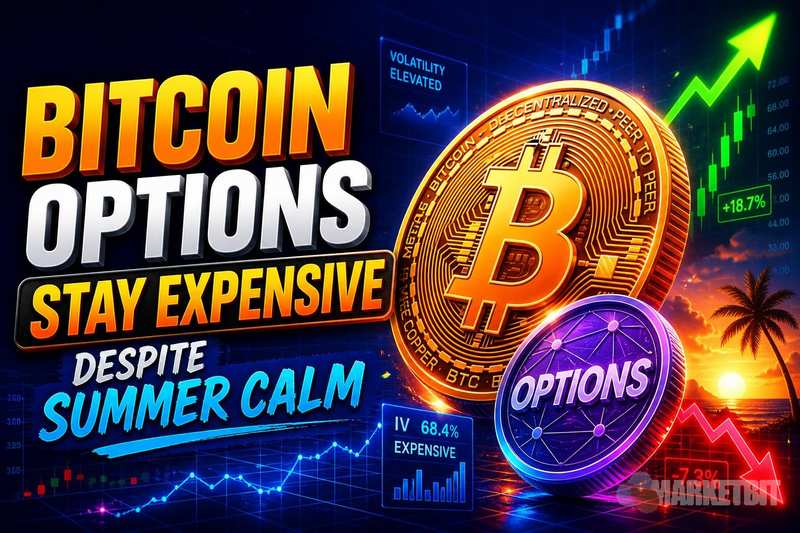
On August 17, Bitcoin's 30-day implied volatility stood at 36.35% versus 21.80% realized, leaving implied readings roughly two-thirds richer than the actual tape justified. That gap is the cleanest single measure of options staying pricey relative to real movement.
Implied vs. realized volatility 36.35% vs 21.80% The spread between implied and realized volatility is the cleanest numeric expression of the story's core point: traders were still paying up for Bitcoin optionality despite a muted summer tape.
Calm price action and expensive options can coexist because a seasonally quiet spot market does not automatically kill demand for hedges or leveraged directional bets. Traders continue to pay for the right to be protected, or positioned, regardless of what the last few weeks of candles looked like.
Premium pricing therefore reflects positioning as much as current movement. When implied stays elevated during a lull, it signals that participants are pricing in what could happen, not just extrapolating the flat summer range forward. This same dynamic showed up earlier in the month, when Bitcoin volatility fell while downside protection stayed costly.
What elevated premiums say about trader positioning
Deribit noted that put options kept trading at premiums even as spot stayed range-bound, a sign that demand for downside protection did not fade with the summer volatility. Puts carrying a bid typically points to hedging appetite ahead of perceived event risk.
Higher premiums are not purely defensive, though. They can equally reflect continued appetite for upside calls if traders expect a breakout once the quiet period ends, so the same rich pricing can house both hedging demand and speculative demand as separate drivers.
Skew and term structure add the nuance that a single volatility number cannot. Skew shows whether traders are paying more for puts or calls, while term structure reveals whether the premium concentrates in near-term hedges or longer-dated exposure. With puts bid, the current skew leans toward protection.
None of this is a guaranteed forecast. Options pricing is a positioning and sentiment lens, not a crystal ball; a rich premium tells you what traders are willing to pay to be positioned, not which direction the next move will take. Institutional flows can reinforce that read, as when UBS lifted Bitcoin exposure through a large ETF call-options bet.
Why this matters for Bitcoin traders heading into the next catalyst
Expensive options raise the cost of both protection and leveraged exposure for short-term traders. When implied volatility sits well above realized, hedgers overpay relative to how much the market is moving, and speculators buying calls or puts face a steeper break-even.
Volmex's live BVIV benchmark, its 30-day forward-looking gauge of Bitcoin implied volatility, printed 56.32 at fetch time, another data point showing the market still assigns a meaningful volatility risk premium even with spot subdued. Sustained readings like that imply the market expects future turbulence despite calm current conditions.
Sentiment, by contrast, remains cautious. The crypto Fear and Greed Index read 31, classified as Fear, on August 17, a backdrop that fits demand for downside protection persisting through the lull.
The practical clue to watch is a repricing in options. If the implied-versus-realized gap starts to compress or expand, it can be an early sign that expectations around an upcoming catalyst are shifting before spot reacts. That is what makes the current premium worth monitoring even when the tape itself is asleep. Broader positioning has stayed defensive too, with Bitcoin recently tracking an equity bounce as weekly ETF outflows hit $390 million.
Disclaimer: This article is for informational purposes only and does not constitute financial or investment advice. Cryptocurrency and digital asset markets carry significant risk. Always do your own research before making decisions.
Read original article on marketbit.net