Bitcoin price analysis indicates that renewed geopolitical tensions have placed fresh pressure on the cryptocurrency market after military actions between the United States and Iran drove oil
Bitcoin price analysis indicates that renewed geopolitical tensions have placed fresh pressure on the cryptocurrency market after military actions between the United States and Iran drove oil prices higher and strengthened the U.S. dollar. Bitcoin and several leading digital assets moved lower as investors reduced exposure to riskier assets amid growing uncertainty.
The latest market reaction highlights how developments in global energy markets and geopolitical events can quickly influence sentiment across cryptocurrencies. While traders continue to monitor military developments, attention is also turning to inflation expectations and their potential impact on interest rate decisions.
What does Bitcoin price analysis indicate about the latest market trend?
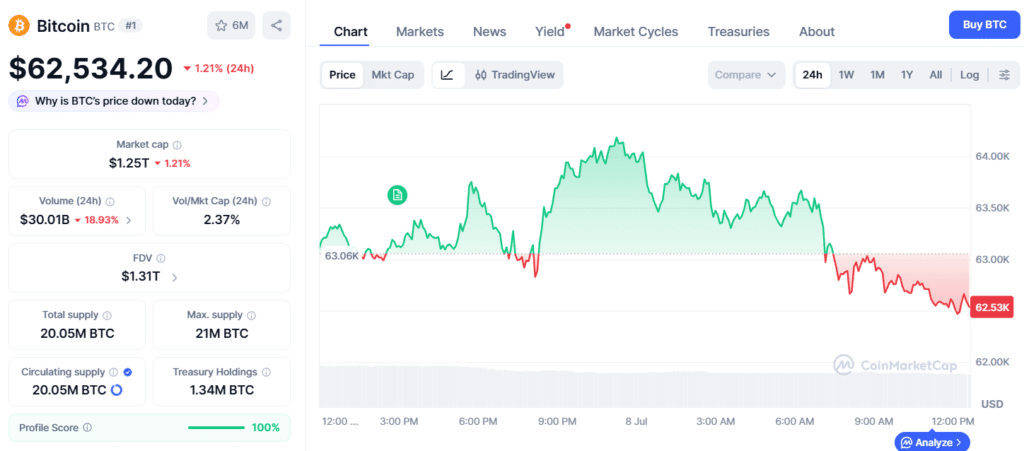
Bitcoin price analysis shows that geopolitical uncertainty has become the dominant factor driving short-term price action. Bitcoin slipped to $62,657 during Asian trading hours, falling nearly 1% since midnight UTC. It is currently trading around $62,541.99, down 1.23% over the past 24 hours. Its market capitalization stands at $1.25 trillion after a 1.22% decline, while 24-hour trading volume dropped 18.97% to $29.84 billion. The volume-to-market-cap ratio is currently 2.38%.
Bitcoin Price Analysis: US-Iran Conflict Sparks Bitcoin Sell-Off as Dollar Strengthens
The broader crypto market also remained under pressure. Earlier trading saw Ether, XRP and Solana decline between 1% and 2.3%. More recent market data shows Ether currently trading around $1,744.57, down 1.87% over the past 24 hours. XRP is currently trading around $1.08 after falling 3.83%, while Solana is currently trading around $77.84 with a 4.47% daily decline.
Why did cryptocurrencies react negatively?
The latest decline followed a sharp escalation between the United States and Iran. The United States said it carried out “powerful strikes” against Iran after attacks targeted three commercial vessels in the Strait of Hormuz, including Qatari and Saudi tankers. Iran responded by stating that it targeted 85 U.S. military installations in retaliation for strikes on its Hormozgan and Mahshahr provinces. The scale of the latest escalation appears to have pushed the two nations’ ceasefire to the brink of collapse.
Additional developments added to market uncertainty. The United States reportedly launched strikes against more than 80 targets while revoking a license that had temporarily allowed Iran to sell oil. Iranian officials described the move as a breach of the existing framework agreement and stated that Tehran would take measures it considers necessary to safeguard its national interests.
How are oil prices influencing crypto markets?
WTI crude futures climbed more than 2% to $72.27 following the latest developments. At the same time, the U.S. Dollar Index remained above 101.00, maintaining Tuesday’s gains as investors moved toward safer assets. Bitcoin price analysis suggests that higher oil prices have renewed concerns over inflation.
Rising energy costs often increase broader price pressures across the global economy, leading investors to consider the possibility that central banks may keep interest rates elevated for longer. Higher borrowing costs generally make fixed-income investments more attractive than higher-risk assets such as cryptocurrencies. That shift in investor preference has weighed on digital assets during periods of geopolitical uncertainty.
Why does the earlier conflict still matter?
The current market reaction also reflects concerns that extend beyond the latest military developments. The conflict between Iran and the United States erupted in late February, pushing oil prices well above $100 per barrel and creating a significant inflationary shock across global markets.
Although oil prices later fell below $60 per barrel, inflation expectations among consumers remained elevated. Those expectations have continued to fuel concerns that interest rates could stay higher across several major economies, including the United States. Market analysts often note that such an environment limits demand for risk-oriented assets because investors can earn more attractive returns from comparatively safer investments.
What should traders monitor next?
Bitcoin price analysis suggests that investors are likely to remain focused on both geopolitical developments and macroeconomic signals over the coming days. Any further escalation around the Strait of Hormuz could continue to influence energy prices and overall market sentiment.

Bitcoin Price Analysis: US-Iran Conflict Sparks Bitcoin Sell-Off as Dollar Strengthens
Investors are also watching for signals from the Federal Reserve regarding inflation and monetary policy. At the same time, U.S.-listed spot Bitcoin exchange-traded funds recently recorded three consecutive days of net inflows, showing that institutional participation has remained active despite broader market weakness. Regulatory developments in the United States are also being monitored as policymakers work toward a clearer framework for digital assets.
Conclusion
Bitcoin price analysis reflects a market that remains highly sensitive to geopolitical developments and macroeconomic conditions. Bitcoin stayed on the back foot as the latest military developments between the United States and Iran reshaped sentiment across global financial markets.
As tensions intensified, investors increasingly focused on what higher oil prices could mean for inflation and future interest rate decisions. Until there is greater clarity on both geopolitical tensions and monetary policy, cryptocurrency markets are likely to remain volatile as traders continue responding to global economic developments.
Glossary
US Dollar Index (DXY): Tracks the strength of the U.S. dollar.
WTI Crude Oil: A key benchmark for U.S. oil prices.
Interest Rates: The cost of borrowing money.
Market Capitalization: The total value of a cryptocurrency.
Safe-Haven Assets: Investments favored during market uncertainty.
Frequently Asked Questions About Bitcoin Price Analysis
How did the US-Iran conflict affect Bitcoin?
The conflict increased market fear causing Bitcoin and other cryptocurrencies to decline.
Why is a stronger U.S. dollar important for Bitcoin?
A stronger U.S. dollar can reduce demand for risk assets like Bitcoin.
How do higher oil prices affect cryptocurrencies?
Higher oil prices can raise inflation concerns and put pressure on crypto prices.
Did other cryptocurrencies also decline?
Yes Ether, XRP, and Solana also fell as the broader crypto market weakened.
Are institutions still buying Bitcoin?
Yes recent spot Bitcoin ETF inflows show that institutional interest remains active.
Sources
Coinmarketcap
CoinDesk
Reuters
Investing.com
Financeyahoo