Bitcoin traded at about $81,685 on Sunday morning. Kraken showed $81,684.70 at the hour, Coinbase $81,718, and the average over the past 24 hours sits at $81,398. Overnight the range ran from
Bitcoin traded at about $81,685 on Sunday morning. Kraken showed $81,684.70 at the hour, Coinbase $81,718, and the average over the past 24 hours sits at $81,398. Overnight the range ran from $80,655 to $81,961, a spread of just over 1.6 percent between low and high. For a Sunday, that is a quiet move.
A different number is the more interesting one this morning: sending bitcoin across the network currently costs as little as it possibly can. The fee estimate from mempool.space for the next half hour stands at one satoshi per virtual byte, the technical floor that nodes on the network will still relay. A standard withdrawal from an exchange to your own wallet therefore costs around 12 cents.
The striking part: the mempool, the queue of transactions still waiting for confirmation, is far from empty. 71,454 transactions are queuing there for space in the next block, 39.1 million virtual bytes in total. That is roughly 39 full blocks, about six and a half hours of work for miners. The fast lane still costs almost nothing. That contradiction is the heart of this morning, and it resolves cleanly.
Where the Bitcoin price stands on Sunday morning
Little has changed since Saturday. On Friday morning bitcoin stood at $81,437, when we covered the start of Deutsche Bank's custody service. That leaves about $250 of gains across two days, less than two tenths of a percent. The level that should shape the start of the week is the overnight high at $81,961: while the price stays below it, it moves inside the range that has held since Friday. On the downside the overnight low sits at $80,655, and only below that does the technical picture turn murky.
Trading volume on Kraken came to roughly 657 bitcoin over 24 hours. That is thin and fits the weekend: the spot market is resting, the traditional futures exchanges are closed, and there are no fund flows on Saturdays and Sundays in any case. There is no impulse to be had before Monday.
One satoshi per byte, and what that unit measures
The bitcoin network fee does not depend on the amount you send. Whether you move 50 euros or 50,000 euros makes no difference to the cost. You pay for space, measured in virtual bytes. A standard withdrawal with one input and two outputs takes up about 141 virtual bytes. A block holds roughly one million of them.
The fee rate therefore states how many satoshi you are willing to pay per byte of space used. A satoshi is one hundred-millionth of a bitcoin, about $0.0008 at today's price. Miners sort the mempool by that rate and fill the next block from the top down. Bid more and you sit further forward. Bid too little and you wait until the crowd thins out.
One satoshi per byte is not simply a low number, it is the floor: the default setting on most nodes will not even relay transactions below it. With the estimate for the next half hour sitting on exactly that value, the minimum is currently enough to make the next block. For the fastest tier the estimate stood at two satoshi this morning, and even that comes to 23 cents.
The mempool backlog is large and the fee is still minimal
This is where it gets interesting if you have ever waited on a confirmation. A full mempool was long read as a warning sign: many transactions queuing, so high fees. This morning that does not hold, and the reason lies in the distribution.
Of the 39.1 million virtual bytes in the mempool, 38.5 million are waiting at rates below one satoshi per byte. That is 98.5 percent of the entire backlog. Only 589,557 virtual bytes, or 1.5 percent, bid one satoshi or more. The average rate across the whole mempool is 0.167 satoshi per byte.
Translated into plain terms: the queue consists almost entirely of transactions that deliberately bid very little and are waiting for better conditions, often from batch processing or from applications that park data on the blockchain. Pay one satoshi per byte today and you overtake all of them, while the data competing with you amounts to about 0.59 of a single block. The backlog does not hold you up, it simply stands beside you.
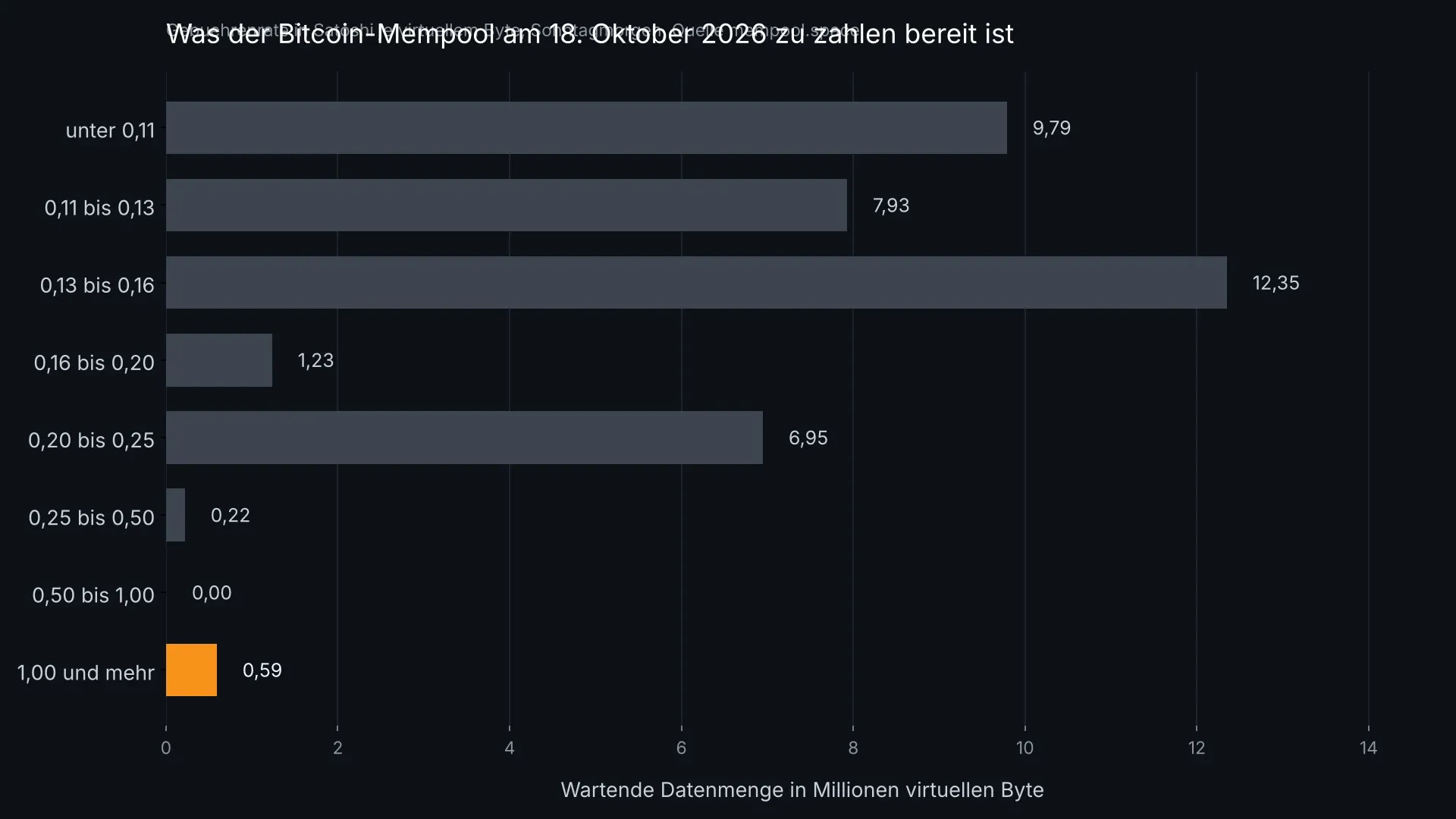
Almost the entire mempool backlog bids less than one satoshi per virtual byte. Only the orange bar at the bottom competes with you for the next block.
What a Bitcoin withdrawal really costs today
Concretely, calculated at this morning's price:
- A standard withdrawal from an exchange to your wallet, one input and two outputs, takes up about 141 virtual bytes. At one satoshi per byte it costs 11.5 cents.
- A transaction with two inputs and two outputs, for instance when you merge two older amounts, takes up about 222 virtual bytes and costs 18 cents.
- Consolidating ten small amounts at once takes up about 722 virtual bytes and costs 59 cents.
For comparison, the same three operations at a rate of 20 satoshi per byte, which is usual in busy phases: $2.30, $3.63 and $11.80. At 50 satoshi per byte it would be $5.76, $9.07 and $29.49. The factor between today and a busy Tuesday therefore runs from twenty to fifty.
How to check the network fee before you withdraw
The figure in this article is a snapshot from Sunday morning. Before you send anything, your own look is worth the effort, and it takes under a minute.
- Open the fee estimate on your own node or on a public mempool service. It usually shows three tiers: the fast lane for the next block, the middle one for about half an hour, and the economical option. If all three sit close together, the network is quiet.
- Compare that figure with what your wallet suggests. Many wallets add a safety margin and offer two to three times the going rate. In quiet phases you pay that for nothing.
- See whether your wallet lets you set the fee rate by hand. If it only offers "fast", "normal" and "slow" without a number, you have no control over the price.
- Look for replace-by-fee support in your wallet. It lets you resend a transaction that went out too cheaply with a higher fee, instead of leaving it stuck for days.
Why your exchange often charges more than the Bitcoin network
One item is missing from the calculation above, and it hits most retail investors harder than any network fee: the exchange's withdrawal fee is a separate number. Many venues charge a flat amount per withdrawal, regardless of what the network costs at the time. Amounts in the range of a few euros are common, or a fixed satoshi figure calibrated to busy periods, which on a morning like this comes to a multiple of the actual network cost.
The cheap window in the network therefore only helps you if your exchange passes it on. Some venues bill dynamically and charge the real network price, others keep the flat fee constant all year. The terms a provider runs are set out in its fee schedule, and reading it before you move is time well spent. To see the different models side by side, the crypto exchange comparison breaks the fee structures down.
There is a second lever. Some exchanges offer withdrawals over the Lightning network. The blockchain fee does not arise there at all, but you need a wallet that speaks Lightning, and you tie yourself to your provider's channel structure. For small amounts that is often the cheaper route, for larger sums the direct path over the blockchain remains the sounder choice.
Consolidating ten small amounts in one go
Who gains most from this morning: months of savings-plan buys, each one moved to your own wallet, leave you sitting on many small pieces. In the Bitcoin network they are called unspent outputs, and every one of them takes up space later, when you sell or reshuffle.
Merging ten such pieces into a single one takes up about 722 virtual bytes. Today that costs 59 cents. In a busy phase at 50 satoshi per byte it would be $29.49. If the housekeeping is on your list anyway, a quiet weekend handles it far more cheaply than a weekday.
A tax note before you start: merging your own amounts into the same wallet is no sale and triggers no taxable event. It can, however, make the allocation of acquisition dates harder if your wallet or your tax software does not track the origin of the individual pieces cleanly. Write down beforehand which amounts you bought when.
The mempool backlog looks like waiting time. Because almost everything in it bids less than one satoshi, the gate stays open for paying transactions.
The next difficulty adjustment falls on October 30
A look ahead that ties into the fee picture. Mining difficulty governs how hard it is to find a block, and it is retuned every 2,016 blocks. On October 16 it jumped by almost six percent, 5.92 percent to be exact. Average block time has sat at 10.21 minutes since then, slightly above the ten-minute target.
The estimate for the next adjustment stands at minus 1.77 percent. It takes effect at block height 973,728, expected on October 30. The blockchain currently stands at height 971,946, so about 1,780 blocks are missing.
The link to the fee is indirect but real. Longer block times mean fewer blocks per day and therefore less space. With strong demand that would push fees up. That rates sit at the floor despite slightly slower blocks shows how thin demand for block space really is right now.
Our take: the lull makes the window
From the newsroom's perspective this morning is a good window for anything that costs space on the blockchain, and at the same time a weak signal for activity on the network. The evidence lines up: an average of 0.167 satoshi per byte across the whole mempool, only 1.5 percent of the backlog above the minimum rate, and trading volume of 657 bitcoin in 24 hours on Kraken are three numbers that say the same thing. There is little going on.
The case for using the window: moving to self-custody or consolidating old amounts costs a twentieth to a fiftieth of what it costs midweek. The case against turning that into a statement about the price: low fees are no buy signal. What they measure is demand for block space, not demand for bitcoin. The two have often diverged in the past, and treating them as one reads a market claim out of a technical metric that cannot carry it.
How long the window holds cannot be forecast seriously. Experience says rates pick up as soon as the venues start working through their batches on Monday. If you have something planned, there is time until then.
How the one-year holding period relates to moving your Bitcoin
A point that concerns German investors and comes up with every wallet move: shifting your own bitcoin from an exchange to your own wallet is no sale. It is not a disposal, it triggers no tax, and it does not interrupt the one-year holding period. What counts is the acquisition date, not the place of custody.
You still need records, though. The tax office sees only a blockchain transaction, not the intention behind it. Keep the exchange's withdrawal confirmation with date, amount and destination address, along with your purchase receipts. Document that cleanly and you can later show that more than a year lay between purchase and sale. What lawmakers plan to do with the holding period is gathered in our piece on the current state of the holding-period reform.
On custody itself: a hardware wallet keeps the keys off your computer, and that is the real reason the move is worth making. Which devices support which blockchains, and how they differ in securing the recovery words, is set out in the hardware wallet comparison. One thing matters above all: write the recovery words down by hand and store them separately from the device. No photo, no cloud, no text file.
What is on the calendar for Monday
The start of the week brings back the data that moves the price. Fund flows into the US spot products are reported again from Monday, the futures market opens, and the venues' batch processing fills the mempool. For the fee picture that means today's rates are more the exception than the rule for the coming week.
For the price the two overnight levels remain: $81,961 on the upside, $80,655 on the downside. A break out of that range would be the first solid signal of the new week.
Bitcoin network fee on October 18: 12 cents per withdrawal
The situation turns into something concrete in three steps:
- Look up the fee yourself before you send. The estimate for the next half hour stands at one satoshi per virtual byte. If your wallet sets more, correct the figure by hand where it allows that.
- Hold your exchange's withdrawal fee against the network price. If your provider bills a flat amount, you pay a multiple of the real cost today. Your provider's fee schedule names the model.
- Get the housekeeping done on a quiet weekend. Merging ten small pieces costs 59 cents today instead of almost $30 in a busy phase. Suitable devices for self-custody are in the hardware wallet comparison.
(As of October 18, 2026. This article is not investment advice. Prices and fee structures change; check the terms with the provider before you buy.)