Bitcoin Price Market Crash and What It Means for You Bitcoin's price market crash in June 2026 has shaken the confidence of both new and experienced investors worldwide. On June 5, 2026, BTC
Bitcoin Price Market Crash and What It Means for You
Bitcoin's price market crash in June 2026 has shaken the confidence of both new and experienced investors worldwide. On June 5, 2026, BTC was trading near $59,875, down roughly 15.3% in just one week. Compared to its all-time high of $126,198 in October 2025, BTC has now lost more than 50% of its value. Yet history has shown that Bitcoin price market crashes often create the biggest opportunities for those who understand the market cycle. If you are watching the numbers drop and wondering what to do next, this guide breaks it all down for you clearly and honestly.
Why Did the Market Crash in June 2026?
Several strong forces came together to push BTC into this sharp correction. Understanding each one helps you make better decisions going forward.
Record ETF Outflows Hit the Market Hard
BTC spot ETFs recorded $2.30 billion in net outflows during May 2026 alone. That is the largest monthly outflow of 2026 and the steepest since November 2025. Institutional investors pulled money faster than Bitcoin's price decline could explain. The cumulative net inflow dropped from $58.09 billion in April to $55.79 billion, signaling that large-scale players were reducing risk exposure well before retail investors felt the pain.
Geopolitical and Macro Tensions
Global events added pressure. News about Hezbollah rejecting an Israeli ceasefire offer sent shockwaves through risk assets. Crypto, which often moves with global risk sentiment, fell hard in response. Add to that the uncertainty around the U.S. Federal Reserve's June 17 interest rate decision, and investors chose to play it safe.
Mt. Gox Repayment Supply Overhang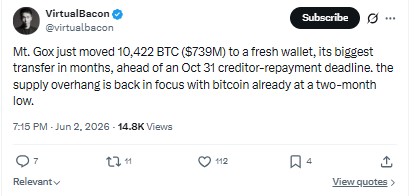
Mt. Gox creditors are scheduled to receive BTC repayments, with a final deadline of October 31, 2026. Each transfer of old BTC to creditors creates selling pressure, since many recipients have waited years and may choose to cash out. A similar large Mt. Gox BTC transfer in November 2025 was followed by a double-digit price drop in the weeks after, giving this pattern real historical weight.
EU MiCA Regulation Pressure
Crypto firms operating in the European Union must now secure licenses before July 1, 2026, or risk losing access to European customers. French regulators have already warned of potential enforcement actions against non-compliant companies. This has created uncertainty and accelerated capital outflows from European crypto markets.
MicroStrategy Broke Its "Never Sell" Rule
MicroStrategy, the world's largest corporate holder of Bitcoin, reportedly sold 32 BTC — a tiny amount but one that triggered massive panic. For years, the company's policy was to only buy, never sell. When that iron rule was broken, it caused fear far beyond the size of the actual transaction. The market interpreted this as a signal that even the biggest believers were stepping back.
Where Is Bitcoin's Price Right Now? (June 6, 2026)
As of June 6, 2026, Bitcoin is trading around $59,000 to $61,500, following a brutal sell-off that began in mid-May. Key data points include:
24-hour trading volume: approximately $39.59 billion
Market cap: roughly $1.26 trillion
Fear & Greed Index: 12 (Extreme Fear)
RSI: near 35, approaching oversold territory
Key support level: $59,000 (if broken, $55,500 comes next)
All-time high: $126,198.07 (October 6, 2025)
Current correction: Over 51% from the all-time high
BTC has broken below the 20-day, 50-day, and 100-day EMAs. The technical picture is bearish in the short term, though oversold indicators suggest selling momentum may be weakening. A key jobs report released on June 6, 2026, could act as a trigger for either direction.
Bitcoin Price Correction vs. Bitcoin Crash: Key Difference
Many people confuse a correction with a crash, and knowing the difference helps you stay calm and act smart.
A correction is typically a 10% to 20% pullback from a recent high. It is a normal part of any asset's price cycle. A crash is a sharper, faster decline, often 30% or more, usually driven by panic, fear, or major negative events.
Bitcoin has experienced both throughout its history. What is happening in June 2026 is a serious correction that has crossed into crash territory—more than 51% below the all-time high. But Bitcoin has recovered from similar situations before: from $69,000 in 2021 it crashed to $15,500 in 2022, only to rally to $126,000 by October 2025. Understanding this cycle is what separates panic sellers from strategic buyers.
How Market Corrections Create New Opportunities
Every major Bitcoin price correction in history has eventually created a buying opportunity for long-term investors. Here is how to think about the current one:
Dollar-Cost Averaging Works Well in Bear Markets
Dollar-cost averaging (DCA) means investing a fixed amount at regular intervals, regardless of price. During a Bitcoin correction, DCA allows you to accumulate more BTC at lower prices. When recovery comes, your average cost is lower than the peak, potentially multiplying your returns.
Technical analysis 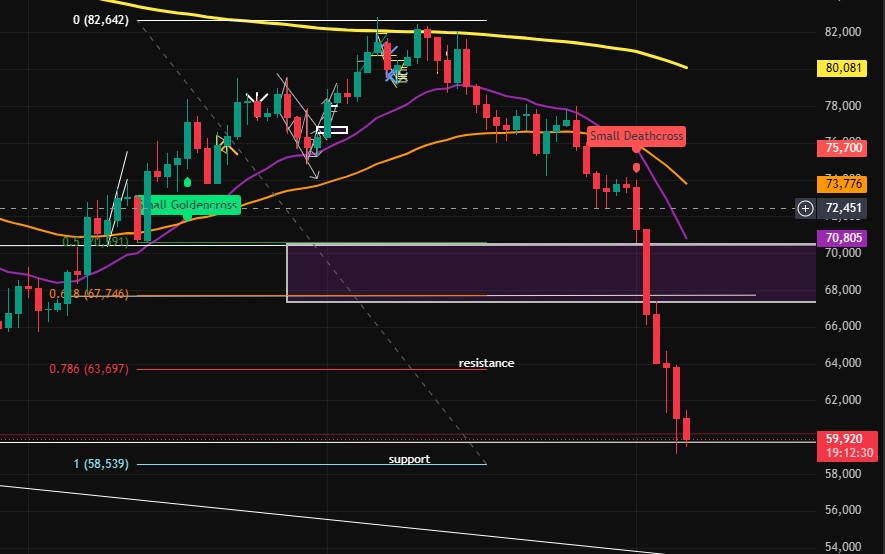
Short Term: Bearish momentum remains strong; price is trading below key moving averages and may test lower support levels before any recovery.
Long Term: Long-term trend remains bullish above major cycle support, but a sustained move below current support could extend the correction phase.
Support
Resistance
- 63,697
- 67,500
- 70,805
- 75,700
- 80,081
Oversold Indicators Signal Possible Reversals
The Relative Strength Index (RSI) near 35 is approaching oversold territory. Historically, when Bitcoin's RSI dips below 30, it often precedes strong recoveries. Traders and long-term holders watch this number closely as a signal to begin positioning before the broader market catches on.
Institutional Infrastructure Is Improving
The CME Group launched 24/7 Bitcoin and Ethereum futures trading on May 29, 2026. This eliminates the weekend liquidity gap that has historically made crypto prices more volatile. Better infrastructure means institutional money can enter more smoothly — which is a long-term bullish signal even in a bearish moment.
Regulatory Clarity Is Coming
Despite the pressure from EU MiCA rules, regulatory clarity in the U.S. has been improving. A clear framework gives institutional investors confidence to allocate capital to Bitcoin. Historically, regulatory clarity has been followed by increased adoption and price appreciation.
What Do Analysts Say About Bitcoin's Recovery?
Analysts are divided, but many see potential for recovery:
A daily close above $68,000 would signal short-term bearish invalidation.
A break below $65,000 would confirm a deeper correction, with $61,000 as the next major test.
If Bitcoin holds the $62,000 support zone, a recovery toward $68,000 by June 30 is possible.
The Federal Reserve's June 17 rate decision is the single biggest upcoming catalyst — a dovish signal could trigger a sharp rally.
The historical June median Bitcoin return is +2.58%, with only five negative Junes in the past twelve years.
Smart Strategies for Investors During a Bitcoin Crash
If you are currently holding Bitcoin or thinking about entering the market, here are approaches worth considering:
Set Clear Entry Points — Instead of trying to catch the exact bottom, decide in advance at what price levels you are comfortable buying. Many investors use Fibonacci retracement levels (61.8% near $67,182 is already broken) to guide entry decisions.
Manage Your Risk Carefully — Never invest more than you can afford to lose. Bitcoin remains highly volatile. Even analysts who are bullish on Bitcoin acknowledge that large price swings will continue.
Stay Updated on Macro Events — The U.S. jobs report on June 6, 2026, and the Fed rate decision on June 17 are critical. Big macro events move BTC more than most technical signals in the short term.
Think Long-Term — Bitcoin's strongest gains have come from long holding periods. Short-term crashes have consistently been buying opportunities for those with the patience to wait for the next cycle.
Author/Expert Opinion
"The June 2026 Bitcoin correction is one of the steepest since the 2022 bear market, but the underlying fundamentals remain intact. Institutional infrastructure has never been stronger. The CME's 24/7 futures launch, improving U.S. regulatory clarity, and Bitcoin's fixed supply are structural positives. Crashes create fear, but fear creates opportunity. Investors who understand the four-year halving cycle and the historical behavior of Bitcoin after corrections are likely approaching this period with a measured accumulation strategy rather than panic. The key is to manage risk, avoid leverage, and think in years, not weeks."
— Crypto Market Analyst Perspective, based on current market data and technical indicators, June 2026
YMYL Disclaimer — For Informational Purposes Only
This report is produced by CoinGabbar for informational and educational purposes only. Nothing in this document constitutes financial advice, investment advice, trading advice, or any other form of recommendation. Cryptocurrency markets are highly volatile and speculative. Past market behaviour is not indicative of future performance. All data cited is sourced from publicly available market data providers as of June 5–6, 2026, and is subject to revision. Readers should conduct their own independent research and consult a qualified financial advisor before making any investment decisions. CoinGabbar, its authors, and its reviewers hold no liability for financial losses arising from the use of this report.