At 08:00 UTC on October 30, 149,686 Bitcoin contracts expire on the Deribit options exchange. At $81,420, the price at midday on Saturday, that is a notional value of $12.2 billion. It is by
At 08:00 UTC on October 30, 149,686 Bitcoin contracts expire on the Deribit options exchange. At $81,420, the price at midday on Saturday, that is a notional value of $12.2 billion. It is by far the largest date in the coming weeks: the expiry on October 23 carries 14,759 contracts, the November date on the 27th another 26,779. The monthly expiry is ten times the size of the next weekly one.
Two thirds of these contracts are calls, in other words bets on rising prices. How they are spread across the strike prices says more about sentiment on the derivatives market than any survey, and it reveals an imbalance that can weigh on the price over the next thirteen days. For where the price may head over a horizon of months, see our Bitcoin price prediction.
The October 30 expiry date, 09:00 German time
An option is the right to buy or sell Bitcoin at a set price. The buyer of a call at $95,000 may exercise at that price on the expiry date, wherever the market happens to trade. If Bitcoin sits below it, the right expires worthless and the seller of the option, known in the trade as the writer, keeps the premium.
On Deribit these contracts are denominated in Bitcoin rather than dollars. So 149,686 open contracts mean 149,686 Bitcoin of underlying value. For comparison, roughly $22 billion of Bitcoin changes hands on the spot market on an average day. An expiry of this size therefore moves the market not through sheer volume, but through the hedging business attached to it.
October 30 is the last Friday of the month and so the monthly expiry. These dates are traditionally the largest, because institutional investors roll their positions in monthly steps. After the clocks change on October 25, the expiry falls at 09:00 German time instead of 10:00 as before.
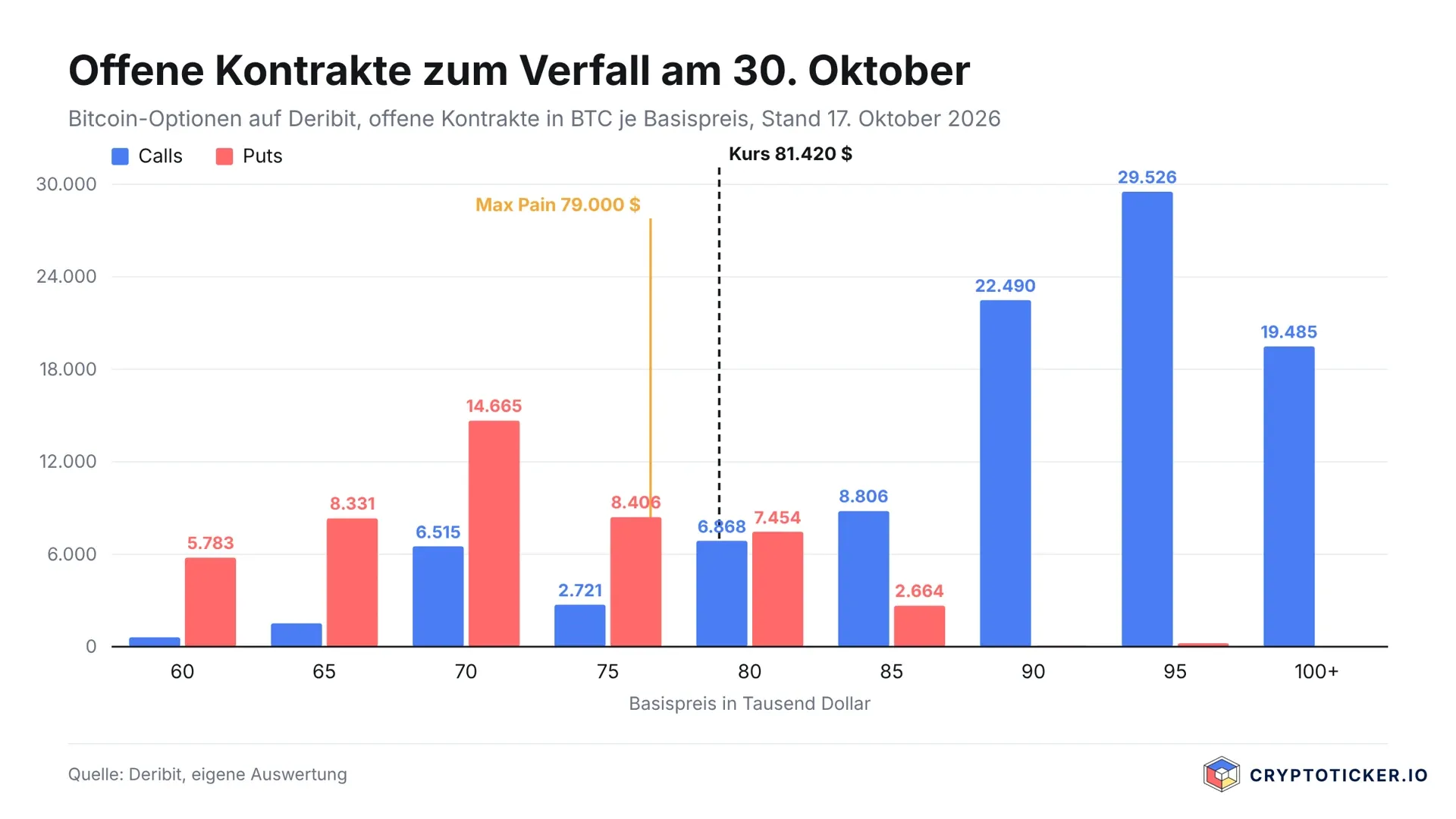
The clusters of calls sit at $90,000, $95,000 and $100,000, while the puts crowd just below the price.
98,552 calls against 51,134 puts: how the expiry is positioned
Breaking the open contracts down by strike price reveals three clusters on the call side, and all three sit well above the current price. There are 25,570 contracts at $95,000, another 15,254 at $90,000 and 14,330 at $100,000. Together with the smaller positions in between, the calls add up to 98,552 contracts.
The picture on the put side is different. The largest single position sits at $70,000 with 4,142 contracts, followed by $75,000 with 3,034 and $72,000 with 3,084. The puts are therefore packed just below the price while the calls sit far away. In total, 51,134 puts face 98,552 calls, a ratio of 0.52.
The top band is the most telling: 19,485 contracts sit at $100,000 and above. That is 13 percent of all open contracts, with a notional value of $1.6 billion. For those positions to be worth a cent on October 30, Bitcoin would have to rise 23 percent in thirteen days.
Max pain sits at $79,000, $2,420 below the price
From this distribution it is possible to calculate the point at which the combined value of all in-the-money options is smallest. That point is called max pain, because it is where buyers of options collectively take out the least. For October 30 our analysis puts it at $79,000, some $2,420 or just under 3 percent below Saturday's midday price.
Max pain is neither a forecast nor a price target. It describes a calculated figure, not a promise, and academic work on max pain theory in equity markets reaches mixed conclusions. Its use is as a bearing: it shows where the positions that have been built up force the fewest payouts, and it currently sits below the price rather than above it.
Its position relative to the market matters more than the point itself. Max pain below the price means the put side sits closer to the action than the call side. Call buyers have placed their stakes at levels the market can only reach in thirteen days with a sharp jump.
How hedging by the option writers feeds through to the price
Behind every call stands a seller who would have to deliver if the option ends in the money. These writers hedge on the spot market: as the price moves towards a large strike they buy Bitcoin, and as it falls they sell again. That continuous adjustment is known as delta hedging, and it generates trading volume that has nothing to do with any view on Bitcoin.
The closer the expiry comes, the sharper the adjustment around the large strikes. Some 40,824 contracts sit at $90,000 and $95,000 combined, and a price approaching those levels forces the writers to buy. The mechanism works as a brake while the price stays well below them: hedges for options that are unlikely to reach their target are unwound step by step, and that means selling in the spot market.
That is precisely where the market stands. At $81,420, with implied volatility to match, the $95,000 calls are all but out of the running on the arithmetic. The hedge behind them melts away day by day, and what is unwound arrives as supply.

On expiry day it becomes clear which way the writers have to turn their hedges.
Friday's forecast revisited: $79,806 held
On Friday this slot carried the Bitcoin forecast on the jump in mining difficulty, with $79,806 on the downside and $82,508 on the upside. Both held: the low of the past 24 hours was $80,761 and the high $82,385. The price has come back 0.9 percent since Friday evening and 1.8 percent over the week.
Two things have changed since then. Computing load on the network, Friday's peg for the story, has eased again after the jump: the three-day average hashrate fell from 1.084 to 1.010 quintillion hashes per second, and the next difficulty adjustment is now estimated at plus 2.0 percent rather than Friday's near 6 percent. Sentiment has also turned: the Fear and Greed Index stands at 55 points, against 69 on October 12.
The implied range to October 30: $76,500 to $86,300
The options market says not only what is being bet on, but also how much the market expects prices to move. Deribit's published volatility measure for Bitcoin stands at 32.2 percent on an annual basis. Converted to the remaining 12.8 days to expiry, that implies a move of a good 6 percent either way.
In figures, the market is pricing a range of roughly $76,500 to $86,300 for October 30. The $90,000 calls would need 10.5 percent, those at $95,000 16.7 percent and those at $100,000 22.8 percent. All three lie outside what the derivatives market itself considers likely.
The same calculation caps the downside. At $76,500, the lower end of the implied range sits a good 5 percent above the 200-day line at $72,419. The 50-day line currently runs at $81,326, $97 below the price: the market is sitting almost exactly on it, and it is the first level to watch in the coming days for whether the direction holds.
The view from the newsroom: the expiry alone will not turn the price
Our assessment: the monthly expiry works as an explanation for moves around October 30, not as a directional signal for the weeks before it. Three pieces of evidence from the figures above support that. First, max pain at $79,000 is only just under 3 percent below the price, so the arithmetic pull is weak. Second, 149,686 contracts count for little against daily spot turnover of $22 billion. Third, implied volatility is low at 32.2 percent, and low volatility means smaller hedging flows.
The concentration argues the other way. Should the price fall below $79,000, the puts at $75,000 and $72,000 come into play, and hedging would then amplify the move rather than damp it. To read the next two weeks, look not at expiry day but at the $79,000 level ahead of it.
Leveraged products, holding periods and tax: the German framework
For investors in Germany the tax treatment is what matters most with options, and the gap is wider than many expect. Anyone holding Bitcoin directly falls under section 23 of the German Income Tax Act: after a holding period of one year the gain is tax-free. Where that rule goes next is covered in the current status of the crypto holding period, on which the German finance ministry declined to commit on October 16.
Derivatives follow different rules. Options, knock-outs, certificates and CFDs on Bitcoin count as forward transactions or capital claims and are taxed under section 20 of the Income Tax Act at the flat withholding rate. There is no holding period there, and no tax exemption after a year. Two routes to the same underlying, two entirely different tax outcomes.
In practice: anyone looking to position for the expiry date will find leveraged products in Germany at brokers that carry such instruments, and a look at the crypto broker comparison shows which providers offer what and at what cost. Anyone who merely wants to tidy up a spot holding has a cheap window right now: transaction fees on the Bitcoin network stand at one satoshi per virtual byte at every tier as of Saturday midday, the minimum. A standard transfer with one input and two outputs weighs about 141 virtual bytes and therefore costs around ten cents. Moving coins from an exchange into self-custody is not a sale and does not interrupt the holding period, though the exchange's withdrawal flat fee comes on top and is often well above the network fee.
Expiry on October 30: 19,485 calls need 23 percent in 13 days
The state of the derivatives market fits into one sentence: the bets on rising prices are numerous, but they are placed too high. Some 19,485 contracts at $100,000 and above need a 23 percent jump in thirteen days, while the options market itself prices only a 6 percent move. As a rule that gap does not close by October 30 through a leap in the price, but by the positions expiring worthless.
Three numbers are worth watching in the coming days: the 50-day line at $81,326 as the next level below the price, max pain at $79,000 as the threshold below which the put side gains weight, and the upper end of the implied range at $86,300. While the price stays between those points, the expiry is a date in the calendar rather than an event.
(As of October 17, 2026. This article is not investment advice. Prices and fee structures change; check the terms with the provider before you buy.)