More than forty crypto companies are urging top AI labs to allow approved Bitcoin security experts to use the cutting-edge models already in the hands of hackers. This request is coordinated
More than forty crypto companies are urging top AI labs to allow approved Bitcoin security experts to use the cutting-edge models already in the hands of hackers. This request is coordinated by the Bitcoin Policy Institute (BPI) and explains that access to technologies, including those from OpenAI and Anthropic as a defensive imperative for software that protects over $1 trillion worth of assets.
The premise is based on a gamble that remains unclear. If both criminals and researchers have access to the same technology, what does this mean for Bitcoin’s safety? The letter from BPI acknowledges that the technology is dual-use in that models allowing a programmer to search for problems in a large system also allow a malicious user to do the same.
The gap the letter is trying to close
In BPI’s view, it is unclear as to who is going to be equipped with weaker tools. According to the letter, when frontier systems ignore prompts about security or lock certain key functionalities behind programs that bypass using any open-source financial architecture, maintainers are forced to resort to weaker open-weight models. Attackers are not under such constraints.
The letter does not call for laboratories to remove safety measures for everybody. Rather, the signatories would like “standing trusted-access programs for qualified defenders of open-source financial infrastructure,” in which researchers pass an evaluation process before gaining access to things prohibited for the public. The idea is that this gives Bitcoin maintainers a new position similar to that of security personnel engaged in advanced cyber activities.
The companies that signed the letter give it significance. According to crypto.news, the signatories include Block, Coinbase, Strategy, MARA, Galaxy, BitGo, Brink, OpenSats, Chaincode Labs, Spiral, Trezor, Unchained, Btrust, and Fedi. A separate report by NewsBTC included Blockstream, Anchorage Digital, ARK Invest, Bitwise, Foundry, and BTCPay Server. (For the complete list of signatories, please refer to the letter here.)
Sophisticated actors using advanced AI to sustain attacks
BPI has reported that it has received various independent reports from open-source maintainers indicating that there are sophisticated attackers who are utilizing advanced AI to carry out attacks, some of these attackers possibly being foreign opponents. As reported earlier by Cryptopolitan, the attack on Bitcoin’s infrastructure is an ongoing menace and not just a single attack.
The individuals responsible for the defense are making claims about an uneven battle. Bitcoin red team contributor Calle tweeted on X on August 13 that the work has resulted in some revelations, adding that it represents “a massive collision between decades of human open source slop against 2 weeks of kimi k3.” Kimi comes from the Chinese AI lab Moonshot, which makes the connection even more striking: the same class of models being tested for defense is also at the center of the broader U.S.-China AI race.
Where the U.S.-China front comes in
The access question is linked to a growing race. Chinese models are “now months, not years,” behind American models, said Yasir Atalan, a CSIS analyst in July, referring to a government study finding DeepSeek V4-Pro – the best Chinese open-weight model – is about eight months behind American leaders.
The Stanford AI Index published data in 2026 showing that the U.S. has developed 59 important models in 2025 while China managed 35 but leads the world in research and patents output.
That matters for Bitcoin because a defensive edge built on restricted U.S. models erodes as capable open-weight rivals spread. There is precedent for AI finding real bugs: an Ethereum Foundation study in July used coordinated AI agents to surface genuine vulnerabilities, including a libp2p flaw later disclosed as CVE-2026-34219.
Whether that capability tilts toward defenders or attackers is the open question the letter cannot answer on its own. SlowMist counted 182 blockchain security incidents in the first half of 2026, worth roughly $956 million, and warned that AI is lowering the barrier to automated attacks and social engineering.
TRM Labs provides us with another useful comparison: a total of 207 incidents and $972 million in losses in H1 2026. This could be a fantastic sidebar in methodology that would illustrate how different security firms count incidents, and while their findings differ, both of them show the same high-frequency/low-loss trend.
Why the arms-race worry is not hypothetical
The figures from SlowMist give weight to the request. There were 182 security incidents in the first half of 2026 that resulted in about $956 million in losses, compared with 121 incidents and $2.373 billion in losses during the same period in 2025.
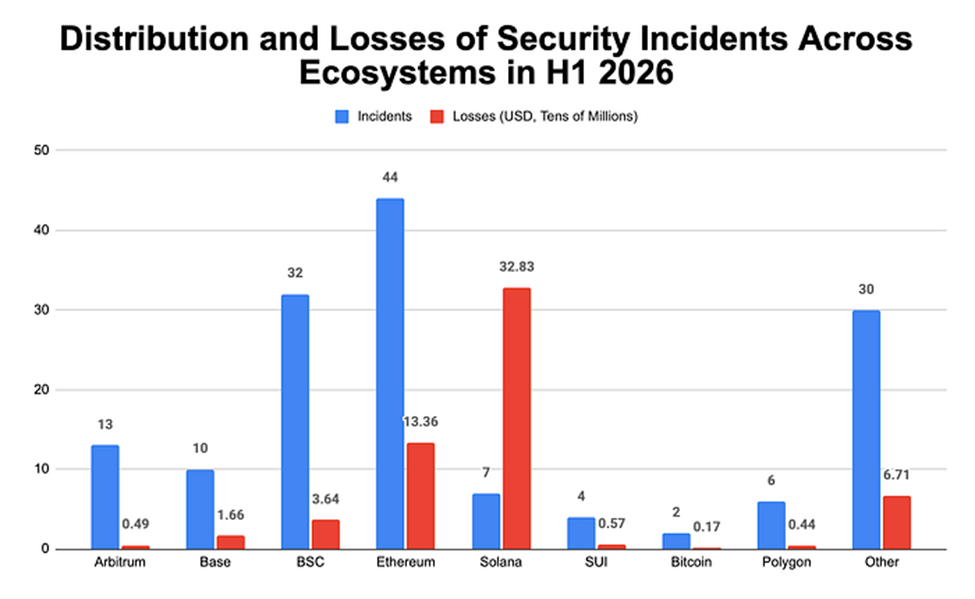
Crypto Losses From Blockchain Vulnerabilities | Source: Slowmist
The SlowMist numbers are well sourced: 182 incidents and about $956 million in losses in H1 2026, versus 121 incidents and $2.373 billion in H1 2025.
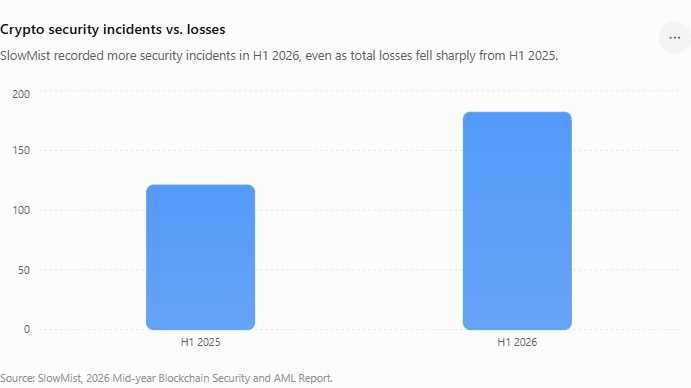
Crypto security incidents rose while losses fell | Source: Slowmist
SlowMist recorded more security incidents in H1 2026, even as total losses fell sharply from H1 2025. The other half of the story is the loss concentration: $2.373 billion in H1 2025 fell to roughly $956 million in H1 2026, despite incidents increasing by about 50%.
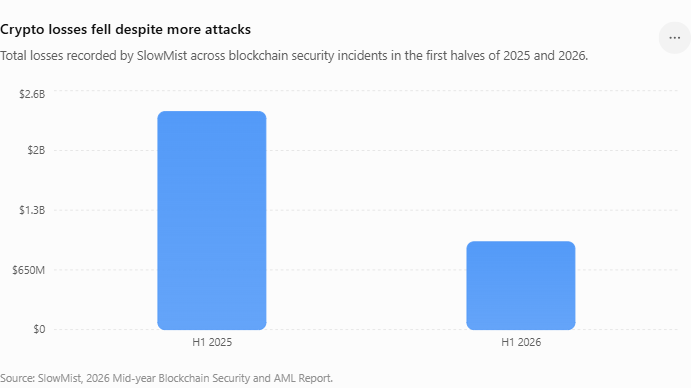
Total losses recorded by SlowMist across blockchain security incidents in the first halves of 2025 and 2026.
182 security incidents cost the crypto industry about $956 million in the first half of 2026, according to SlowMist. The incident count rose from 121 a year earlier, even as losses fell sharply. The industry’s next question is whether giving defenders frontier AI can push that trend further — reducing the severity of attacks even as AI makes attacks faster and more numerous. Aside from that chilling note, here’s a predictive thought:
“Sometimes old things need to burn so new things can grow on healthy soil” – Calle
If you're reading this, you’re already ahead. Stay there with our newsletter.