Strategy sold bitcoin during the first two weeks of August to cover a shareholder obligation, the first time it has done so since it began buying bitcoin in 2020. It sold 1,690 bitcoin for $1
Strategy sold bitcoin during the first two weeks of August to cover a shareholder obligation, the first time it has done so since it began buying bitcoin in 2020. It sold 1,690 bitcoin for $108.6 million, at an average price of $64,262 a coin, and used the proceeds to buy back 1.15 million shares of its STRC preferred stock. It was the fourth straight week Strategy had been a net seller.
The sale trimmed Strategy’s holdings to 840,447 bitcoin, bought over the years for $63.36 billion at an average price of $75,385 a coin. That position now carries an unrealized loss of roughly $8.7 billion at current prices. The company also raised $653 million from selling new common stock and used most of it to lift its cash reserve to $4.65 billion as of August 9.
Strategy was not the only bitcoin, ether or Solana treasury company explaining an unusual move in the same two-week stretch.
Six other names, six different problems
Seven treasury companies, seven different problems, August 2026 CompanyRecent actionStated reasonHoldings nowMSCI deletion candidate?StrategySold 1,690 BTC ($108.6M)Fund STRC preferred stock buyback840,447 BTCYesRiot PlatformsSold 9,665 BTC in H1 ($732.5M)Fund AI data-center buildout11,380 BTCNoMetaplanetDenied sale after 5,014 BTC transferRoutine custody move; launched new BitBonds debt program43,000 BTCYesFG NexusSold entire ETH treasury (~$61M)Exiting crypto to buy manufactured housing0 ETHNoDeFi Development CorpShut down Treasury Accelerator$27.3M Q2 net loss on digital assets2.31M SOLNoBit DigitalPledged 49,000 LsETH (74%) as loan collateral$50M loan from Galaxy Digital~66,192 LsETH convertedNoGameSquare$12.1M notes vs. $2.1M cash on handETH-backed debt leaves little free cash14,840 ETH ($23.3M)No
Riot Platforms sold bitcoin to fund its shift from mining into AI computing. It sold 9,665 bitcoin in the first half of 2026 for $732.5 million, including 3,778 bitcoin in the first quarter alone, leaving 11,380 bitcoin on hand at the end of June. Roughly half of that remaining position sits pledged as collateral. The company says the proceeds are going toward a data-center buildout that includes a 191-megawatt lease it expects to generate about $9.1 billion in rent over 20 years.
Metaplanet spent August 12 denying that it had sold anything. A transfer of 5,014 bitcoin, worth about $322 million at the time, moved between two of the company’s own custodial wallets and touched off online speculation that it had been sold. Chief executive Simon Gerovich said on the record that no bitcoin was sold and that holdings remained at 43,000 bitcoin.
“No bitcoin was sold, and our holdings remain 43,000 BTC.”
Simon Gerovich, CEO of Metaplanet, on the 5,014 BTC wallet transfer that briefly looked like a sale
The same week, Metaplanet launched BitBonds, a fixed-rate debt program meant to let it raise cash without selling bitcoin or issuing new shares. That is a new fixed obligation the company will have to service no matter where the bitcoin price goes.
FG Nexus went further than either of them and left the business entirely. It sold its full ether treasury before June 30, raising an estimated $61 million. One detailed reading of the filing put total staking income over the life of the program at only about $144,000, a figure not broken out in the company’s own summary release. The company’s 10-Q shows a $41.2 million loss tied specifically to the ether exit and a consolidated net loss of $56.9 million for the first half of the year. FG Nexus is now putting the proceeds into manufactured housing, better known as mobile home parks.
DeFi Development Corp, a Solana treasury company, is shutting down the Treasury Accelerator program it used to fund other Solana-linked ventures. It posted a $27.3 million net loss for the second quarter, driven by a $21.5 million loss on its digital assets that reversed a $21.2 million gain a year earlier. The company still holds 2.31 million SOL and bought back some of its convertible debt at a discount of roughly 35 percent to face value.
Bit Digital converted 73,235 ether into 66,192 units of liquid-staked ether during the quarter and pledged 49,000 of those units, worth $105.6 million, as collateral for a loan from Galaxy Digital. That is about 74 percent of the converted position. The loan’s initial $50 million draw carries 5.45 percent interest, and one review of the loan terms, a detail not spelled out in the company’s own 8-K, found the company has 24 hours to post more collateral after an ordinary margin call. Bit Digital kept the remaining 17,192 units, worth $27.6 million, as a buffer, and separately booked a $46 million non-cash impairment on the position, which the company says is not a realized loss.
GameSquare’s own filing shows the gap between a headline treasury and usable cash. It held 14,840 ether worth about $23.3 million as of June 30, against $12.1 million in ether-backed promissory notes, for coverage of about 147 percent. The loan terms let lenders demand more collateral if coverage falls below 130 percent and seize pledged ether after a 24-hour cure period if it falls below 120 percent. Cash on hand was $2.1 million.
MSCI’s clock started in January and never stopped
On January 6, 2026, MSCI said it would not remove bitcoin and ether treasury companies from its stock indexes, reversing a narrower proposal that had circulated months earlier. It did not close the matter. MSCI froze index mechanics for the treasury companies it already included and said it would open a broader consultation on what it called non-operating companies, a category wide enough to cover any firm that holds assets rather than runs a business.
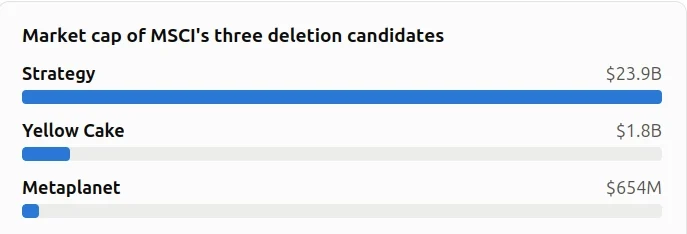
Market cap of MSCI’s three deletion candidates
That consultation arrived on August 3, 2026. MSCI’s document sets out a two-step test. A company first needs at least half its assets tied to actual operations to clear an initial screen. Companies that fail get checked against five financial ratios, and tripping four of the five puts them up for removal, unless they are already index members, in which case the bar is more forgiving and requires two straight years of failing before deletion. Running that test flags three companies for removal from MSCI’s Global Investable Market Indexes: Strategy, at a $23.9 billion market capitalization, Yellow Cake, a uranium holding company worth $1.8 billion, and Metaplanet, worth $654 million by market cap, a figure distinct from the roughly $3 billion in bitcoin it holds directly. Three more companies, SharpLink, Center Laboratories and Lydia Holding, sit on a watchlist. The consultation closes at the end of September, MSCI plans to publish results by October 16, and any changes would take effect at the November index review.
Two names overlap. Five don’t.
Strategy and Metaplanet are the only two companies from this list of seven that MSCI has actually proposed removing. Riot, FG Nexus, DeFi Development, Bit Digital and GameSquare do not appear anywhere in MSCI’s proposal. Yellow Cake has no connection to bitcoin or ether treasuries at all; it holds physical uranium.
Neither Strategy nor Metaplanet has linked its recent move to index risk. Strategy’s own filing attributes its sale to funding preferred dividends. Metaplanet’s chief executive attributed the wallet transfer to routine custody, not to anything related to MSCI. MSCI’s screen looks at asset composition and cash flow, not at why a company sold anything in a given week. Two separate pressures are running on their own tracks, and they intersect at two of the seven names in this story, not all seven.
The number everyone’s citing is contested
JPMorgan has put a figure on what MSCI’s move could cost. The bank estimated that removing Strategy alone could force $1.8 billion to $2.8 billion in passive selling from MSCI-tracking funds, and that a combined move by MSCI, FTSE Russell and S&P Dow Jones could push the total as high as $8.8 billion. The estimate drew public calls online to boycott JPMorgan, with some users accusing the bank of front-running the market with its own research. No evidence has surfaced that JPMorgan holds a financial stake in the outcome. The accusation concerns timing and influence, not a disclosed conflict.
MSCI has backed off this exact fight once already. The January reversal followed months of pressure, and nothing in the current proposal guarantees the November review ends any differently for Strategy or Metaplanet this time.
What November actually decides
The next fixed point is October 16, when MSCI is due to publish the results of this consultation ahead of the November index review. Strategy and Metaplanet are the two names in this story with a specific date attached to their risk. The other five are working through their own financing pressure on their own timelines, with no index deadline forcing the issue either way.