Key Takeaways Bitcoin mining difficulty fell 10.09%, from 138.96T to 124.93T, at block 953,568. The drop is Bitcoin’s 11th-largest downward adjustment and the second-largest of 2026. A roughl
Key Takeaways
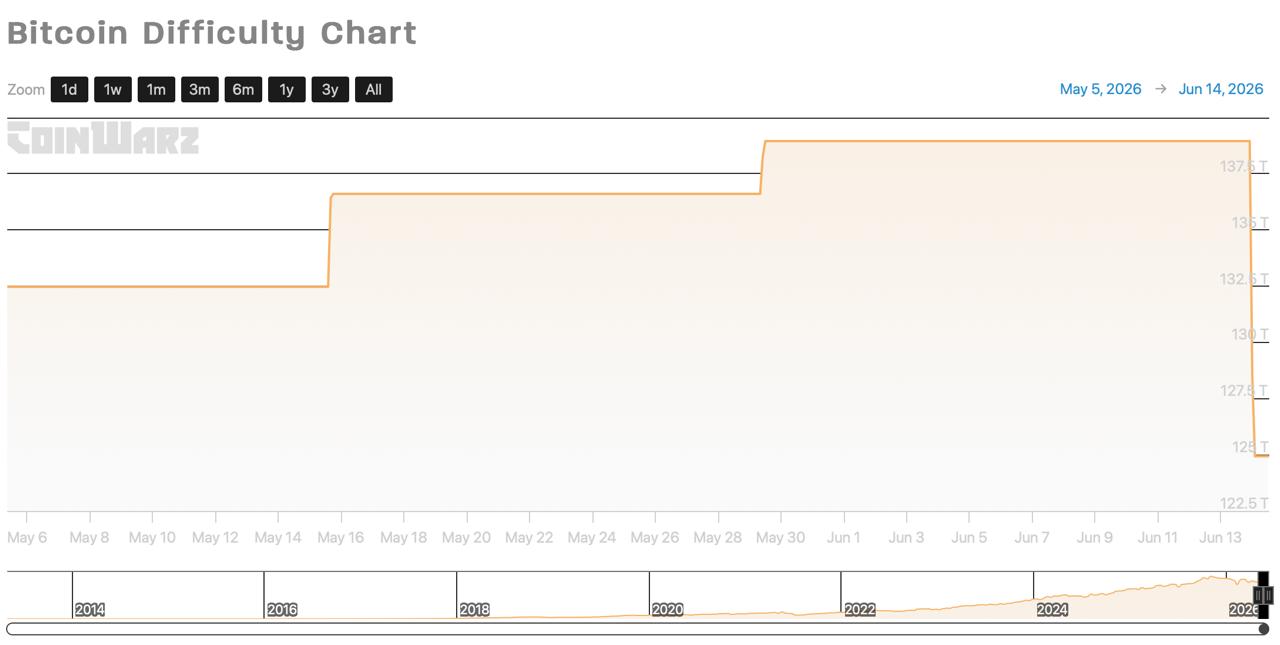
- Bitcoin mining difficulty fell 10.09%, from 138.96T to 124.93T, at block 953,568.
- The drop is Bitcoin’s 11th-largest downward adjustment and the second-largest of 2026.
- A roughly 15% June price decline pushed miners offline, stretching the epoch to 15.6 days.
- Active miners now earn over 9% more BTC per unit of hashrate, lifting hashprice toward $30.
Bitcoin’s mining network has delivered one of its sharpest corrections of the year. The latest difficulty adjustment cut the metric by 10.09%, from 138.96 trillion to 124.93 trillion at block height 953,568, according to CoinWarz data. The move ranks as the 11th-largest downward adjustment in Bitcoin’s history and the second-largest of 2026, a direct consequence of the price weakness that squeezed miners through June.
What a Difficulty Adjustment Actually Is
Bitcoin automatically recalibrates how hard it is to mine a block every 2,016 blocks, roughly every two weeks, targeting an average of one block every ten minutes. When miners switch off and blocks take longer to produce, the network lowers difficulty to compensate; when hashrate piles back in, difficulty rises. It is a self-correcting feedback loop that keeps block times stable without any central coordinator, and a large downward move like this one is the protocol’s response to miners leaving the network.
This adjustment confirmed exactly that. The epoch ran 15.6 days, well beyond the 14-day target, a direct signal that hashrate had bled off the network and blocks were taking longer than intended.
Why Miners Went Offline
The trigger was price. Bitcoin fell roughly 15% in June, briefly dropping below $60,000 before rebounding toward $64,000, which compressed mining margins sharply. According to Galaxy Research, that decline pushed some hashrate offline as operations running older hardware or paying higher electricity rates slipped below breakeven.
The selloff also dragged hashprice, a measure of daily mining revenue per unit of hashrate, below the $30 per petahash mark that sits near gross breakeven for many operators. As TheEnergyMag noted, that threshold matters because it pushes more sites toward or below breakeven once corporate overhead, debt service, and expansion costs are counted; the most efficient fleets can stay profitable below it, while older machines and higher-cost operators are the first to power down.
There is a second, structural driver beyond price. A growing list of publicly listed mining firms has been redirecting energy and computing capacity toward high-performance computing and AI data center operations, which carry steadier revenue than Bitcoin mining at current prices. That reallocation removes hashrate from the network independently of short-term profitability, and it has become a recurring theme across 2026’s difficulty declines.
What the Adjustment Means for Miners
The drop is a direct reprieve for operators who stayed online. A roughly 10% difficulty reduction lifts the amount of Bitcoin earned per unit of active hashrate by a comparable margin, with the increase exceeding 9%. That improvement can push hashprice back toward and above the $30 per petahash threshold, easing the margin pressure that forced the shutdowns in the first place. In effect, the miners who endured the squeeze now capture a larger share of block rewards from the capacity that left.
Worth noting, the final 10.09% cut came in deeper than the roughly 9.55% that had been estimated in the hours before the adjustment, reflecting just how much hashrate had come offline by the time the network retargeted.
The Pattern of 2026
This is the third significant difficulty decrease of the year, and the second to rank among Bitcoin’s all-time largest. Difficulty fell 11.16% on February 7, a drop driven by price weakness compounded by winter-storm disruptions to mining infrastructure, followed by a 7.76% reduction in March. The current 10.09% cut sits between them in magnitude and joins February in the network’s 11 largest downward adjustments ever recorded.
Galaxy Research framed the move as the textbook pressure mechanism that plays out when prices fall: a lower price reduces miner revenue, marginal hashrate exits, and difficulty adjusts down to restore equilibrium for the operators that remain. It is the network functioning as designed, with the difficulty drop acting as the automatic stabilizer that keeps mining viable through a downturn.
READ MORE:
 Two Wall Street Banks Mark $60K as Bitcoin’s Floor Zone
The next adjustment, estimated for around July 11, will show whether hashrate returns. If Bitcoin’s price stabilizes and the offline capacity powers back on, difficulty would climb again at that point; if miners stay off or continue shifting toward AI workloads, a further downward move is possible. For now, the network has reset to a level that gives surviving miners breathing room, and the direction of the next epoch depends largely on whether price recovers enough to bring the idled hashrate back.
This article is for informational purposes only and does not constitute financial advice. Consult a professional before making investment decisions.The post Bitcoin Threw Surviving Miners a Lifeline at Block 953,568 appeared first on Coindoo.