Bitcoin’s biggest holders appear to be doing something many traders associate with the calendar’s “risk-off” period: instead of steadily cutting exposure into year-end, they’ve been adding. D
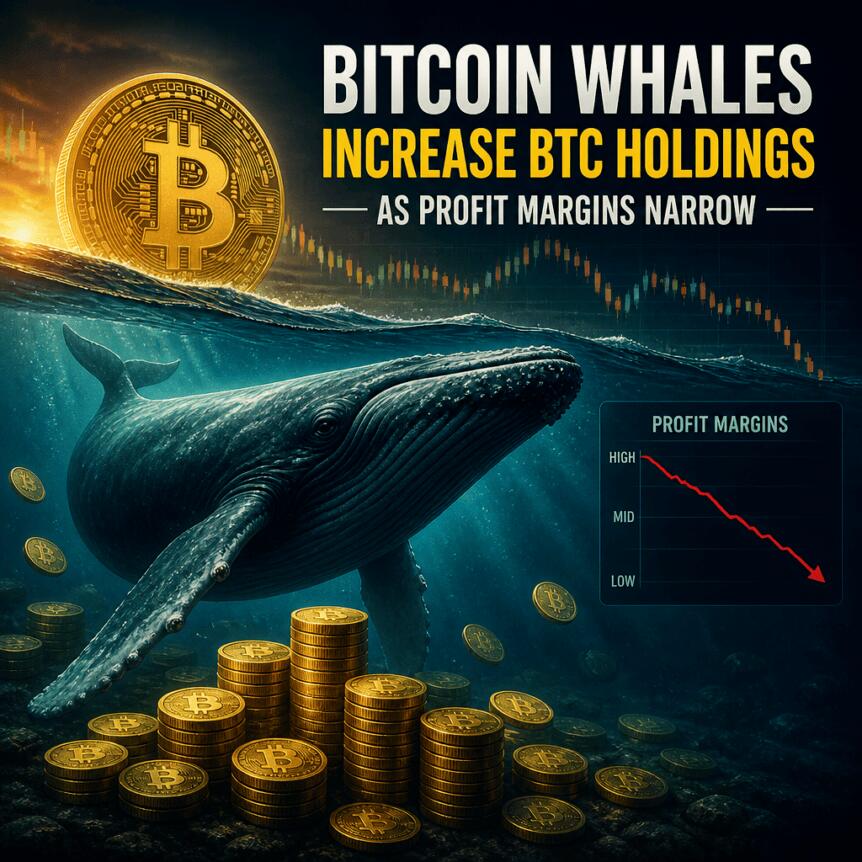
Bitcoin’s biggest holders appear to be doing something many traders associate with the calendar’s “risk-off” period: instead of steadily cutting exposure into year-end, they’ve been adding. Data from onchain analytics firm CryptoQuant shows whales increased their collective BTC holdings while Bitcoin’s market value slid sharply over the same window.
CryptoQuant reports that addresses holding between 1,000 and 10,000 BTC added roughly 121,000 Bitcoin from Sept. 30 to Nov. 21. That lift brings the group’s combined balance to nearly 2.95 million BTC, even as Bitcoin fell by about 30% during the period. At the same time, unrealized profits across addresses holding at least 1,000 BTC dropped dramatically—down 81% to $23.8 billion from $124.7 billion on Sept. 30.
Key takeaways
- Whales (1,000–10,000 BTC) accumulated about 121,000 BTC between Sept. 30 and Nov. 21, pushing their total near 2.95 million BTC.
- Unrealized profit among whales fell 81% to $23.8 billion, despite the continued buying.
- Earlier year-end behavior often shows whale balance declines—CryptoQuant notes this has happened in 7 of the last 9 fourth quarters since 2017.
- Dolphins (100–1,000 BTC) trimmed holdings slightly, shedding about 15,169 BTC (0.28% of their balances).
- Bitcoin-backed borrowing may be replacing outright selling, according to patterns CryptoQuant linked to CoinRabbit loan data.
Year-end accumulation despite shrinking paper gains
CryptoQuant’s whale definition—addresses holding 1,000 to 10,000 BTC—helps frame why the behavior stands out. The period examined aligns with a time when large holders typically become more defensive. In the research, CryptoQuant argues that whales have historically reduced their balances toward the end of the year in both bull and bear markets.
Specifically, the firm’s report—supported by crypto lending platform CoinRabbit—states that since 2017, whale balances declined in seven of the nine previous fourth quarters, with only 2019 and 2020 not fitting that pattern. The current quarter breaks that trend, with whales adding rather than trimming while BTC’s price declines erode unrealized gains.
Not all large holders behaved the same way. CryptoQuant also tracks “dolphins,” a cohort defined as addresses holding between 100 and 1,000 BTC. That group slightly reduced its exposure, dropping about 15,169 BTC, equivalent to 0.28% of its holdings—small compared with whale activity during the same interval.
Loan activity points to liquidity without selling
The report’s next layer focuses on the mechanics behind why whales might buy (or at least avoid selling) when unrealized profits are compressing. CryptoQuant suggests that borrowing against Bitcoin holdings could be providing liquidity while limiting the need to liquidate BTC outright.
In this view, the “accumulation while prices fall” dynamic becomes less contradictory: whales can access cash through loans, keep their BTC exposure intact, and possibly even add more, rather than converting BTC to fiat. The research ties this possibility to CoinRabbit usage data.
According to CryptoQuant, among CoinRabbit users with more than $100,000 in loans, the number of Bitcoin-backed loans rose 298.9% month-on-month in October. However, total loan volume fell by 16.2% over the same comparison. CryptoQuant interprets the mismatch as evidence that whales and other large participants may be taking out more frequent loans that are comparatively smaller—consistent with borrowing for cash needs rather than selling Bitcoin.
The pattern contrasts with October 2025. CryptoQuant reports that during that earlier period, the number of Bitcoin-backed loans fell by 3.7%, while total loan volume increased by 122.8%. In other words, the two years show different “loan mix” behavior: either larger loan sizes with fewer new loans, or more new loans with smaller sizes.
Tax reporting pressure could be changing incentives
CryptoQuant’s findings also intersect with broader policy shifts. Crypto tax firm Summ suggested that changes in reporting requirements—particularly the Crypto-Asset Reporting Framework (CARF)—could influence how investors manage taxable events.
Summ’s point, as presented in the research write-up, is that CARF begins requiring participating jurisdictions to collect transaction data from crypto exchanges and other service providers starting in January. The firm noted that the first international exchanges of tax-related information are expected in 2027.
In that context, Summ CEO Shane Brunette characterized holding BTC and borrowing against it as a rational response “to a world where every sale is visible.” The underlying idea is straightforward: if sales are more readily identifiable and reportable, borrowing against existing holdings may become relatively more attractive than converting BTC into fiat.
While that explanation does not automatically prove causation, it helps frame why the observed loan behavior could matter to investors. For large holders, loan-based liquidity can potentially reduce the frequency of realized selling—an important distinction when investors are navigating both price volatility and changing compliance environments.
What investors should watch next
The main question now is whether this whale accumulation persists as Bitcoin’s price trajectory continues and as more market participants respond to financing and reporting incentives. Readers should watch whether whale balances keep rising, whether whale unrealized profit keeps compressing, and whether borrowing trends on Bitcoin-backed lending platforms remain consistent—especially the balance between growing loan counts and changing total loan volume.
This article was originally published as Bitcoin Whales Increase BTC Holdings as Profit Margins Narrow on Crypto Breaking News – your trusted source for crypto news, Bitcoin news, and blockchain updates.