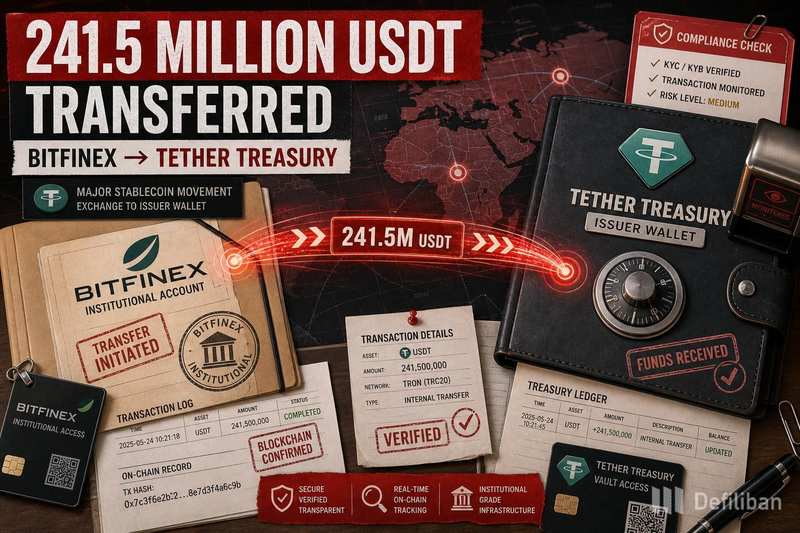
Bitfinex has transferred 241.5 million USDT to the Tether Treasury, a large stablecoin movement that has drawn attention from on-chain watchers and market participants tracking liquidity flow
Bitfinex has transferred 241.5 million USDT to the Tether Treasury, a large stablecoin movement that has drawn attention from on-chain watchers and market participants tracking liquidity flows across major crypto infrastructure.
What the Bitfinex-to-Tether Treasury transfer involved
The transaction moved 241.5 million USDT from Bitfinex, one of the longest-running cryptocurrency exchanges, to the Tether Treasury wallet. USDT is the most widely used stablecoin in crypto markets, pegged one-to-one to the U.S. dollar.
Treasury transfers of this size are routinely flagged by blockchain monitoring services. When USDT moves from an exchange back to the issuer's treasury, it can indicate token redemptions, internal rebalancing, or preparation for burns.
Bitfinex and Tether share common ownership under iFinex Inc., which means transfers between the two entities represent intra-company movements rather than arm's-length transactions. This corporate relationship is important context for interpreting the flow.
Why large USDT movements are tracked
Traders and analysts monitor large stablecoin transfers because they can signal shifts in exchange liquidity. A substantial outflow of USDT from an exchange to a treasury wallet may reflect reduced trading demand or planned supply adjustments on the issuer's side.
However, the size of a transfer alone does not confirm immediate buying or selling pressure in the broader market. On-chain movement between affiliated entities, particularly between Bitfinex and Tether, does not necessarily translate into directional market activity. Observers in the crypto space have previously seen similar treasury-level USDT flows across both Ethereum and Tron networks without corresponding price disruptions.
This distinction matters in a market where large transfers are sometimes misinterpreted as whale trades. In cases involving stablecoin issuers and their affiliated exchanges, the movement often reflects operational treasury management rather than speculative positioning.
What to watch next
Market participants will be watching for follow-up signals. If the transferred USDT is subsequently burned, reducing total supply, it would suggest a genuine redemption. If it remains in the treasury and is later redeployed, it may indicate liquidity repositioning.
Official statements from Bitfinex or Tether would add clarity, though neither entity has historically provided real-time commentary on routine treasury operations. Exchange balance data over the coming days will offer a more reliable indicator of whether this movement reflects a meaningful shift in USDT circulation.
The transfer also arrives during a period of heightened regulatory scrutiny around stablecoins globally. In the EU, authorities have been exploring broader frameworks around crypto-related financial flows, including efforts such as unified crypto tax proposals targeting digital asset activity.
KEY TAKEAWAYS
- Bitfinex transferred 241.5 million USDT to the Tether Treasury, a notable intra-company stablecoin movement.
- The transfer does not confirm market-directional intent; it may reflect redemptions, rebalancing, or routine treasury management.
- Follow-up indicators to watch include whether the USDT is burned, redeployed, or accompanied by official statements from either entity.
Disclaimer: This article is for informational purposes only and does not constitute financial or investment advice. Cryptocurrency and digital asset markets carry significant risk. Always do your own research before making decisions.
Read original article on defiliban.io