Bitget is restarting withdrawals on a per-asset basis rather than as a single platform-wide event, the exchange has stated, with Bitcoin withdrawals already open and Ether withdrawals schedul
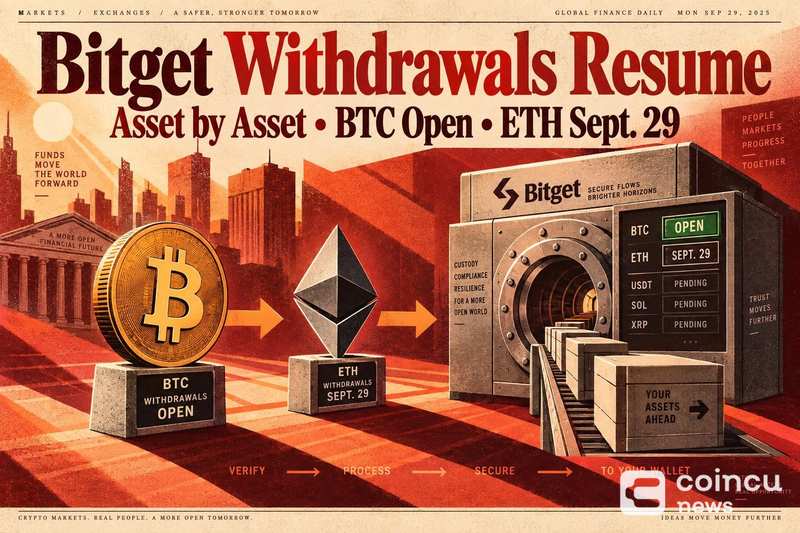
Bitget is restarting withdrawals on a per-asset basis rather than as a single platform-wide event, the exchange has stated, with Bitcoin withdrawals already open and Ether withdrawals scheduled for September 29, while the status of USDT transfers remains only partially disclosed in the exchange's latest update.
Bitget Says BTC Withdrawals Are Open
What Bitget Has Confirmed About BTC Withdrawals
According to Bitget, Bitcoin withdrawals are currently available, making BTC the first major asset to come back online in what the exchange describes as a sequential, asset-by-asset restart. Bitcoin is the largest cryptocurrency by market capitalization, per CoinGecko, which makes its restoration the highest-visibility signal of the exchange's progress. The framing matters: an asset-by-asset rollout means BTC's availability does not signal that other tokens have resumed, and users should verify each asset individually before initiating a transfer.
The approach mirrors how exchanges typically manage infrastructure-level disruptions, isolating recovery to individual assets rather than toggling all networks simultaneously, which reduces the risk of cascading failures during restoration. Earlier this year, Bitget disclosed that a third-party vulnerability caused what the CEO described as the first security incident in eight years, providing context for why the exchange may be proceeding cautiously with withdrawal restoration.
ETH Withdrawals Scheduled for September 29
BTC's Current Status Versus ETH's Scheduled Restart
Bitget has designated September 29 as the target date for Ether withdrawal resumption, according to the exchange's own update. "Scheduled" is a conditional status, not a confirmed open; whether ETH withdrawals actually resumed on that date should be verified directly in Bitget's withdrawal interface or official notices rather than assumed from the announced timeline.
The staggered gap between BTC and ETH availability reflects the operational complexity of restarting distinct blockchain networks, each with its own node infrastructure and confirmation requirements. The prior incident that prompted the review involved significant ETH exposure: attackers had swapped roughly $351.6 million in stolen ETH for BTC via THORChain, which may inform why the ETH network restart is being handled with particular deliberateness. Users awaiting ETH transfers should confirm current status against Bitget's live announcement channel, as schedules can shift without a revised public notice.
USDT Status and What Users Should Verify
Why an Asset-by-Asset Restart Matters for USDT Transfers
The exchange's update references USDT but the available headline text truncates at "fo...", leaving the USDT timetable or network-specific status incomplete. No confirmed restart date or network (TRON, Ethereum, BNB Chain, or others) for USDT withdrawals can be reported based on the current disclosure.
USDT is issued across multiple chains, which complicates a staged restart further: a Bitget announcement covering USDT may apply only to one network while others remain paused. The broader financial stakes of the incident were outlined in earlier coverage of what Bitget's $352 million loss means for DeFi users, which remains relevant context for USDT holders assessing counterparty risk. Users planning USDT transfers should check the specific network status in Bitget's withdrawal interface before submitting, given that network-level availability can differ even when the token itself is listed as available.
What an Asset-by-Asset Withdrawal Restart Means
Checks to Make Before Submitting a Withdrawal
A staged restart creates a period during which different assets carry different operational statuses simultaneously. An exchange user who sees BTC withdrawals confirmed open should not infer that ETH, USDT, or any other asset is also live; each must be independently verified against the exchange's current status page or official announcement.
Beyond asset-level status, network-specific conditions apply: a token like USDT that operates on multiple chains may be open on one network and suspended on another within the same restart window. Before submitting any withdrawal, users should confirm both the asset and the specific network are listed as active, check for any minimum confirmation or processing time notices Bitget may have attached to restored assets, and avoid queuing large transfers immediately after a restart until normal processing cadence is confirmed. For reference on how peer exchanges have navigated similar events, coverage of Binance's temporary withdrawal suspension amid an AWS outage illustrates operational precedents in this category.
FAQ About Bitget's Withdrawal Restart
Are BTC Withdrawals Open on Bitget?
According to Bitget, yes, BTC withdrawals are currently open as part of the asset-by-asset restart the exchange has announced. Users should verify this status directly on Bitget's platform, as conditions may change without an updated public announcement. Bitcoin's liquidity profile, tracked on CoinMarketCap, makes it the most actively transacted asset affected by this restart sequence.
When Are ETH Withdrawals Scheduled to Resume?
Bitget has stated that ETH withdrawals are scheduled for September 29. As of the current update, this is a scheduled date, not a confirmed reopening; whether the timeline held should be confirmed via Bitget's withdrawal interface or official notices rather than treated as settled.
Is USDT Withdrawal Status Confirmed in This Update?
No. The available Bitget update references USDT but the disclosed information is incomplete, with the relevant detail truncated. No confirmed date, network, or availability status for USDT withdrawals can be reported from this disclosure; users should check Bitget's official channels directly for a complete USDT status. For context on Bitget's recent product trajectory alongside this operational disruption, see coverage of Bitget adding 470 stock rTokens.
Disclaimer: This article is for informational purposes only and does not constitute financial or investment advice. Cryptocurrency and digital asset markets carry significant risk. Always do your own research before making decisions.
The post Bitget Withdrawals Resume Asset by Asset: BTC Open, ETH Sept. 29 was initially published on Coincu.