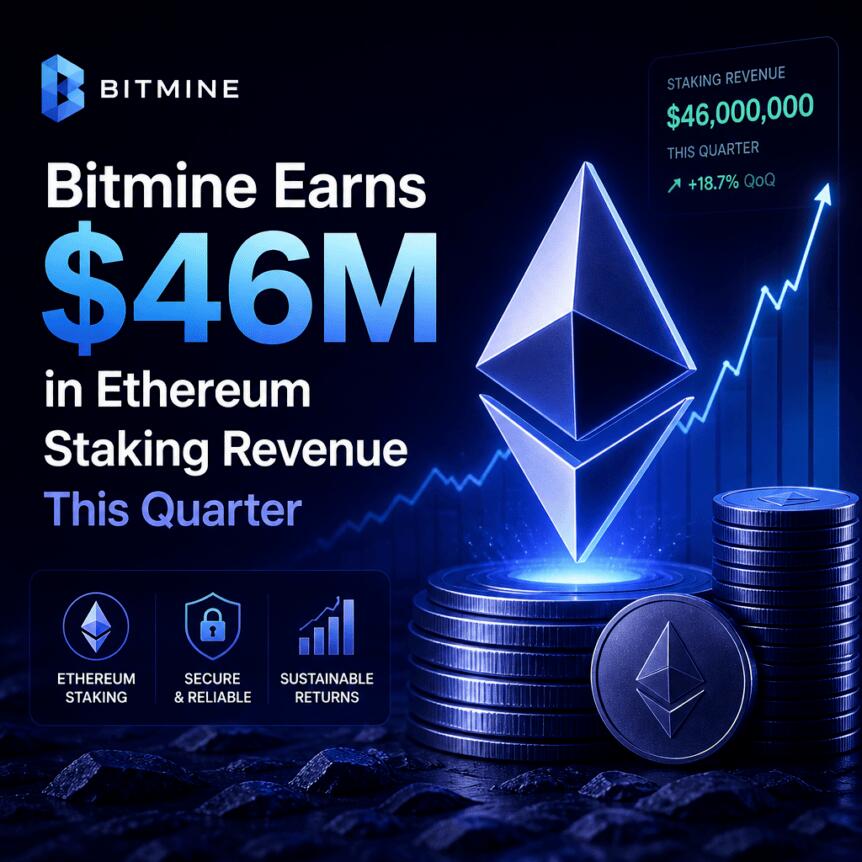
Bitmine Immersion Technologies says its Ethereum staking operation is now the dominant driver of its business, with $45.7 million in revenue generated from Ether staking and validation in the
Bitmine Immersion Technologies says its Ethereum staking operation is now the dominant driver of its business, with $45.7 million in revenue generated from Ether staking and validation in the most recent quarter. The figure underscores how the company’s earlier focus has shifted toward institutional-grade Ethereum participation, following the launch of its staking platform in March.
In its latest 10-Q filing, Bitmine reports that staking revenue represented 98% of total revenue for the three months ended May 31. By comparison, it recorded $624,000 from self-mining Bitcoin (BTC) and $168,000 from consulting services during the same period.
Key takeaways
- Bitmine recorded $45.7 million in quarterly revenue tied to Ether staking and validation, making staking its overwhelming revenue source.
- Staking contributed 98% of Bitmine’s total revenue for the three months ended May 31, far ahead of BTC self-mining and consulting.
- Bitmine said it has staked 85% of its Ether holdings—about 4.9 million ETH—after its March institutional staking platform launch.
- The company’s staking strategy is linked to MAVAN, an institutional validator infrastructure offering that expanded beyond Bitmine’s own treasury.
Quarterly results highlight the staking-driven shift
The latest numbers show a stark transformation in Bitmine’s revenue profile. According to the company’s filing, Ether staking and validation drove $45.7 million during the three months ended May 31. In the same quarter, non-staking lines—BTC self-mining and consulting—remained comparatively small, at $624,000 and $168,000 respectively.
Bitmine also frames this as evidence that its strategy pivot is working at scale. The results follow a year earlier when the company reported just $2 million in total revenue for the quarter ended May 31, 2025, and the largest contributor at that time was machine leasing.
For investors and market participants, the key question is sustainability: staking revenues tend to depend on the size of assets actively deployed and the evolving economics of Ethereum network activity. While Bitmine’s filing provides a snapshot of recent performance, readers will likely look for how the company’s staked percentage and validator operations translate into future quarterly results.
Bitmine says 85% of its ETH is staked
Alongside the financial disclosure, Bitmine said on Monday that it has staked 85% of its ETH holdings. The company linked that figure to approximately 4.9 million ETH.
Bitmine’s announcement also pointed to the scale of its holdings, including an update that ETH holdings reached 5.77 million tokens and total crypto and cash holdings of $11.3 billion. (The company’s statement was carried in a release from PR Newswire.)
In the same context, Tom Lee, Bitmine’s chairman, said that at full deployment—when the company’s ETH is “fully staked by MAVAN and its staking partners”—projected annualized staking rewards would be $284 million. His remarks suggest the company sees significant upside if it continues to increase the portion of its Ether actively earning staking returns.
Still, investors should separate projections from realized results. The $45.7 million quarterly revenue already reflects current operations, while the $284 million annualized statement is conditional on full staking at scale. The next signal to watch is whether Bitmine maintains the staked level and how it evolves with network conditions and validator capacity.
MAVAN expands validator infrastructure beyond Bitmine’s treasury
Central to Bitmine’s staking push is MAVAN, an institutional-grade Ethereum staking platform. Bitmine’s financial performance is explicitly connected to the March launch of MAVAN, which the company describes as operating validator infrastructure for its own holdings and for external clients.
MAVAN—short for “Made in America VAlidator Network”—was developed initially to support Bitmine’s Ethereum treasury. Its mission later broadened after Bitmine acquired Australia-based non-custodial validator operator Pier Two Holdings. According to the reporting in earlier coverage from Cointelegraph, the platform’s reach expanded to support institutional investors, custodians, and partners across the ecosystem.
That expansion matters because validator infrastructure can generate recurring fee streams, but it also increases operational exposure—such as dependence on client demand, service performance, and the ability to manage validator operations reliably at scale. Bitmine’s latest quarter suggests its staking model is generating substantial revenue today, but the longer-term test will be whether MAVAN can keep attracting and retaining external staking and validation business.
Tom Lee also points to Robinhood Chain’s ETH-denominated activity
Outside Bitmine’s own staking results, Tom Lee discussed another development: Robinhood Chain, which he described as a “breakaway success.” In his remarks, Lee highlighted that dollar volumes exceeded $1 billion since Robinhood Chain’s July 1 launch, and he compared that activity to other decentralized exchanges.
He argued that the chain’s structure ties user behavior to Ethereum because Robinhood Chain uses ETH as the native gas token, with transaction fees denominated in ETH and finality settled on Ethereum. Lee also referenced Robinhood’s 27 million users paying crypto fees denominated in ETH, framing it as evidence that everyday users increasingly interact with ETH as money.
While this is not directly tied to Bitmine’s quarterly financials, it adds color to the broader narrative Lee is promoting: Ethereum’s role as a settlement layer and fee asset may drive more real-world usage. For readers, the practical takeaway is to consider how L2s and DEX ecosystems using ETH-denominated fees could affect sentiment around demand for staking and on-chain utility—though the causal link to staking revenue would still need to be demonstrated through future reporting.
As Bitmine heads into subsequent quarters, the most important items to monitor are whether its ETH staked percentage continues rising toward full deployment, how MAVAN performs with external clients, and whether staking revenue remains the clear majority of total earnings under changing network conditions.
This article was originally published as Bitmine Earns $46M in Ethereum Staking Revenue This Quarter on Crypto Breaking News – your trusted source for crypto news, Bitcoin news, and blockchain updates.