This article was first published on Deythere. BitMine Immersion Technologies is looking for investors to fund its next Ethereum accumulation, despite the company’s current Ethereum holdings b
This article was first published on Deythere.
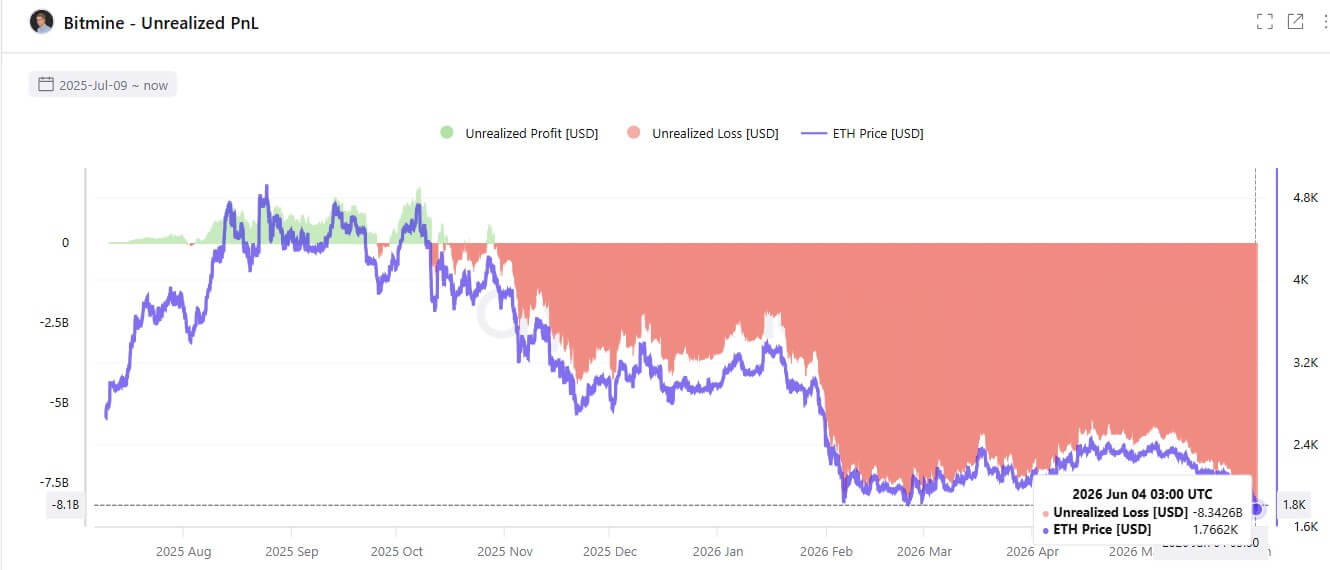
BitMine Immersion Technologies is looking for investors to fund its next Ethereum accumulation, despite the company’s current Ethereum holdings being worth almost $9 billion in unrealized losses.
The company, led by Fundstrat co-founder Thomas Lee, announced recently that it plans to issue 3 million shares of 9.50% Series A Perpetual Preferred Stock, potentially raising $300 million in the process.
These special shares, which will trade on the New York Stock Exchange under the ticker BMNP pending approval, come with a fixed annual dividend of 9.5% and are valued at $100 each.
BitMine Ethereum treasury position, which is currently worth about $8.9 billion less than its peak value, continues to plummet as ETH itself dips below $1800.
BitMine Ethereum Treasury Is Still Buying ETH
The preferred stock offering is not designed just to strengthen the balance sheet.
BitMine said they may use some of the proceeds raised to buy even more ETH, expand their staking infrastructure, cover working capital, invest in other Ethereum-focused projects or even use it to buy back their own shares. Moelis & Company and Cantor are teaming up as joint lead bookrunners to help get this going.
Bitmine recently reported having about 5.42 million ETH in holdings which represents around 4.49% of Ethereum’s total circulating supply and are now on the way to hitting their target, which they like to call the “Alchemy of 5%”.
Despite Ethereum’s recent downturn, BitMine is still adding to its holdings instead of reducing exposure.
 BitMine Ethereum Treasury
Why Ethereum Gives BitMine a Different Model
BitMine Ethereum treasury approach is a bit different from corporate Bitcoin treasury firms because BitMine generates income from staking.
According to the numbers, almost 4.72 million ETH from its treasury is currently staked through its validator operations and those staked assets generate protocol rewards while remaining on the balance sheet.
Bitcoin treasury firms are typically reliant on their assets appreciating in value to be able to justify capital raises. Ethereum treasury companies, however, can potentially generate revenue from staking rewards without having to sell off the asset.
BitMine previously stated that annualized staking revenue is running in the hundreds of millions of dollars. Although with the proposed offerings, the company would face approximately $28.5 million in annual dividend obligations if all shares are sold.
Theoretically, staking income should be able to cover those payments under normal market conditions.
However, as the company itself pointed out in a filing, staking revenue is not guaranteed and that staked ETH may not always be immediately available for liquidation during periods of market stress.
This financing method of Bitmine Ethereum treasury has some similarities with Michael Saylor’s Bitcoin-focused company, Strategy.
Both firms have turned to capital markets to raise funds for buying more cryptocurrency. Both have turned to preferred shares as a means to attract investors seeking yield without having to directly hold any digital assets. There are some important differences, however.
 BitMine Ethereum Treasury
Strategy’s STRC preferred shares try to keep their price stable around par value using a system of variable dividends. BitMine’s preferred shares on the other hand offer a fixed 9.5% coupon paid out weekly, when declared by the board.
If dividends are not paid, they accumulate and compound weekly. The penalty rate can gradually rise, reaching as high as 15% annually.
This puts pressure on BitMine Ethereum treasury to maintain sufficient cash flow regardless of Ethereum’s price performance.
Conclusion
BitMine’s ambitious financing effort is happening in the middle of one of the toughest times for Ethereum treasuries.
The value of BitMine Ethereum treasury is worth billions less today than it was when the majority of the accumulation occurred which has exposed the dangers of large-scale corporate crypto strategies.
Yet, the management of the company is unrelenting in its pursuit of building its treasury.
Supporters are of the opinion that Ethereum’s staking yield provides a built in revenue stream that isn’t available to Bitcoin treasuries.
However skeptics are saying that the fixed dividend obligations remain fixed even when markets are in decline.
Right now, BitMine is betting that Ethereum’s long-term value and staking economics will outweigh short-term market pain.
Glossary
BitMine Ethereum Treasury – BitMine’s strategy of holding large amounts of ETH on its corporate balance sheet.
Preferred Stock- A type of shares that usually pays out dividends and is ranked above common stock in terms of liquidation.
Staking – locking cryptocurrency to help secure a blockchain, in return for earning some rewards.
Perpetual Preferred Stock – preferred shares without an end date that keep paying dividends forever.
Unrealized Loss – A paper loss resulting from an asset’s decline in value that has not yet been sold.
Frequently Asked Questions About BitMine Ethereum Treasury
What is BitMine’s new preferred stock offering?
BitMine is planning to sell 3 million shares of 9.50% series A perpetual preferred stock which may raise around $300 million.
How much ETH does BitMine Ethereum treasury currently hold?
They own around 5.42 million ETH, which is roughly 4.49% of Ethereum’s circulating supply.
Why has BitMine Ethereum treasury chosen a 9.5% dividend rate?
They are using preferred shares to raise cash, and also to attract investors who are looking for a regular income stream through a fixed annual payout.
What kind of losses is BitMine Ethereum treasury sitting on?
Recent estimates put the company’s paper losses at $8.9 billion following the drop in Ethereum’s price.
What differentiates Ethereum treasury companies from Bitcoin ones?
Ethereum can earn yield on its holdings through staking rewards, so treasury companies don’t have to sell any of the asset to get a return.
References
CoinDesk
EQS
Nasdaq
TheBlock
Blockhead