The first U.S. spot exchange-traded product built around NEAR started trading on NYSE Arca on September 29. That alone is a milestone for an asset that has spent most of its market life far o
The first U.S. spot exchange-traded product built around NEAR started trading on NYSE Arca on September 29.
That alone is a milestone for an asset that has spent most of its market life far outside the institutional ETF conversation. But the more interesting feature is not the listing. It is what Bitwise intends to do with the NEAR after the fund buys it.
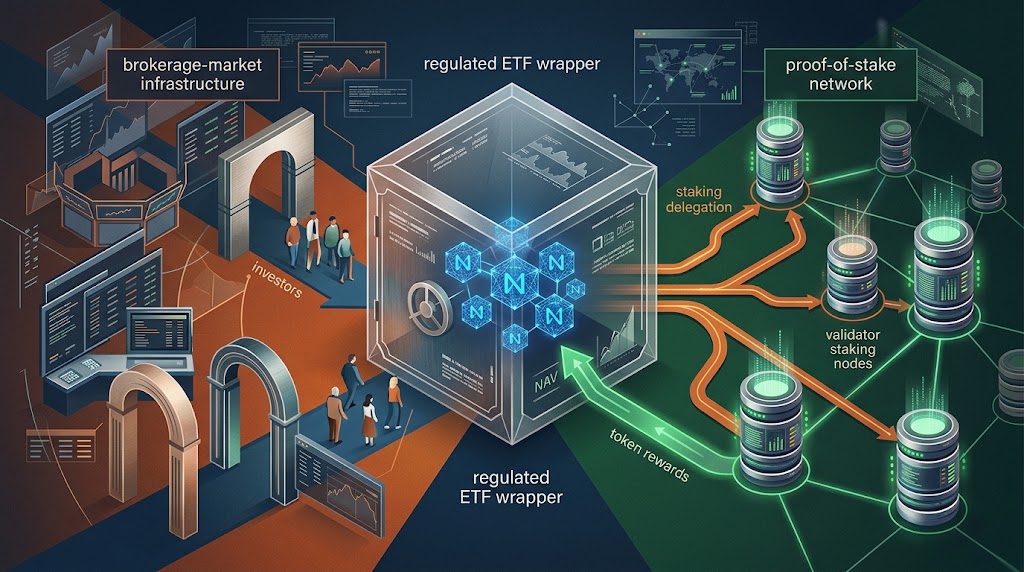
The Bitwise NEAR ETF, ticker NRR, has a primary objective of tracking the value of the NEAR it holds and a secondary objective of earning additional NEAR through staking. Bitwise says it intends to stake the fund's tokens in-house, with staking rewards accruing to shareholders through the fund's net asset value.
In other words, this is not simply a cold-storage wrapper around a proof-of-stake asset. The fund is designed to participate in the network while holding it.
NRR charges a 0.75% management fee. Bitwise says NEAR's average staking reward is around 5%, although realized rewards can move and are not guaranteed.
That creates a different economic structure from a passive spot product. If staking works as intended, the fund can accumulate additional NEAR before expenses rather than simply holding a fixed quantity per share and watching the token price move.
The important wording is 'accruing through NAV.' Investors are not being promised a cash dividend. The fund's staking activity changes the value of the assets backing the shares.
Optimisus has already covered why staking yield should never be read as free return. In Ethereum, record staking participation has compressed validator economics and triggered proposals to cut issuance further. The percentage printed in a product launch is therefore a starting condition, not a permanent coupon.
The ETF solves several practical problems for an investor who wants NEAR exposure through a brokerage account. There is no private key to manage, no validator to choose and no separate tax or operational workflow for claiming staking rewards.
The risks underneath do not disappear. The SEC registration statement describes staking as a secondary objective and discusses risks including validator performance, slashing, network changes, liquidity and the possibility that staking activity may not generate the expected return.
That distinction matters. A regulated wrapper can move operational responsibility from the investor to the sponsor, but it cannot rewrite the consensus rules of the asset inside the wrapper.
This is similar to the broader point Optimisus made in its explainer on how crypto ETF flows actually work: the familiar ETF interface can make access simpler without changing the machinery underneath.
Bitwise is positioning NEAR as infrastructure for an emerging AI-agent economy and describes NRR as exposure to the future of 'AI money.' That is a thesis, not a property of the ETF.
The fund holds NEAR. It does not own a diversified portfolio of AI companies, AI agents or revenue streams. The investment case ultimately depends on demand for the NEAR token and on whether activity on the network translates into durable economics for the asset.
That is worth separating from the product launch because crypto ETFs increasingly arrive with a narrative attached. Bitcoin products sold scarcity. Ether products sold programmable finance. Solana products emphasized throughput and staking. NEAR is being introduced to brokerage investors through AI.
The wrapper is real. The narrative still has to earn its evidence.
The original U.S. spot bitcoin ETFs were easy to understand structurally: the trust acquired bitcoin and held it. Proof-of-stake assets make the design question harder because an unstaked token leaves a native source of network rewards unused.
Managers can choose not to stake and keep the product operationally simpler. Or they can stake and accept additional protocol, validator and liquidity complexity in exchange for potential rewards.
NRR lands firmly in the second camp. That matters beyond NEAR because every successful staking ETF becomes another data point for how regulators, custodians, exchanges and asset managers can package productive crypto assets for public markets.
Optimisus recently showed how large that distinction can become on corporate balance sheets: BitMine's ETH position is notable not only because of its size, but because millions of ETH are being staked.
The first useful metrics are straightforward: assets under management, trading liquidity, how much of the fund's NEAR is actually staked, realized staking rewards after operating frictions, and how tightly shares track NAV.
After that comes the more important test. If NRR attracts meaningful assets, it will show that U.S. investors are willing to buy single-token exposure well beyond bitcoin, ether and the largest payments-focused assets through a regulated exchange product.
The milestone is not that NEAR suddenly became institutional because an ETF exists. It is that the ETF market is becoming granular enough to package a smaller proof-of-stake network and preserve one of the token's native economic functions inside the wrapper.
This is not financial advice.