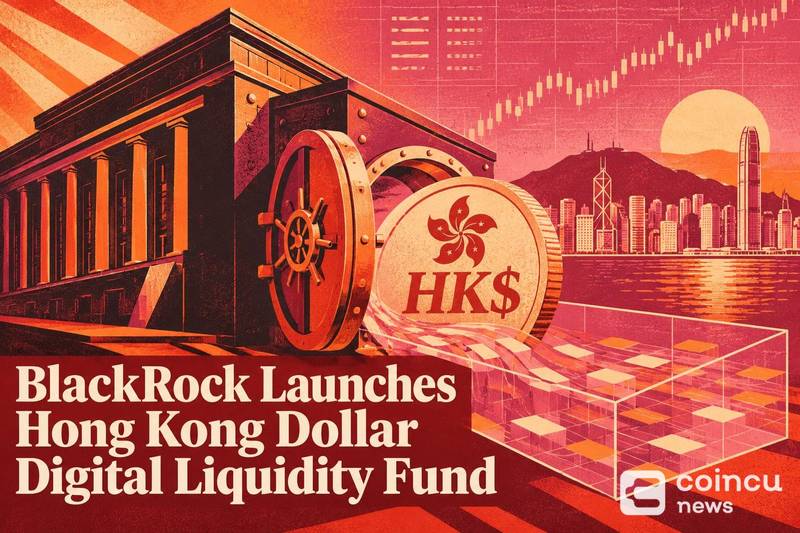
According to BlackRock, the BlackRock HKD Digital Liquidity Fund is the asset manager's first tokenized money market fund in Hong Kong and across Asia Pacific, while fund disclosures explicit
According to BlackRock, the BlackRock HKD Digital Liquidity Fund is the asset manager's first tokenized money market fund in Hong Kong and across Asia Pacific, while fund disclosures explicitly warn that investors bear sole responsibility for the security of their private keys, with neither the fund nor its transfer agent liable for lost or compromised credentials.
The fund also carries the distinction of being the first Hong Kong-domiciled Constant Net Asset Value (CNAV) money market fund available to both institutional and retail investors, according to BlackRock's official press release. For related coverage, see Hong Kong Licenses and Stablecoins: Who Is Reshaping Finance?.
Fund structure spans fiat rails and on-chain settlement
The BlackRock HKD Digital Liquidity Fund offers two participation tracks: Tokenized Units, which represent blockchain-based ownership records, and conventional Non-Tokenized Units for investors preferring traditional settlement, per the BlackRock press release. According to BlackRock, subscriptions and redemptions are accepted via fiat currency and digital cash, including stablecoins and tokenized deposits. Context on this theme: Hong Kong SFC Unveils Roadmap to Strengthen Virtual Asset Regulation.
Standard Chartered serves simultaneously as custodian, fund administrator, trustee, and tokenization provider, a concentration of roles that reflects the limited pool of institutions currently equipped to bridge traditional fund infrastructure with on-chain settlement in Hong Kong. Standard Chartered also acts as a bank distributor for HKDAP, the Hong Kong dollar-backed stablecoin issued by Anchorpoint Financial Limited, a Standard Chartered-led entity, according to Hubbis reporting on the launch. Hubbis described HKDAP as one of the first regulated on-chain HKD-backed stablecoins and reported that the BlackRock fund represents its first commercial application. More on this in Dollar at 19-Month High: Asia Session Roundup.
Smart-contract vulnerabilities named as explicit fund risk
BlackRock's product page for the fund, published at blackrock.com/hk, lists smart contract vulnerabilities among the material risks investors must accept. The disclosure is unusually direct for a product coming from one of the world's largest asset managers: code bugs, execution failures, or exploits in the smart contracts governing Tokenized Unit issuance and transfer could expose investors to losses that fall outside the conventional fund risk framework.
BlackRock's product page identifies smart contract vulnerabilities as a material risk for Tokenized Units. Hong Kong's growing stablecoin licensing landscape, detailed in coverage of Hong Kong's licensing and stablecoin regulatory environment, provides the broader legal context within which these disclosures operate.
Private-key responsibility placed entirely on investors
The fund's risk disclosures go further on the custody question, stating that investors bear sole responsibility for the security of their private keys, the cryptographic credentials that control access to Tokenized Units held on-chain. Neither the fund nor the transfer agent will assist investors in recovering lost, stolen, or compromised keys, per the BlackRock product page. This is a material departure from traditional fund investing, where loss of access to an account triggers a recoverable identity verification process rather than a permanent forfeiture.
The practical implication is that retail investors who opt for Tokenized Units are taking on a custody burden that institutional counterparties typically delegate to qualified custodians. An investor who loses their private key loses access to their Tokenized Units, with no recourse to the fund structure for recovery. This framing aligns the fund's Tokenized Unit terms closer to self-custody cryptocurrency norms than to conventional mutual fund or money market fund investor protections.
Dominic Maffei, CEO and Co-Founder of Anchorpoint Financial Limited, said BlackRock's decision to launch its first tokenized fund in Asia Pacific from Hong Kong reflects growing institutional conviction that digital assets are becoming an integral part of mainstream financial markets, while underscoring the strength of Hong Kong's regulatory framework and digital asset ecosystem, according to Hubbis.
"Hong Kong has long helped connect investors, markets and ideas from around the world. [The fund is] increasing efficiency, expanding access and enabling greater connectivity between traditional investments and digital financial infrastructure." Susan Chan, Head of APAC, BlackRock — via Hubbis
Situating the HKD fund within BlackRock's broader tokenization push
BlackRock's USD-denominated BUIDL fund, launched in 2024 on Ethereum, had grown to approximately USD 2.3 billion in assets under management according to a single secondary source reported by Hubbis, though that figure may be slightly dated. The HKD fund is structurally distinct: it is domiciled in Hong Kong and designed partly for local retail access rather than purely for institutional use.
The choice to anchor the fund to the Hong Kong dollar rather than USD positions it differently from BUIDL in the institutional liquidity stack. HKD-denominated cash management tools have historically been dominated by bank deposits and plain-vanilla money market funds; a CNAV fund with optional tokenized settlement introduces a new settlement-efficiency argument for treasury teams operating across Hong Kong's financial infrastructure. For context, BlackRock's Ethereum ETF product ETHA has separately faced outflow pressure in spot ETF markets, underscoring that the firm is pursuing multiple parallel digital asset product tracks across jurisdictions simultaneously.
According to Hubbis, the launch represents the first commercial application of HKDAP, Anchorpoint Financial's regulated HKD stablecoin. If the fund generates meaningful subscription volume through digital cash rails, HKDAP's circulation will grow in tandem, giving Standard Chartered's stablecoin infrastructure a live stress test at institutional scale before the broader market matures.
What is confirmed versus what is still unclear
According to BlackRock's press release, the fund is available to both retail and institutional investors, accepts HKDAP stablecoin for subscriptions and redemptions, and carries explicit smart contract and private key risk disclosures. No initial target AUM or fundraising goal has been disclosed.
The fund's connection to HKMA's Project Ensemble, the tokenization initiative that facilitated earlier sandbox testing of tokenized fund settlement in Hong Kong, is confirmed in BlackRock's press release. What is not confirmed: whether the fund uses a specific blockchain or distributed ledger protocol, what smart contract audit history exists for the tokenization infrastructure, or what thresholds Standard Chartered has set for private key custody arrangements offered to retail participants who may lack institutional-grade key management tools.
FAQ: BlackRock's Hong Kong dollar digital liquidity fund
What did BlackRock announce?
BlackRock announced the BlackRock HKD Digital Liquidity Fund, a Constant NAV money market fund domiciled in Hong Kong and denominated in Hong Kong dollars. It is BlackRock's first tokenized money market fund in Hong Kong and Asia Pacific, and the first HK-domiciled CNAV MMF available to both institutional and retail investors, per the BlackRock press release.
What risks did BlackRock flag?
BlackRock's product disclosures explicitly identify two categories of digital-asset-specific risk: smart contract vulnerabilities, which could expose Tokenized Unit holders to losses from code bugs or exploits, and private key risk, under which investors bear sole responsibility for securing the credentials that control their on-chain holdings, with no recovery assistance from the fund or its transfer agent, per the BlackRock HK product page.
Why do smart contracts and private keys matter for a money market fund?
Conventional money market funds operate entirely within regulated financial institution infrastructure; lost account access is recoverable through identity verification. Tokenized Units in this fund exist on a blockchain, controlled by cryptographic private keys. If a retail investor loses that key, their units become permanently inaccessible, a custody risk with no analogue in traditional fund investing. The smart contract governing issuance and transfer introduces code-layer risk absent from paper-based or bank-system-based fund structures.
Who provides the infrastructure?
Standard Chartered serves as custodian, fund administrator, trustee, and tokenization provider, and is also the bank distributor of the HKDAP stablecoin used for digital cash subscriptions, per BlackRock's press release. Anchorpoint Financial Limited, a Standard Chartered-led entity, issues HKDAP; according to Hubbis, this fund is the stablecoin's first commercial deployment.
What to watch next
The key near-term signals for this product are subscription volume through HKDAP rails, which will indicate whether retail investors are genuinely adopting digital cash settlement rather than conventional fiat routes, and whether Hong Kong's tightening virtual asset licensing regime produces additional stablecoin issuers that the fund may eventually accept alongside HKDAP. Any announcement of a specific blockchain or smart contract audit would also reduce one of the more significant gaps in the current public disclosure. If BUIDL's USD 2.3 billion trajectory is any reference point, per the Hubbis secondary source report, a successful HKD-denominated equivalent would validate the case for local-currency tokenized cash products across Asia Pacific and pressure peer asset managers to accelerate comparable filings with the SFC.
Editorial credits
LZ
Liam Zhang
Writer · Coincu
HN
Haruto Nakamura
Editor · Coincu
Monitors published articles around the clock and can correct or withdraw them.
Checked by Coincu QC Team before publishing on November 22, 2026 for headline accuracy, original value, metadata, commercial disclosure and authorship claims: our AI review system checks every article before it goes live, and our editor monitors it after publication. Report an error.
Coincu uses AI for research, drafting and review. Our editorial team is responsible for every article and corrects or withdraws articles when needed. How we review.
Disclaimer: This article is for informational purposes only and does not constitute financial or investment advice. Cryptocurrency and digital asset markets carry significant risk. Always do your own research before making decisions.
The post BlackRock Announces HKD Digital Liquidity Fund was initially published on Coincu.