BlackRock's (NYSE: BLK) iconic fund, iShares Bitcoin Trust ETF (Nasdaq: IBIT), saw a net inflow of $665.16 million on Oct. 19, posting its strongest day in over 12 months. The fund last recor
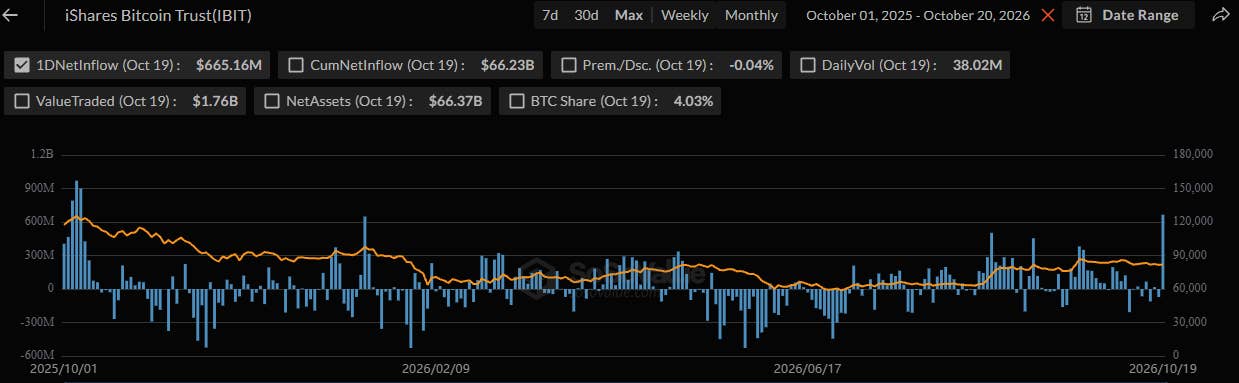
BlackRock's (NYSE: BLK) iconic fund, iShares Bitcoin Trust ETF (Nasdaq: IBIT), saw a net inflow of $665.16 million on Oct. 19, posting its strongest day in over 12 months.
The fund last recorded a larger net inflow on Oct. 7, 2025, when it attracted $899.42 million, as per the onchain analytics platform SoSoValue.
BlackRock's iShares Bitcoin Trust, Source: SoSoValue
BlackRock took years to embrace Bitcoin
When Bitcoin was launched in 2009, it was worth a few cents only. By November 2021, it was approaching $70,000.
Then came a long crypto winter that lasted months but the leading cryptocurrency successfully recovered. After sinking below $17,000 in late 2022, it began ascending and was trading above $42,000 by the end of 2023.
Being a decentralized cryptocurrency, Bitcoin is free from the control of centralized bodies like governments and banks and runs on a peer-to-peer model.
Though the ethos of Bitcoin is entirely opposite to that of Wall Street, BlackRock could no longer ignore it and launched a spot Bitcoin ETF in January 2024.
The fund tracks the spot price of the leading cryptocurrency and offers indirect BTC exposure to investors who want to gain a taste of crypto from the comfort of a stock exchange.
The largest of its kind so far, IBIT holds $66.37 billion in net assets and has seen a cumulative net inflow of $66.23 billion as of Oct. 19.
BlackRock also issues iShares Bitcoin Premium Income (Nasdaq: BITA).
Launched in June 2026, it gains Bitcoin exposure through holdings that include BTC and IBIT shares and sells call options to generate income for investors.
With BlackRock ETF, Wall Street Meets Bitcoin (2:16)
BlackRock's crypto ETFs
The asset manager also issues two ETFs linked to Ether (ETH), the second-largest cryptocurrency following BTC.
Launched in June 2024, iShares Ethereum Trust ETF (Nasdaq: ETHA) offers indirect ETH exposure to investors.
Launched in February 2026, iShares Staked Ethereum Trust ETF (Nasdaq: ETHB) tracks the performance of ETH's price and rewards from staking a position of the Trust's ETH holdings.
All the ETFs mirror the performance of the corresponding cryptocurrencies on the chart.
Both Bitcoin and IBIT are 5% down this year. Similarly, Ether and ETHA are both down 17% this year.
Popular on TheStreet Roundtable:
BlackRock's new filing shows restriction to BTC and ETH
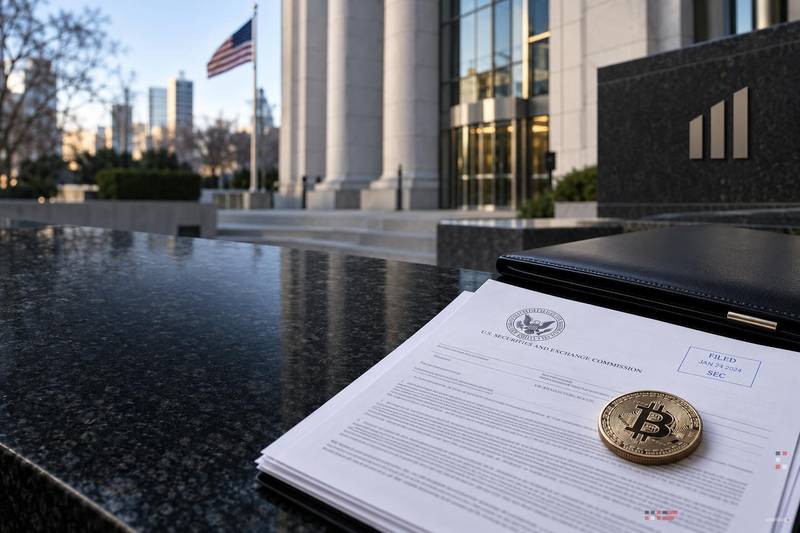
On Oct. 19, BlackRock filed with the U.S. Securities and Exchange Commission (SEC) to launch another Bitcoin fund called iShares Bitcoin Managed Protection ETF (PBIT).
The fund seeks to offer upside IBIT or other BTC exposure with a level of downside protection but it would also put a limit on gains.
The latest filing also shows BlackRock is restricting itself to Bitcoin and Ether.
When TheStreet Roundtable asked why the asset manager doesn’t engage with other cryptocurrencies, Nexo analyst Iliya Kalchev said large asset managers concentrating on the two leading cryptocurrencies has less to do with these assets themselves than with what it takes to build a successful ETF.
He explained that a fund has:
- to be legally permissible,
- liquid enough to trade at size,
- economically viable for the issuer, and
- wanted by both retail and institutional investors.
Both Bitcoin and Ether meet all four criteria today, which is why they have become the natural foundation of the category, Kalchev argued.
Regulatory status, credible price discovery, institutional-grade custody, and sufficient market depth and demand are among the basic barriers any asset needs to cross to be considered to build a fund around, he explained.
“Digital assets are working through the same checklist, and each item is a maturing infrastructure question rather than a ceiling on the asset class,” he added.
Kalchev took the example of Bitwise closing its spotDogecoin ETF (NYSE Arca: BWOW) to argue a cryptocurrency’s popularity doesn’t necessarily translate into a demand for an ETF.
But the Bitwise Solana Staking ETF (NYSE Arca: BSOL) has gathered around $1.3 billion in net assets as it combines real utility with institutional demand, he expanded.
Kalchev also underlined thatthe SEC’s March 2026 guidance designating Solana and XRP as examples of digital commodities removes part of the regulatory obstacle.
The test before crypto ETFs is attracting durable allocations rather than launch-week flows, he emphasized.
“That is a healthy standard for a maturing market, and Bitcoin and Ether have set the benchmark by meeting it first,” Kalchev said.
The Roundtable 100
If you follow our market coverage, don’t miss the Roundtable 100. Updated every Friday, it's a power ranking of the 100 most investable tech stocks, including digital assets. Check out the latest RTB 100 rankings at roundtable100.com.
Disclaimer: This article is for informational purposes only and does not constitute financial advice. Cryptocurrency investments are highly volatile and risky. Always conduct your own research before making any investment decisions.
Related: One concern unites Americans before midterms