Blast is shutting down. The Ethereum Layer 2 that promised "native yield" on ETH and stablecoins announced on X that it will wind down the chain, asking every user to pull their assets back t
Blast is shutting down. The Ethereum Layer 2 that promised "native yield" on ETH and stablecoins announced on X that it will wind down the chain, asking every user to pull their assets back to Ethereum mainnet. The reason is blunt: running Blast costs more than the L2 earns, and the team sees no credible path to fixing that. Here is what happened, what you need to do, and why the Blast shutdown says a lot about the state of the Layer 2 market.
Why Is Blast Shutting Down?
The official answer is money. In its announcement, the Blast team wrote that the ongoing costs of maintaining the chain exceed the revenue generated by the L2, and that it does not see a credible path to making Blast economically sustainable. In other words, sequencer fees and ecosystem activity never grew large enough to cover the cost of running the network.
That is a sharp fall for a project that launched in late 2023 with a lot of noise. Blast, created by Blur founder Pacman, pitched itself as the first L2 with native yield: ETH deposits earned staking rewards through Lido, and stablecoins earned yield through MakerDAO. The invite-only deposit campaign and points program pulled in billions of dollars before the mainnet even went live in early 2024.
The warning signs were there for a while. The project's official X account had been silent since September 2025, more than a year before the shutdown post. For a chain that lived on hype, points and airdrop campaigns, a year of silence was effectively a slow goodbye.
In its message, the team apologized to the users and developers who believed in Blast, built on it and supported the ecosystem, and said its priority is now a shutdown that is as smooth and safe as possible.
How Do You Withdraw From Blast Before the Deadline?
If you hold anything on Blast, the instruction is simple: move it to Ethereum mainnet. That includes balances sitting in the Blast PWA (the mobile web app), not just funds in DeFi protocols on the chain. Here is the timeline the team laid out:
- Withdrawal delay drops to 24 hours. Blast is cutting the normal L2 to L1 withdrawal period to 24 hours to speed things up.
- Lido assets come out first. Before user withdrawals reopen, Blast will unwind its own Lido positions, the stETH that powered the native yield. This is expected to take about one week.
- Withdrawals paused during that week. While the Lido unwind runs, user withdrawals will temporarily be unavailable, even though the 24-hour delay has already been announced. Do not panic if the bridge does not work yet.
- Withdrawals resume with the 24-hour delay. Once the Lido process is done, the normal Blast interface reopens.
- October 26, 2026 is the deadline for the easy route. Until then, you can withdraw through the regular Blast bridge interface.
- After October 26, you are on your own with the contracts. Assets stay withdrawable, but you will have to interact directly with the Blast bridge contracts on Ethereum L1. The team says it will publish detailed instructions before that date.
The practical advice: do not wait for the last day. Interacting with raw bridge contracts is doable for experienced users, but it is a bad place to be if you only hold a few hundred dollars and have never used Etherscan. Withdraw through the interface as soon as it reopens, and make sure you have enough ETH on Blast to pay for the exit transaction.
Also watch out for scams. Shutdowns like this are a magnet for fake "Blast recovery" sites and phishing links. Only use the official Blast bridge and the links published through the project's own channels.
What Happened to the BLAST Token?
The BLAST token tells the same story in one chart. It launched in June 2024 through a large airdrop and briefly reached a market capitalization of around $2.2 billion. Since then it has lost more than 98% of its value. A token that was supposed to reward the most loyal users ended up as one of the worst-performing airdrops of the cycle.
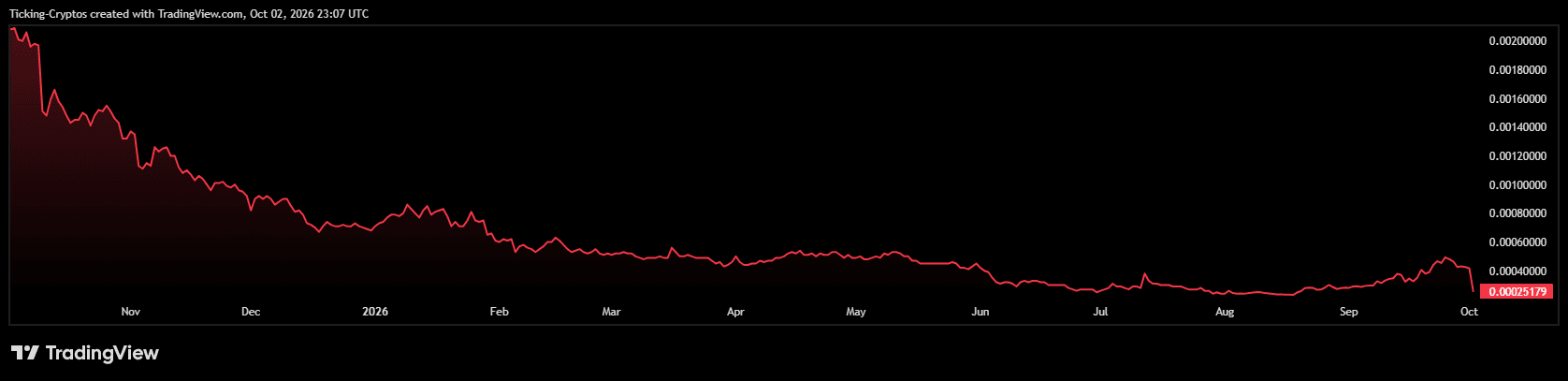
BLAST token price n USD
The decline was not just about price. Blast's total value locked, which once sat in the billions thanks to the native yield pitch, bled out as the airdrop was claimed and the points program ended. Once the incentives stopped, so did most of the activity. With no activity, there were no fees. With no fees, the economics the team describes in its shutdown post simply did not work.
For BLAST holders, the announcement does not spell out what happens to the token itself. The shutdown post only covers assets on the chain. Anyone still holding BLAST on Blast should bridge it to Ethereum mainnet with everything else and follow the official instructions. You can track the BLAST price and the rest of the market on our crypto prices page.
What Does the Blast Shutdown Mean for Ethereum Layer 2s?
Blast is not a tiny chain nobody heard of. It was one of the most hyped Ethereum L2s of 2024 and briefly ranked among the largest by total value locked. Its shutdown is a reminder that launching a rollup is cheap, but keeping one alive is not. Sequencers, data posting, security monitoring and developer support all cost money, every single month, whether or not anyone is using the chain.
The bigger problem is that Ethereum now has dozens of general-purpose L2s fighting over the same users and the same fees. Most of them survive on token incentives and venture capital rather than organic revenue. When the incentives run out, the chains that never built a real reason to exist beyond points and airdrops have nothing left to stand on. Blast is the most prominent example so far, but it is unlikely to be the last.
For users, the lesson is just as clear. Yield that comes from a chain's own treasury or from locked incentives is not free money. Before you bridge funds to a new L2, ask who pays for the chain, how it earns, and how you get out if the team walks away. In Blast's case, the exit still works. Make sure you use it before October 26.
To see how the broader Layer 2 sector and DeFi TVL are holding up, check our market charts.