This article was first published on TurkishNYR. Blockchain ecosystems are now expanding into multi-chain networks and as a result, blockchain interoperability solutions are needed for seamles
This article was first published on TurkishNYR.
Blockchain ecosystems are now expanding into multi-chain networks and as a result, blockchain interoperability solutions are needed for seamless asset and data transfers.
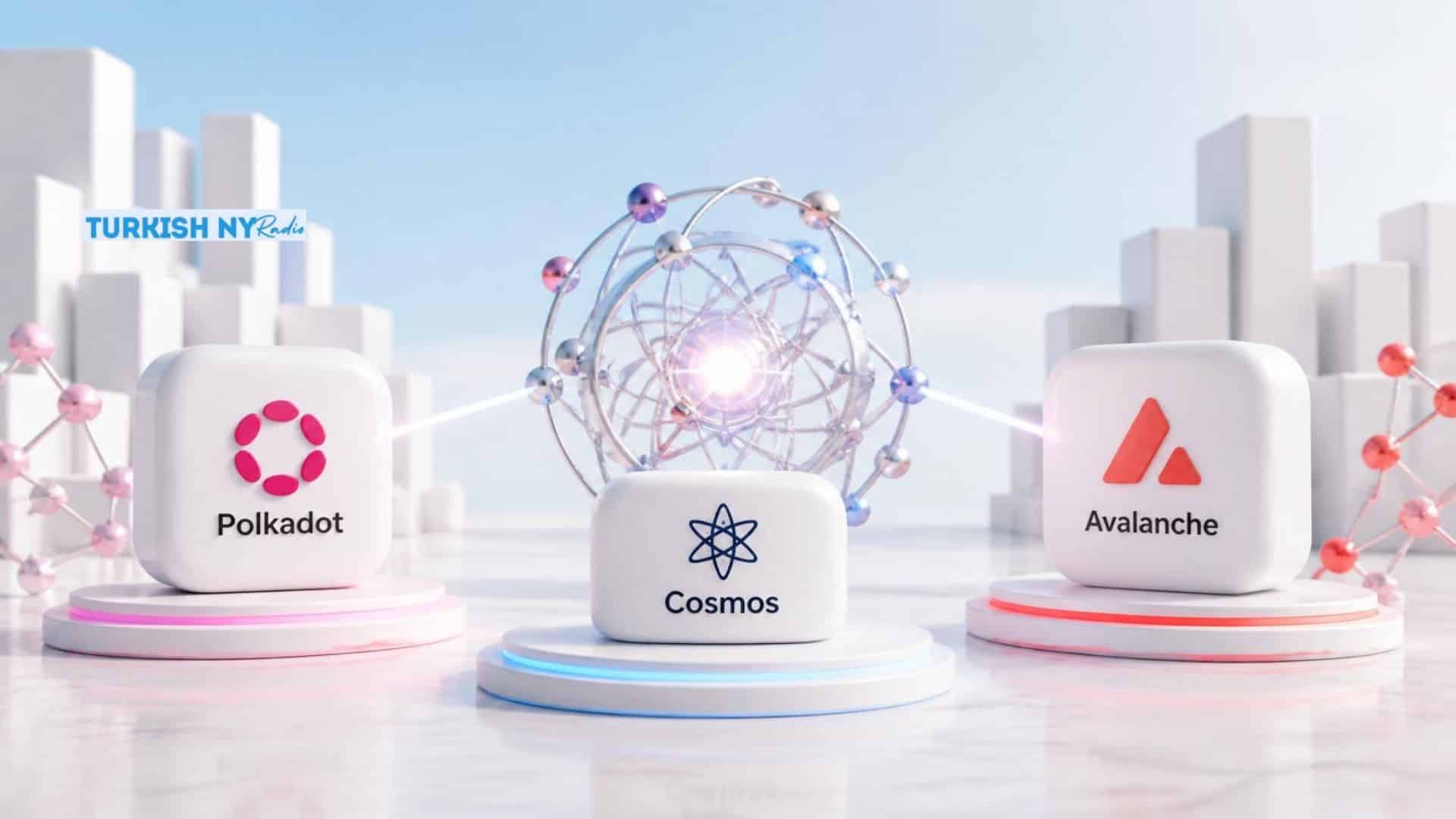
Polkadot, Cosmos, and Avalanche each offer unique architectures and messaging protocols to connect chains.
Polkadot: Parachains and XCM for Cross-Chain Messaging
Polkadot is a Layer-0 multichain relay network designed explicitly and purpose-built for interoperability. Its architecture features a Relay Chain (hub) and multiple parachains (parallel chains) that share security and communicate via XCM (Cross-Consensus Messaging).
The Polkadot Relay Chain validators secure all parachains under one umbrella, allowing each parachain to focus on its own functionality (e.g. smart contracts, DeFi, gaming) while relying on unified security.
Polkadot allows other blockchains to share security, communication, and asset transfer without relying on potentially insecure cross-chain bridges.
Cross-Chain Messaging (XCM)
Polkadot’s XCM is a native protocol that moves messages and assets between parachains. With XCM v2+ (launched 2023), parachains can transfer tokens and make arbitrary calls across chains without external bridges.
Polkadot documentation emphasizes that XCM and light-client proofs enable secure trust-minimized messaging between chains. Parity engineer Derek Yoo noted that Polkadot’s XCM uses a light client-based approach, which is the gold standard for secure cross-chain interactions.
Unlike centralized bridges, this on-chain messaging ensures end-to-end cryptographic verification.
Bridges to External Chains
In addition to XCM, Polkadot supports bridges for connectivity to chains like Ethereum and Bitcoin. Bridges let Polkadot apps access external liquidity and assets, though they carry extra trust assumptions compared to XCM.
The official docs explain that while XCM handles intra-Polkadot messaging, bridges extend this functionality to external blockchains such as Ethereum and Bitcoin.
For instance, Snowbridge is a Polkadot-Ethereum bridge for moving tokens trustlessly between ecosystems.
Polkadot 2.0 and Agile Coretime
In 2025-2026, Polkadot rolled out its “Polkadot 2.0” upgrade, significantly boosting performance. Main components include Agile Coretime, Asynchronous Backing, and Elastic Scaling.
Agile Coretime replaces rigid auctions with flexible scheduling, letting parachains lease coretime on-demand or in bulk. It enables projects to lease coretime for short periods instead of committing to long-term slot auctions”.
Async Backing pipelines block building to double throughput. Overall, Polkadot 2.0 allows up to 10× higher throughput, benefiting cross-chain apps. These enhancements, along with a March 2026 tokenomics overhaul (2.1B DOT supply cap, lower inflation), place Polkadot as a high-performance interoperability solutions system.
Ecosystem and Metrics
Over 65 Polkadot parachains (e.g. Acala, Moonbeam, Astar) are active, supporting DeFi, smart contracts, and bridges. However, Polkadot’s current DeFi TVL is modest (tens of millions) compared to Ethereum. The DOT token trading at $0.88 with a market cap $1.4B, fuels governance, staking, and fees.
With 1.69B DOT circulating (cap 2.1B) and 50% staked, Polkadot’s economics incentivize security and decentralization.
In essence, Polkadot’s interoperability solution focuses on its shared-security model and XCM protocol, enabling parachains to communicate directly and securely.
 Blockchain Interoperability Solutions
Cosmos: IBC and Sovereign Zones for Interoperability
Cosmos envisions an “Internet of Blockchains” where sovereign zones connect via the Inter-Blockchain Communication (IBC) protocol. Each Cosmos zone (including the Cosmos Hub) is an independent Tendermint BFT chain with its own validators.
IBC provides native, light-client-based message-passing between zones, avoiding centralized bridges. According to a 2026 analysis, Cosmos IBC is designed as a native cross-chain protocol using light-client verification and native chain-to-chain communication instead of relying on external bridges.
This means tokens or data move securely: when ATOM or other tokens are sent over IBC, they are locked on the source chain and a voucher minted on the destination.
IBC and Roadmap
IBC launched in 2021 and rapidly grew. By mid-2026, over 115 blockchains support IBC, up from 8 at the beginning. Cosmos Labs’ roadmap shows major IBC upgrades.
In 2025, Cosmos added Ethereum to the IBC network (via an Ethereum light client module) and began productionizing IBC v2 for Solana and EVM chains.
The goal is to expand to “dozens of networks” beyond Cosmos-native chains. If successful, Cosmos would become a universal cross-chain layer spanning Ethereum, Solana, and other ecosystems.
Interchain Security (ICS)
Cosmos offers Interchain Security, where new (consumer) chains lease the Cosmos Hub’s validator set for instant security. This lets emerging zones focus on features while piggybacking on ATOM staking.
For example, the Composable chain (a Cosmos SDK network) proposed joining Cosmos Hub’s security while bridging multiple ecosystems. While Interchain Security doesn’t itself move tokens, it supports interoperability solution by binding multiple chains economically.
Ecosystem and Metrics
The Cosmos ecosystem has dozens of hubs and zones (e.g. Osmosis, Juno, Injective). Many are launchpads for DeFi, NFTs, or specialized use cases. Notably, IBC-enabled chains can seamlessly swap tokens (e.g. ATOM, OSMO) and share liquidity.
Cosmos Hub’s ATOM token which has a circulating supply of 517M and trading at $1.52, secures the network. Although Cosmos DeFi TVL is fragmented (e.g. Osmosis DEX $13M TVL), the strength is in broad connectivity, meaning Cosmos provides the plumbing for multi-chain apps.
Cosmos’ vision is sovereign, modular, and interoperable chains linked by IBC. The Cosmos 2.0 upgrades and IBC v2 aim to further increase throughput (target 5,000 TPS) and reduce latency, making IBC fast enough for enterprise workloads.
Avalanche’s approach to interoperability solution focuses on its Subnet which is now fully sovereign L1 architecture and native messaging protocols. Avalanche consists of a core set of built-in chains (X-Chain, C-Chain, P-Chain) and Avalanche L1s; customizable blockchains (formerly “subnets”) each with its own validators and virtual machine.
In 2024-2025, Avalanche cut the cost of creating these custom chains: the “Avalanche9000” (Etna) upgrade reduced L1 launch costs by over 99%, enabling any developer or enterprise to spin up an Avalanche L1 cheaply.
Above all, Avalanche’s design purposefully isolates execution: each L1 can tailor consensus rules, data privacy, and fees, avoiding congestion on others.
Inter-Chain Messaging (ICM and ICTT)
To knit together this multi-chain ecosystem, Avalanche introduced native protocols. ICM (Interchain Messaging) allows any Avalanche L1 to send messages (calls, data) to another without external bridges.
Cryptographic proofs (signed by the source chain’s validators) accompany every message, so the destination chain can verify and trust the data. The follow-on protocol, ICTT (Interchain Token Transfer), provides secure token movements between L1s using audited smart contracts.
Together, ICM/ICTT elevate Avalanche into a truly interoperable blockchain ecosystem. Users and developers can seamlessly move assets or calls across Avalanche chains with low latency and fees.
Granite Upgrade (Nov 2025)
Avalanche continues to refine its interoperability. The Granite upgrade happened in November 2025 and notably improved ICM performance and stability. It introduced epoched validator snapshots on the P-Chain so that cross-chain messages refer to a fixed validator set for 5-10 minutes, greatly simplifying trust proofs.
As a result, ICM became simpler, faster, and easier to go about, reducing message failures and costs. Granite also enabled modern cryptography (biometric-friendly signatures) and dynamic block times, but most relevant here is that Avalanche now offers secure, low-cost messaging natively between all its subchains.
Avalanche Bridge
Avalanche also maintains a high-speed bridge to Ethereum (Avalanche Bridge, AB), though recent architectural focus is on ICM. The AB, revamped in 2021, uses multi-party computation for trust-minimized transfers of ETH/ERC-20 to AVAX/cAVAX. It sees substantial usage by DeFi users.
However, Avalanche emphasizes that ICM/ICTT avoid the risks of bridges entirely by working within Avalanche’s ecosystem.
Ecosystem and Metrics
Avalanche’s C-Chain hosts Ethereum-compatible DeFi and NFTs, while dozens of specialized L1s (gaming, finance, enterprises) spring up on demand. Notable projects (e.g. Chainlink, Aave, Benqi) run on Avalanche.
CoinStats reports Avalanche’s total DeFi TVL (C-Chain + L1s) was about $1.2-1.3 billion in late 2025 which quite modest compared to Ethereum’s $37 billion, but growing after the 2024 upgrades.
AVAX’s market cap is similarly $1.4 billion, with price trading at $6.62 and 414M circulating. Avalanche prioritizes low-latency and compliance (e.g. permissioned subnets) for enterprises. Its infrastructure allows game studios and institutions to create isolated execution environments yet still interoperate via Avalanche’s protocols.
 Blockchain Interoperability Solutions
Comparing Blockchain Interoperability Solutions
The table below compares key features of Polkadot, Cosmos, and Avalanche as interoperability platforms:
FeaturePolkadotCosmosAvalancheLaunch (Mainnet)20202019 (Cosmos Hub)2020Architecture TypeRelay Chain (Layer-0) + Parachains (Layer-1s)Hub-and-Zones (multiple sovereign L1s)Primary Chains + Custom L1s (formerly “Subnets”)ConsensusNPoS (Nominated PoS) with BABE/GRANDPATendermint BFT (Delegated PoS)Avalanche Consensus (Snowman) PoSInteroperability TechXCM (Cross-Consensus Messaging), Trustless BridgesIBC (Inter-Blockchain Communication), Light Clients, ICSICM (Interchain Messaging), ICTT (Token Transfer), Avalanche BridgeSecurity ModelShared security: one validator set secures all parachainsSovereign: each zone secures itself (Hub offers optional shared security)Sovereign: each L1 has own validators (independent security)Connected Chains65+ active parachains (plus parathreads)115+ IBC-connected zones/chains (as of 2026)20+ active L1 networks (custom blockchains)Message VerificationOn-chain XCM via light clients in relayLight clients on each chain, cryptographic packet verificationValidator-signed proofs relayed on Avalanche’s P-ChainUnique StrengthsUnified security; flexible Para chains; dynamic scheduling (Coretime)Modular, sovereign chains; rapid IBC growth; enterprise featuresHorizontal scaling via custom L1s; ultra-fast finality; native messaging (ICM/ICTT)Major 2024–26 UpgradeXCM v2 launch (May 2023); Agile Coretime (Sept 2025)IBC v2 (Eureka) for Ethereum/EVM support; Cosmos 2.0Avalanche9000 (Etna) enabling cheap L1s (Dec 2024); Granite (ICM enhancements, Nov 2025)Native Token (Ticker)DOTATOMAVAXToken UseStaking, governance, feesStaking, governance, feesStaking, fees, network operationsDeFi TVL (2026)Low (<$100M, mostly on parachains)Fragmented (e.g. Osmosis $13M); Cosmos Hub has ICS focus$1.2B (2025) across C-Chain + L1s (vs ETH $37B)
Trends and Outlook
Industry experts stress that modern interoperability favors built-in, trust-minimized protocols over ad-hoc bridges. For example, Polkadot founder Gavin Wood’s colleague Dan Reecer hailed XCM’s rollout as a massive innovation achieving a first-of-its-kind multi-chain network with unified security.
Avalanche’s team also noted that ICM/ICTT remove traditional complexities and security risks of cross-chain development, effectively making Avalanche a truly interoperable blockchain ecosystem.
Cosmos Labs and analysts push to expand IBC to Ethereum and Solana, aiming to make Cosmos not just a “Cosmos-only” network but a universal cross-chain layer.
All three solutions address the main challenge of isolated blockchains, but in different ways.
Polkadot uses a relay chain to enforce a single security umbrella, greatly simplifying trust among its parachains.
Cosmos retains fully independent chains but provides IBC tools so they can interoperate securely if they opt in.
Avalanche grants chains total autonomy (private or public) and relies on cryptographically-proven messaging to tie them together.
Finally, market metrics show varying adoption levels. As of mid-2026, Polkadot and Avalanche each command market caps around $1.5-2 billion with active development and proposed tokenized ETFs.
Cosmos’s ATOM ($0.79 B) supports an ecosystem of 115+ chains, and its tokenomics are being reformed to capture cross-chain fees.
While DeFi TVLs remain far higher on Ethereum/L2s, the rollouts of IBC to new blockchains and Polkadot/Avalanche performance upgrades suggest these interoperability solutions are set for growth.
Analysts agree that genuine cross-chain apps (liquid staking, cross-chain DEXs, order-book apps) require secure messaging: The vision is grand if execution on these protocols continues.
Conclusion
Blockchain interoperability solutions like Polkadot, Cosmos, and Avalanche each play a role in Web3’s multi-chain future. Polkadot’s relay-chain design and XCM protocol provide shared security and direct parachain messaging.
Cosmos relies on IBC and sovereign zones to connect hundreds of independent chains. Avalanche’s customizable L1 subnets and native messaging (ICM/ICTT) achieve high throughput and seamless asset transfers.
Looking ahead, industry analysis says that extending these protocols to networks like Ethereum and rollups will be a major trend. These interoperability layers are laying the path for a truly connected blockchain ecosystem, enabling developers and users to move freely across chains.
Glossary
Interoperability: The ability of different blockchains to communicate, share data, and transfer assets seamlessly.
Relay Chain (Polkadot): The core Polkadot chain that provides security and consensus for connected parachains.
Parachain: A parallel blockchain attached to Polkadot’s Relay Chain.
XCM (Cross-Consensus Messaging): Polkadot’s protocol for sending messages (including token transfers) between parachains and the Relay Chain in a trustless manner.
IBC (Inter-Blockchain Communication): A Cosmos-native protocol that allows two blockchains to send packets (e.g. tokens, data) back and forth using light-client verification.
Subnet / L1 (Avalanche): A custom, sovereign Avalanche blockchain (previously called a subnet) with its own validators and consensus.
ICM (Interchain Messaging): Avalanche’s built-in protocol enabling any two Avalanche chains (subnets/L1s) to communicate natively without third-party bridges, using cryptographic proofs.
Light Client: A type of blockchain client that verifies chain state with minimal data.
Frequently Asked Questions About Blockchain Interoperability Solutions
What is blockchain interoperability solutions?
Blockchain interoperability refers to the ability of different blockchain networks to communicate and exchange assets or data seamlessly. Interoperability solutions enable cross-chain token transfers and smart contract calls without centralized intermediaries.
How does Polkadot achieve blockchain interoperability solution?
Polkadot uses a central Relay Chain to connect many parachains. It enforces unified security across chains so each parachain trusts the others and uses the XCM messaging format to send messages and tokens cross-chain.
What is Cosmos IBC and why is it important?
IBC (Inter-Blockchain Communication) is Cosmos’s native protocol for connecting independent blockchains (zones). It uses light clients: each chain runs a verified checkpoint of the other, enabling trust-minimized packet transfers. IBC supports token transfers (ICS-20) and advanced features (Interchain Accounts). It’s important because it avoids centralized bridges.
What are Avalanche’s subnets and ICM?
Avalanche allows custom blockchains (subnets/L1s) to be built with independent rule sets. Each subnet can define its own validators and virtual machine. Interchain Messaging (ICM) is Avalanche’s built-in protocol enabling any two Avalanche subnets to communicate natively.
How do these interoperability solutions handle security?
Security models differ. Polkadot uses shared security where one validator set secures all parachains, so cross-chain messages inherit trust. Cosmos zones are independent; each zone’s own validators secure it. Cosmos Hub offers optional Interchain Security to new chains for extra protection, but otherwise each chain must secure itself. Avalanche’s subnets are fully sovereign; each has its own validators and stake.
ReferencesPolkadot
Cosmos
Avalanche
Disclaimer: This article provides technical and market information only. It is not investment advice. Always conduct your own research or consult a professional before making financial decisions.