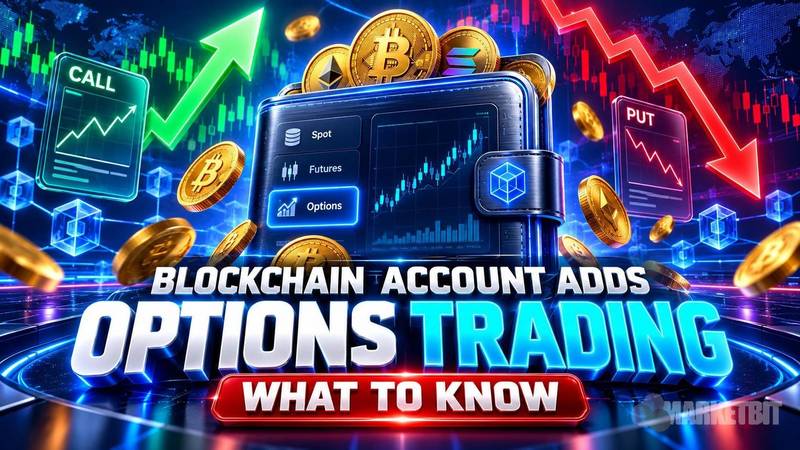
Blockchain Trading Account has added options trading to its product suite, extending the derivatives toolkit available to account holders beyond spot and standard order types. Options introdu
Blockchain Trading Account has added options trading to its product suite, extending the derivatives toolkit available to account holders beyond spot and standard order types. Options introduce contract-based exposure with defined premium costs, distinct mechanics from outright crypto purchases, and a risk profile that requires separate evaluation before use.
What to Know About Blockchain Trading Account Options Trading
The addition of options to Blockchain Trading Account gives users a contract-based instrument alongside existing trading features. Options are agreements that grant the holder the right, but not the obligation, to buy or sell an underlying asset at a specified price before or at expiry, with the premium paid representing the maximum loss for a long position. For related coverage, see Raydium RAY Token Rises 64% as Solana Trading Shifts.
Three points define the feature addition: first, options expand strategy flexibility beyond directional spot trades; second, contract terms including expiry, strike price, and settlement method determine the trade's payoff structure; third, options carry time-decay risk not present in spot holdings, meaning the premium erodes as expiry approaches if the position moves unfavorably. For related coverage, see 7 Best ChangeNOW Alternatives in 2026 (Aggregators and Single Providers).
Blockchain.com has been pursuing regulatory engagement for derivatives products, including a CFTC approval process for prediction markets alongside Binance.US, signaling a broader push into contract-based instruments across its platform. For related coverage, see XRP Treasury Reports SEC Approval to Raise New Capital.
How Options Trading Fits Into a Crypto Trading Strategy
A call option grants the right to buy the underlying asset at the strike price; a put option grants the right to sell. A trader holding spot bitcoin who purchases a put option at the current price pays a premium to establish a floor on losses if price falls, functioning as portfolio insurance rather than a leveraged directional bet.
Conversely, a trader with a directional view can express it through a call option, paying a defined premium for upside participation with loss capped at the premium cost. This contrasts with perpetual futures, where losses on a long position are uncapped and liquidation thresholds apply to the full notional size.
Options can also be sold (written), which collects premium upfront but creates obligation: a short call obligates the seller to deliver the asset at strike if exercised, and a short put obligates purchase at strike. Selling options produces income but generates theoretically unlimited loss on short calls if price moves sharply against the position.
For traders already active across spot and derivatives markets, options positioning data, including open interest by strike and expiry, is trackable on derivatives analytics platforms such as Coinglass, where aggregate market open interest and liquidation levels provide context on how other participants are positioned.
Options integrate with standard technical analysis frameworks, including support and resistance levels visible on a BTC/USDT chart, which traders use to select strike prices relative to expected price ranges within a given expiry window.
Platform-level trading experience matters significantly when options are involved, given the added complexity of managing Greeks (delta, theta, vega) alongside price. Interface quality directly affects execution precision in options strategies where entry timing and order routing affect realized premium costs.
Risks and Checks Before Using the New Feature
Options purchased outright carry a maximum loss equal to the premium paid, but that premium can go to zero if the contract expires out-of-the-money. Time decay (theta) accelerates in the final days before expiry, making the timing of entry and exit critical to the trade's outcome.
More complex strategies, including spreads, straddles, or any structure involving short options legs, introduce risk profiles that exceed the initial premium. A naked short position has uncapped theoretical loss on the upside for calls or loss down to zero for puts on the underlying asset.
Before placing a first options trade on Blockchain Trading Account, the following checklist applies:
- Eligibility: Confirm your account tier and jurisdiction meet the platform's options access requirements, as derivatives availability varies by region and account verification level.
- Supported markets: Verify which underlying assets are listed for options, including whether BTC, ETH, or altcoin contracts are available.
- Expiry terms: Identify whether contracts are European-style (exercise only at expiry) or American-style (exercise any time before expiry), as this changes hedging mechanics.
- Settlement: Confirm whether settlement is physical delivery of the underlying asset or cash-settled, which affects how expiry positions resolve.
- Fees: Review maker and taker fees on options contracts, plus any exercise or assignment fees, which can materially affect net returns on short-dated, low-premium trades.
- Risk disclosures: Read the platform's options risk disclosure fully; regulatory requirements in most jurisdictions mandate that platforms provide this document before options access is granted.
Risk tolerance and prior experience with derivatives are the threshold questions before allocating to options. Traders who have not previously managed theta decay or volatility exposure should consider paper trading or minimum-size positions before scaling. Options are not a straightforward substitute for spot positions; they require active monitoring of contract parameters that do not apply to outright asset holdings.
The addition of options to Blockchain Trading Account raises the platform's derivatives surface alongside its existing spot and order-type features. Key risk levels to track when using options: the premium paid as the defined downside on long positions, the strike price as the breakeven input, and the expiry date as the hard deadline after which unexercised out-of-the-money contracts expire worthless.
Disclaimer: This article is for informational purposes only and does not constitute financial or investment advice. Cryptocurrency and digital asset markets carry significant risk. Always do your own research before making decisions.
Read original article on marketbit.net