A BEP20 transfer on BNB Chain costs you less than half a cent today. On September 27, 2026, we read out eleven real USDT transfers from a single block, and the most expensive of them cost 0.0
A BEP20 transfer on BNB Chain costs you less than half a cent today. On September 27, 2026, we read out eleven real USDT transfers from a single block, and the most expensive of them cost 0.0035 euros. Anyone who wants to know why that is, how to tell BEP20 from ERC20, and which trap hides in the decimal places of all things will find the practice here in one piece.
BNB Chain, formerly Binance Smart Chain, is an EVM-compatible blockchain. EVM-compatible means this chain speaks the same language as Ethereum, which is why the same wallets, the same address formats and largely the same applications work there. That is exactly where the most common mishap comes from, because an address on BNB Chain looks like an address on Ethereum. How the network token itself is developing you can read in our BNB price prediction; here the subject is the network underneath.
What BNB Chain Is and Why Gas Is Paid in BNB Here
Every transaction on BNB Chain consumes computing work, and that work is measured in gas. Gas is the unit of account for effort, the gas price says what one unit of it costs, and both are paid in BNB. The token is therefore no pure investment object; it is the operating fuel of the chain.
The technical figure you need whenever you set up a wallet is the chain ID. For BNB Smart Chain it is 56. We queried it directly through a public node of the network on September 27, 2026, and you can do the same at any time. Anyone who instead copies a chain ID out of some random guide ends up, in the worst case, on a cloned network. The technical key data are listed by the project in its own developer documentation.
The family also includes opBNB, a layer 2. A layer 2 is a second chain that bundles transactions and passes the result to the main chain in order to cut costs. Its chain ID is 204, likewise queried on the same day. For most readers it remains a footnote, because the main chain is already cheap enough.
BEP20, ERC20 or TRC20: How to Spot the Right Network on a Withdrawal
BEP20 is the token standard of BNB Chain, meaning the set of rules a smart contract has to follow so that every wallet recognises the token. If you withdraw USDT from an exchange, you usually have the choice between BEP20, ERC20 and TRC20. The amounts are identical; the costs and the networks are not.
Telling them apart by address format is unambiguous, but only half useful. An address on BNB Chain begins with 0x and has 42 characters, a Tron address begins with a capital T and has 34. Tron, then, you recognise immediately. Ethereum and BNB Chain, by contrast, look identical, because both use the same format.
From this follows the most important rule of this section: between Ethereum and BNB Chain the address format does not protect you. On a withdrawal you have to actively pick the network the receiving side specified. Send BEP20 to an Ethereum address and the balance afterwards sits on BNB Chain under that same address. If you control the private key, you can usually reach it again by adding BNB Chain in your wallet. If the address belongs to an exchange, its support desk alone decides, and that can take time or fail.
How to get a new network into a wallet in the first place we described on September 26, 2026, in our overview adding a network, bridges, explorers.

Set against the amount, the fee on BNB Chain is barely more than a drop.
What a BEP20 Transfer Really Costs Today
Rather than take over estimates, we measured. The basis is block 124,336,541 of BNB Smart Chain, dated September 27, 2026. It contained 125 transactions, 20 of which went to the USDT contract. For eleven of them we read out the receipt individually.
The measured consumption
Gas consumption came to 29,715, 34,515 or 51,627 units. The low figures belong to recipients who already hold USDT, the high one to a recipient for whom the contract first had to create a new storage slot. The effective gas price was 0.10 to 0.11 gwei; one gwei is the billionth part of a BNB. The block's base fee stood at zero.
Converted into euros
At a BNB price of $781.99, or 684.45 euros (CoinGecko, September 27, 2026), that works out at 0.0020 euros for the cheapest and 0.0035 euros for the most expensive of the measured transfers. A plain BNB transfer at 21,000 gas comes in below that again. In practice this means the fee is not a cost factor, yet without BNB in the account nothing happens either.
The comparison that settles the choice of network
On the same day we ran the same measurement on Tron. There a USDT transfer cost 6.4285 TRX, roughly 1.88 euros, and double that on a first receipt. The difference between the two chains therefore runs to a factor of 500 to 900. Anyone who has the choice, and whose counterparty supports BEP20, has thereby made the decision. Anyone without the choice should at least know what they are paying for.
The Trap of the 18 Decimal Places: USDT Counts Differently on BNB Chain
Even experienced users often do not know this quirk, and it regularly causes a moment of panic. We queried the USDT contract on BNB Chain directly: it reports the name Tether USD, the ticker USDT and 18 decimal places. On Tron and on Ethereum the same token has only 6.
In practice that means a raw value shown to you by an explorer or a contract carries twelve more zeros on BNB Chain than on the other chains. Wallets convert this themselves, which is why nothing strikes you in everyday use. Anyone working with a script, reading amounts out of a receipt or addressing a contract directly, however, will be out by a factor of one trillion here.
The second consequence concerns bookkeeping and tax tools. If you import transactions raw, spot-check whether the amounts are plausible. An entry of over a million euros where ten euros moved almost always has this cause.
Because BNB Chain is EVM-compatible, practically every Ethereum wallet works there once the network has been entered.
Adding the network
In the common wallets, BNB Smart Chain is preconfigured today and only needs to be activated. Entering an RPC endpoint by hand is the exception, for instance when the default node responds slowly. Never enter an endpoint that somebody sent you in a chat: a manipulated node can show you false balances and lure you into a signature.
Which wallet
Trust Wallet is the most searched-for app for BNB Chain in German-speaking countries and ships with the network built in. MetaMask asks for one more click but has the broader support among decentralised applications. For amounts you rarely move, the private key belongs on a device with no network connection. Which software wallets have proved themselves, and how to spot an unsafe one, is shown in our comparison of crypto software wallets.
Always keep some BNB ready
Even though the fee is tiny, without BNB in the account not a single transaction can be sent. An equivalent of two to three euros is enough for hundreds of transfers. Many users send their tokens to the chain and only then discover that they cannot do anything with them.
Reading BscScan: Checking Status, Token Transfers and Approvals
BscScan is the block explorer of BNB Chain, in other words a search engine for everything that has happened on the chain. Three things you should be able to find there.
Has my transfer gone through? Enter the transaction hash or your address. A success note together with the block number ends any discussion with a support desk that claims otherwise. Blocks appear at a rate of one a second, so a longer wait rarely points to network congestion.
What exactly moved? The token transfers tab states which contract booked which amount. Check the contract address, not the name. Anyone can assign a name; an address, no.
What have I approved? The explorer lists the approvals granted by your address. More on that in a moment, because the biggest quiet risk sits here.
One warning on troubleshooting: if a transaction fails with a note about the gas limit, the network has not failed. The ceiling you set was too low. Something similar applies to broken or discontinued tokens, as we described on September 9, 2026, on the shutdown of several networks by Binance.
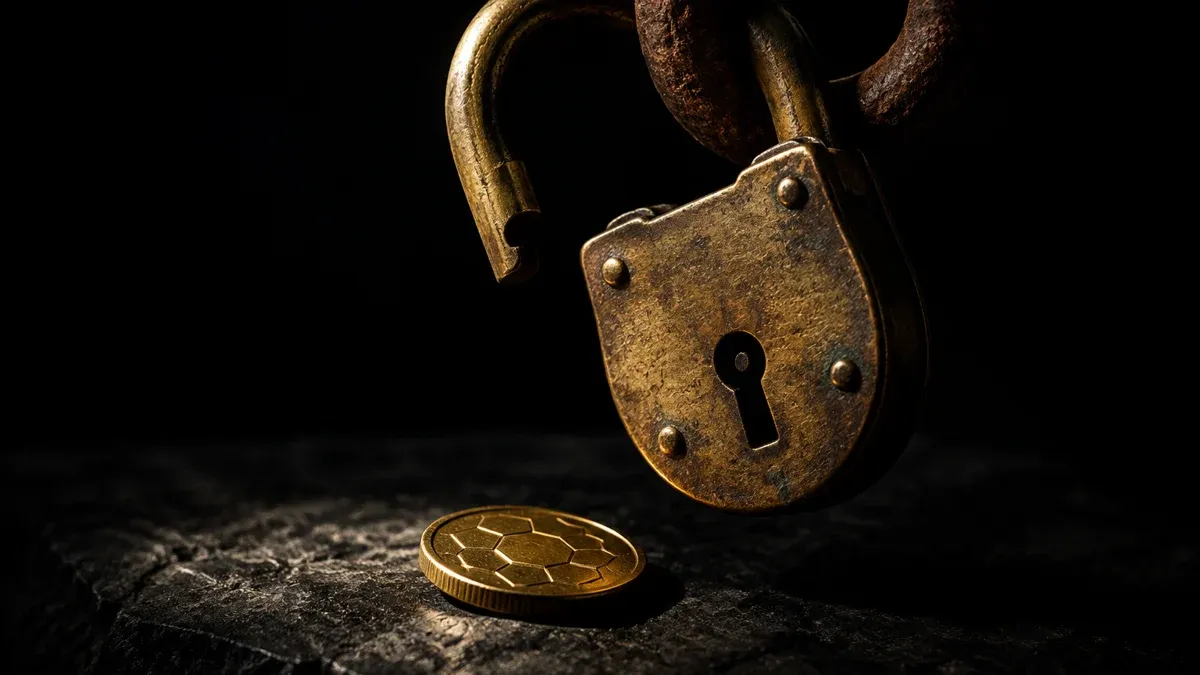
An approval you have granted is a lock left hanging open until you close it yourself.
Using PancakeSwap Safely: Slippage, Approvals and Fake Tokens
PancakeSwap is by far the largest decentralised exchange on BNB Chain. According to DefiLlama's data, roughly $2.25 billion in capital sat there on September 27, 2026, which is 89 percent of all capital in decentralised exchanges on this chain. Anyone swapping on BNB Chain as a rule swaps there.
Three things you should have understood beforehand.
Approval. Before the first swap of a token, the application asks you for permission to move that token out of your wallet. This approval applies without a time limit and often over an unlimited amount. Set it, if your wallet offers that, to the amount you actually intend to swap.
Slippage. Slippage is the margin by which the actual price may deviate from the one displayed. A high value lets your swap go through even once it has turned bad. Leave the default setting alone. If a token demands a conspicuously high slippage, that is a warning sign and no technical detail.
Fake tokens. Anyone can create a BEP20 contract bearing the name of a well-known token. Search the application for a ticker and you will therefore often get several hits. What counts is always the contract address from a source you trust independently, and not the order of the search results.
Revoking Approvals: Why Old Permissions Remain an Open Gate
An approval does not lapse because you never open an application again. If the contract in question is taken over later, or somebody finds a gap in it, the old permission is enough to clear out your balance. You no longer have to click anything for that, and it is exactly why wallets keep running empty whose owners have been inactive for months.
The run-through takes five minutes. Open the approvals overview for your address on BscScan, go through the list and revoke everything you do not actively need. Each revocation is itself a transaction and costs a few fractions of a cent. Two fixed dates a year are entirely sufficient.
What Remains of BEP2 and the Beacon Chain
One point that still turns up in older guides and today leads you astray. Alongside the Smart Chain there used to be BNB Beacon Chain with its own standard, BEP2, recognisable by addresses beginning with bnb1. That chain has been shut down; BNB Chain lists it on its own site under the heading Fusion as completed and provides a tool there for recovering affected tokens.
For you this means two things. First, a guide offering you BEP2 as a withdrawal option is out of date, and you should not trust it on other points either. Second, if you find an address in old records that begins with bnb1, it belongs to that shut-down chain. Anyone who suspects a balance is still there goes through the recovery tool and through nobody else who offers this by direct message.
Buying BNB in Germany: What MiCAR Means for Your Access
Since the European crypto regulation MiCAR took full effect, crypto service providers, crypto-asset service providers in the language of the regulation, need authorisation in order to serve clients in the European Economic Area. For you this is above all a question of access: on which trading venue can you buy BNB against euros at all, and who supervises it.
An authorised platform does not mean your price risks are any smaller. What is supervised is the provider and its handling of your money, not the value of a token. Which trading venues hold authorisation is shown in our overview of crypto exchanges compared; which obligations stand behind such an authorisation is set out in our overview of the MiCA licensing duties. What carries BNB as a token economically we set out on September 20, 2026, in our article on the chain's lead in tokenised assets.
Tax: When a Swap on BNB Chain Becomes Taxable
Every swap of one token for another is, in Germany, a disposal of the one and an acquisition of the other. Under Section 23(1) sentence 1 no. 2 of the Income Tax Act, that is a private disposal transaction if less than a year lies between acquisition and swap. This holds on a decentralised exchange just as it does on a centralised one, even though nobody there sends you an annual statement.
Because fees on BNB Chain are so low, hundreds of small events accumulate quickly, and every single one has to be documented. So pull your transactions regularly via your address from the explorer, or via a tool that handles it automatically. Which ones can do that is set out in our comparison of crypto tax tools. For a binding assessment of your individual case, your tax adviser remains responsible.
BNB Chain: What to Take Away
- Keep a small BNB balance on hand. Two to three euros are enough for hundreds of transactions, and without them everything comes to a halt. Where to get BNB against euros is shown in our overview of crypto exchanges compared.
- Choose the network deliberately, not by address format. Ethereum and BNB Chain look identical; only Tron you recognise by the capital T. Enter BNB Chain with chain ID 56 into a wallet you control yourself, see our comparison of software wallets.
- Clear out your approvals twice a year and keep records. Open permissions are the biggest quiet risk, and with fees in the cent range the tax documentation quickly becomes unmanageable. Tools for that are set out in our comparison of crypto tax tools.
(As of September 27, 2026. This article is not investment advice. Prices and fee structures change; check the terms with the provider before you buy.)