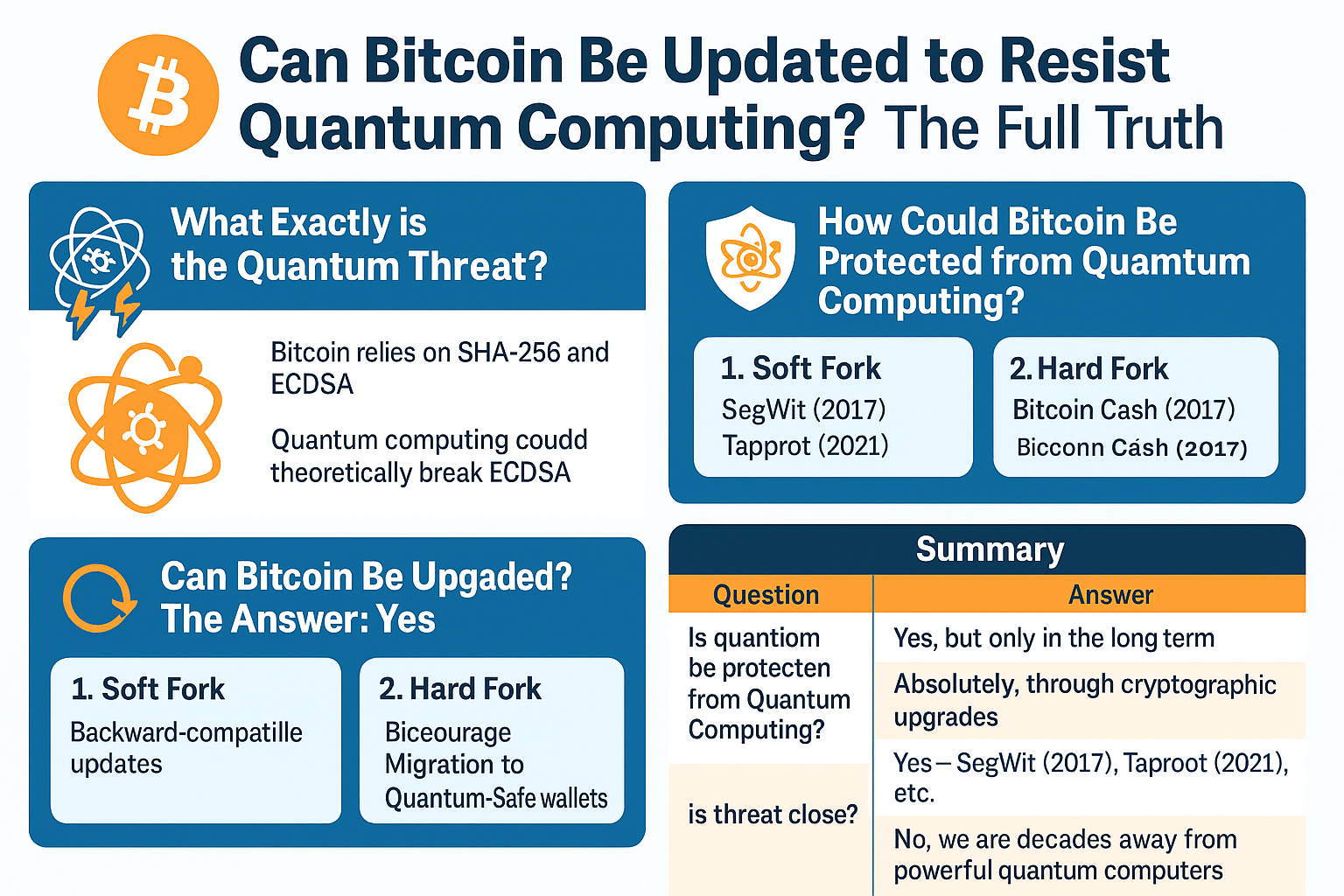
In recent years, there’s been a lot of debate about quantum computing and its potential to break the cryptography behind systems like Bitcoin. Some claim that once humanity reaches a “quantum
In recent years, there’s been a lot of debate about quantum computing and its potential to break the cryptography behind systems like Bitcoin. Some claim that once humanity reaches a “quantum breakthrough,” it could mean the end of Bitcoin.
But is this really true? And can Bitcoin be upgraded to protect itself from this threat?
In this article, we break down the full truth, exploring whether Bitcoin is truly upgradable and how it could defend itself against future quantum threats.
Bitcoin relies on two main cryptographic systems:
- SHA-256: Used for mining blocks and validating data.
- ECDSA: Used to generate digital signatures for wallets and transactions.
Quantum computing, especially Shor’s Algorithm, could theoretically break ECDSA if a quantum computer with 1 million reliable (logical) qubits is built. As of today, we only have machines with a few hundred or thousand noisy, unstable qubits.
✅ The result?
Bitcoin is completely safe for now, and is expected to remain so until at least 2040–2055, according to experts at IBM, NIST, and leading cryptographers.
Bitcoin is not a closed system. It’s open-source and designed to evolve via two main upgrade paths:
1. Soft Fork – Backward-compatible updates
Examples:
- SegWit (2017) – Improved scalability and fixed transaction malleability.
- Taproot (2021) – Enhanced privacy and smart contract efficiency.
2. Hard Fork – Major, non-compatible changes that can split the network if not agreed upon
Example:
- Bitcoin Cash (2017) – Resulted from a disagreement over block size.
This shows that Bitcoin is upgradable when necessary, especially if a clear threat exists.
If quantum computing becomes a real threat, several solutions are already on the table:
1. Switch to Post-Quantum Cryptography
These are cryptographic systems designed to resist quantum attacks, such as:
- XMSS
- SPHINCS+
- Dilithium (now NIST-approved)
2. Encourage Migration to Quantum-Safe Wallets
Users could be prompted to move their coins to addresses using quantum-resistant signatures before quantum threats become realistic.
3. Emergency Hard Fork
If a sudden breakthrough occurs, Bitcoin could undergo an emergency hard fork to secure the network against exploitation.
Yes, and for good reason.
The Bitcoin community is extremely cautious with upgrades. Any major change usually faces:
- Long debates
- Rigorous security audits
- A strong push for global consensus
Still, if the quantum threat becomes clear and imminent, it’s likely that the community would unite to defend the network.
Bitcoin is not a static system. It’s an evolving protocol, built to adapt and survive. With an active developer base and a committed global community, Bitcoin has plenty of time to transition into quantum resistance if or when it’s needed.
The future is safe—as long as we stay alert and proactive.