What Happens to Money During War? Understanding Crypto During War When a missile hits a bank, the money does not vanish. But the way to reach it can. Cash machines stop, apps freeze and branc
What Happens to Money During War? Understanding Crypto During War
When a missile hits a bank, the money does not vanish. But the way to reach it can. Cash machines stop, apps freeze and branches close. So can crypto during war keep money moving, or does it fail exactly when people need it? The honest answer depends on which step of the journey you mean.
Digital tokens can send value across borders fast when a phone and a signal survive.
They struggle at the last step, turning tokens into food, fuel and cash.
Stablecoins suit payments better than Bitcoin. Neither replaces a bank.
What Happens to Money When War Breaks the Banking System?
War rarely deletes money. It cuts access. Branches close, cash runs short and payment networks fail.
Sudan shows how deep this goes. A December 2024 CGAP analysis says only 15% of Sudanese held an account before the war. South Darfur, home to over 3 million people, had no commercial bank branches. The pound has lost more than two thirds of its value against the dollar since September 2023.
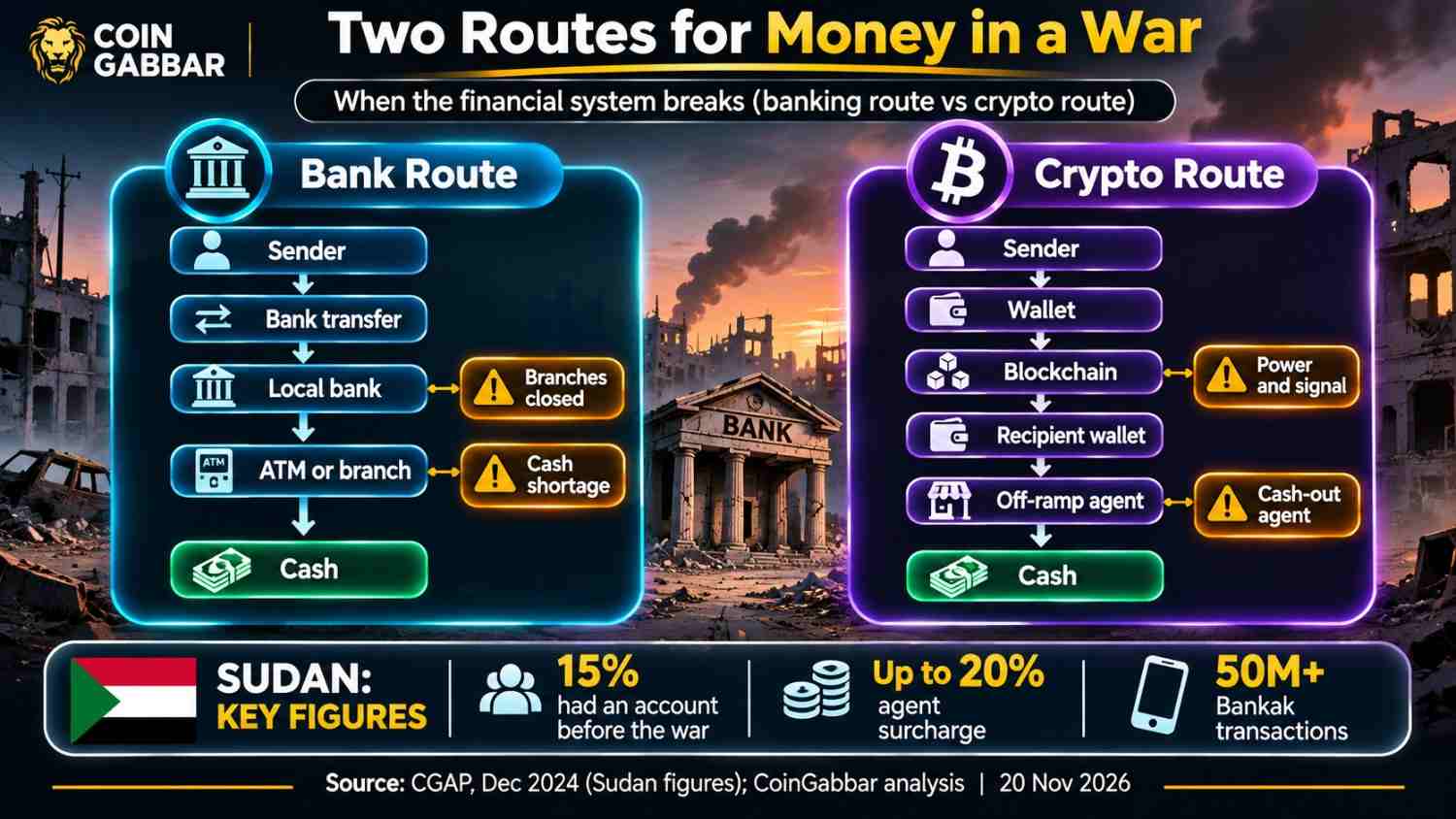
People turned to a bank app called Bankak, which handled over 50 million transactions. Cash still had to come out through agents charging up to 20%. Hawala networks, informal trust-based transfers, filled other gaps.
How Can Crypto During War Move Money When Banks Are Down?
It needs no branch. A person needs a wallet, an app that holds the secret keys controlling funds, as our guide onwhat are crypto wallets explains. Then anyone with a signal can send them value.
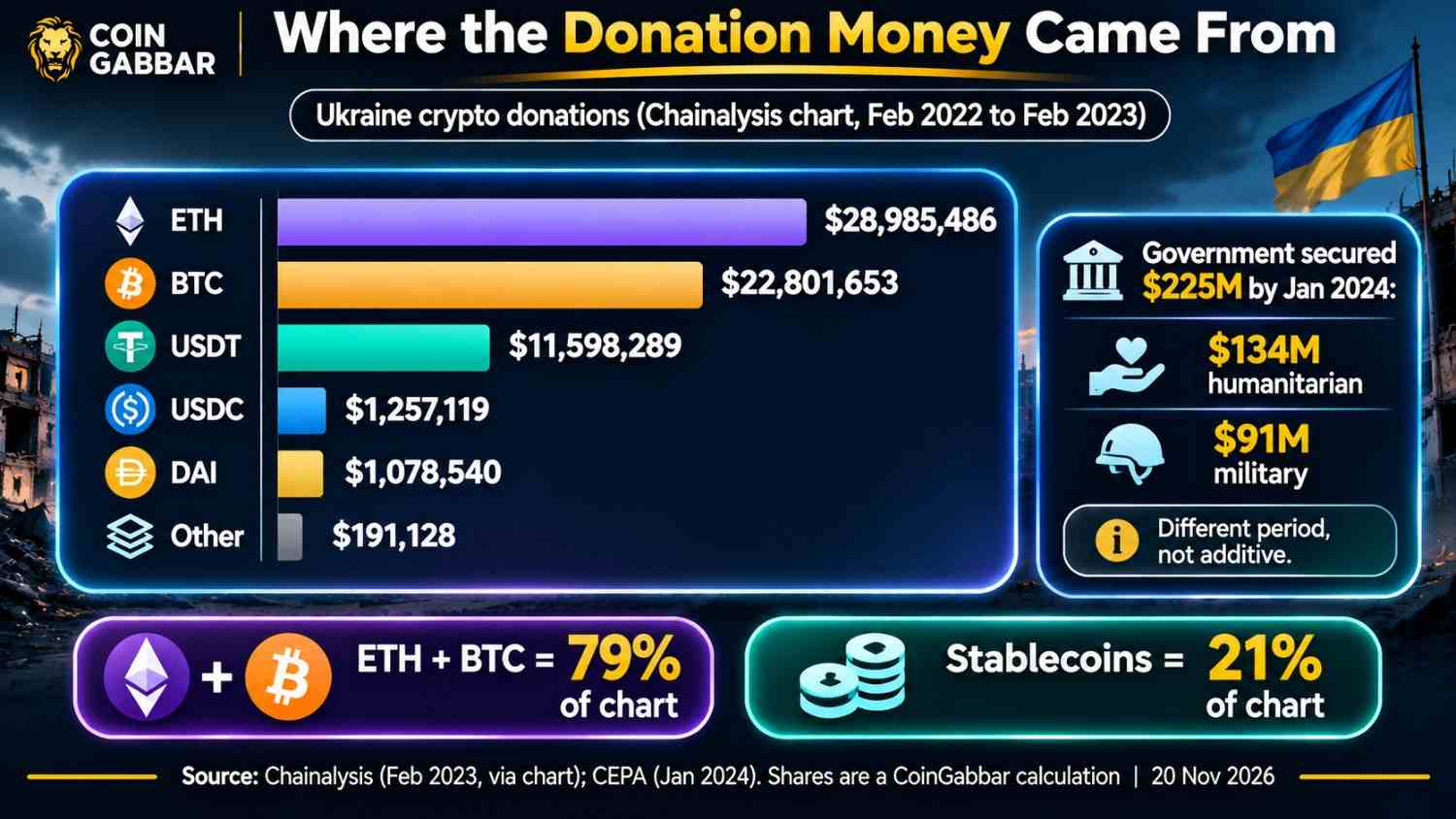
On 26 February 2022, Ukraine’s official account posted addresses accepting Bitcoin, Ether and USDT. Chainalysis later tracked over $70 million donated in roughly a year, with most arriving in the first months.
Ether and Bitcoin made up about 79% of the chart’s total. Stablecoins made up about 21%. This is a CoinGabbar calculation from Chainalysis chart values, so treat it as approximate.
What Did Ukraine’s Crypto Donations Actually Prove?
They proved speed and reach. A CEPA analysis from January 2024 says Ukraine’s government secured $225 million in digital assets, about $134 million for humanitarian use and $91 million for the military. That covers a longer period than the Chainalysis figure, so the two cannot be added.
Officials said about 60% of suppliers accepted digital assets, an unverified claim.
Donations also stayed modest next to traditional aid. Receiving donations is not delivering aid.
Can Digital Money Reach People in Sudan and Other Conflict Zones?
We found no verified source showing token use in Sudan. The documented tools are bank apps, agents and hawala. That gap matters: the rescue claim is not proven everywhere.
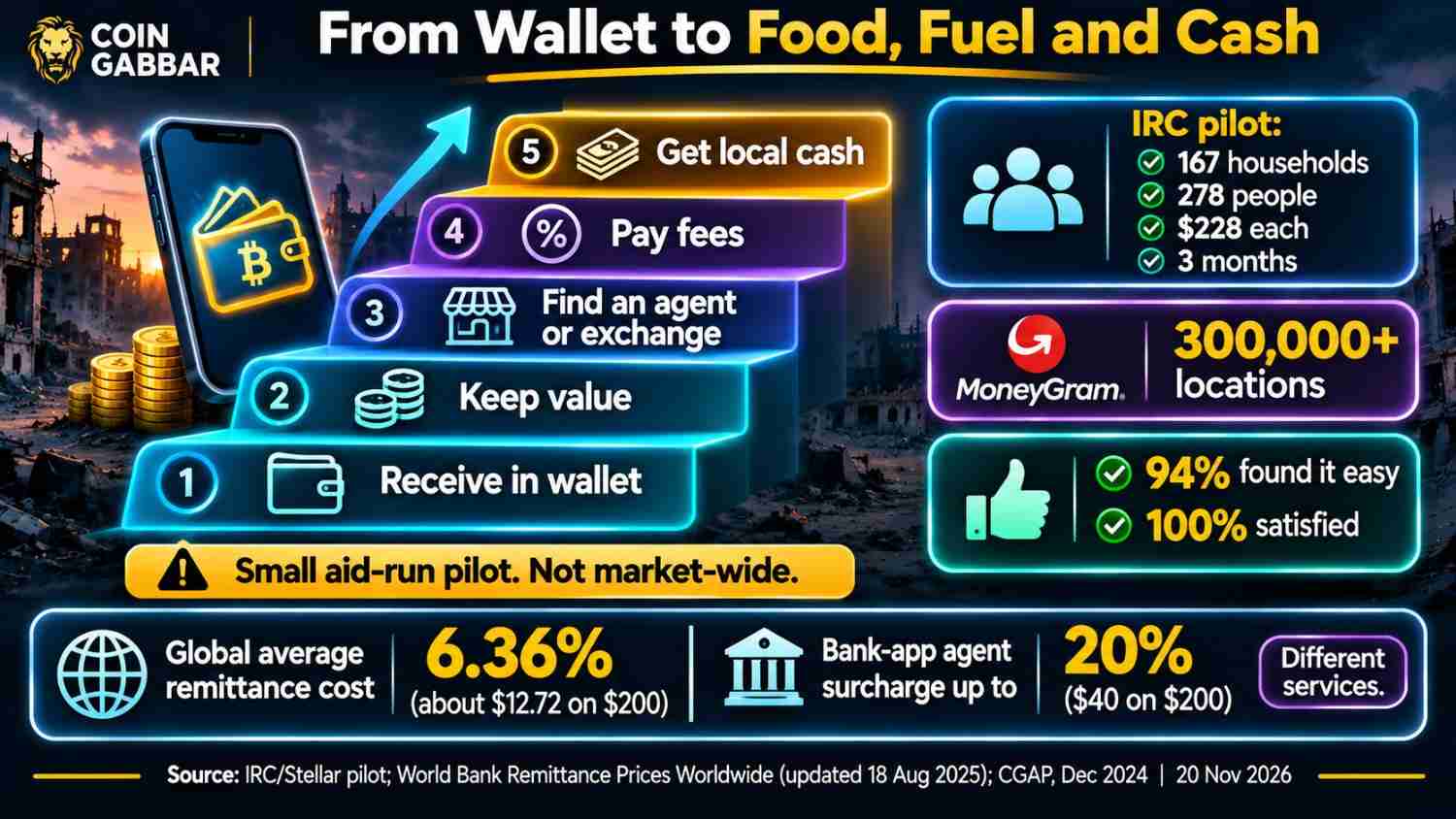
The best tested case of crypto during war is humanitarian. An International Rescue Committee pilot in Ukraine reached 167 households, or 278 people, with $228 each over three months through a phone wallet. Recipients could cash out through MoneyGram, which lists over 300,000 locations.
All recipients reported satisfaction and 94% found it easy. The pilot was small and aid-run, not market-wide.
Which Is More Practical in a Crisis: Bitcoin or Stablecoins?
Stablecoins usually fit payments better. A stablecoin tracks a currency such as the dollar, as ourwhat is a stablecoin guide shows. Bitcoin has no issuer but swings in price.
After strikes on Iran on 28 February 2026, Bitcoin fell to $63,176, then rose about 12% to $71,012 by 25 March, according to market reports. That is a wide range for someone paying rent.
Stablecoins carry issuer risk, including freezes, as ourstablecoin freeze explained page covers.
The BIS says they fail three tests: singleness, elasticity and integrity. It still notes their cross-border use in emerging markets.
What Happens to Crypto When Power and Internet Fail?
It stops. A wallet needs a charged device and a signal to send funds.
In March 2022, monitors said Ukraine’s connectivity dipped about 20% nationally. Mariupol was effectively offline for a week. The network proved resilient overall, and Starlink was switched on.
A lost phone can also mean lost funds. Keep a written backup of the recovery phrase, away from the device.
Why Is Turning Crypto Into Cash the Hardest Step?
This is the last-mile problem: the final step from tokens to food, fuel or local cash. For crypto during war, wallets are easy. Cash agents are the choke point.
A 20% surcharge on $200 is $40. That is a bank-app figure, not a token fee. It shows what agent costs can do. TheWorld Bank puts the global average remittance cost at 6.36%, about $12.72 on $200. See ourremittances guide for options.
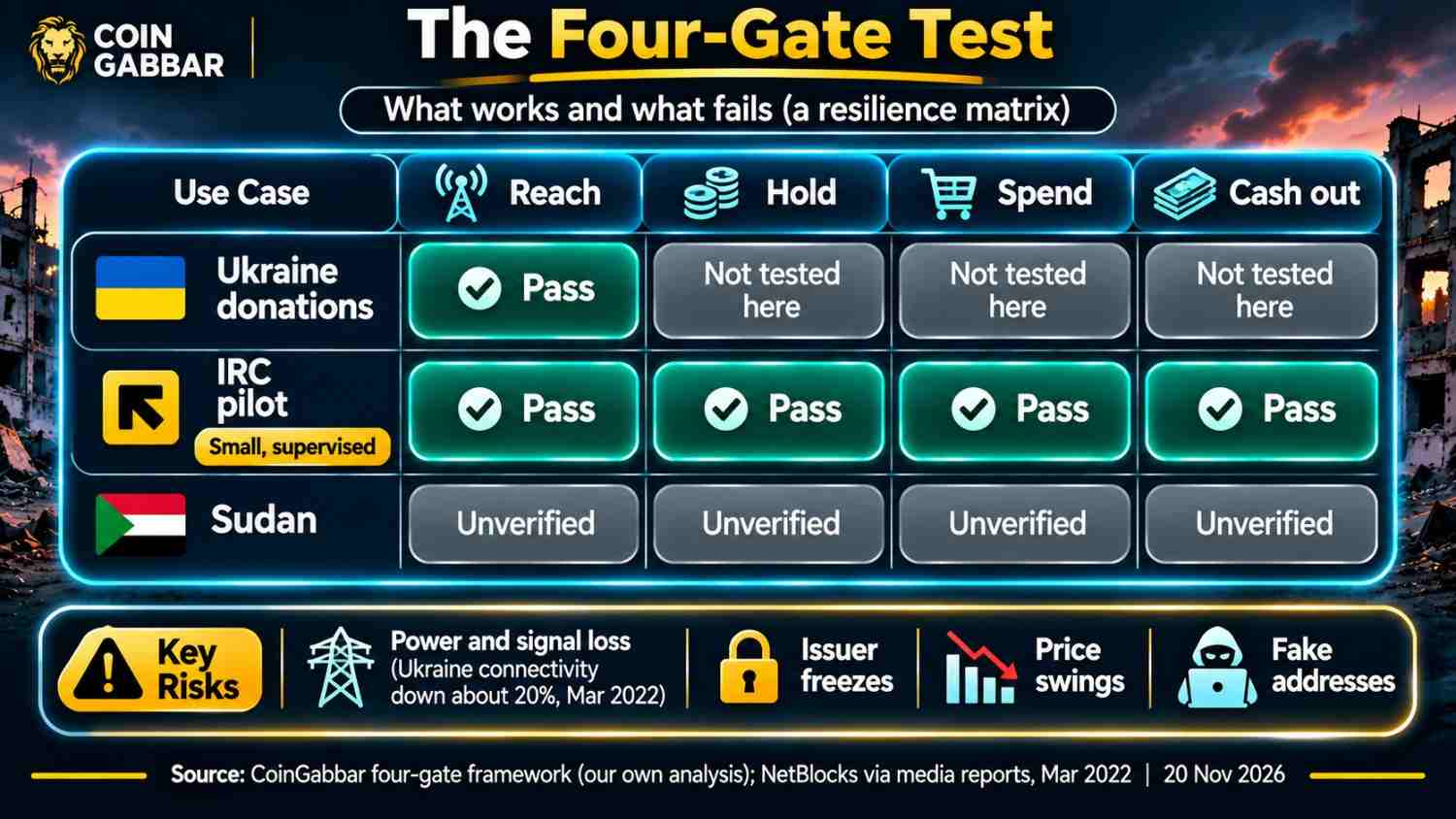
Fake addresses are another danger, as our report onAI crypto scams in 2026 shows. Ukraine’s donations passed Reach. The IRC pilot passed all four, but only in a small supervised setting. Sudan remains unverified.
This framework is our own analysis. It is not from the cited papers.
Which Key Terms Matter When Banks Are Closed?
An off-ramp is a service that turns tokens into local cash. A seed phrase is the recovery code for a wallet.
A bearer asset belongs to whoever holds the keys. Lose them, and nobody can reverse the loss.
The IMF modelled that capital controls can speed up stablecoin adoption, which can weaken the controls. It is a model of small economies, not a war study. Read theIMF note.
Expert Opinion: Can Crypto Ever Replace Banks in a War?
CoinGabbar analysis suggests crypto during war works best as a backup route for sending value, not a replacement for banks.
This view rests on the Ukraine donation data, the IRC pilot, the BIS and IMF assessments, and the missing Sudan evidence.
The strongest case is a stablecoin sent to someone who already has a wallet and a trusted cash-out agent.
Disclaimer: This guide explains documented cases. It is not financial, legal or safety advice. No outcome can be promised or assured. Prices swing sharply, and a lost key or fake address can cause permanent loss, a real risk. Sanctions and local laws differ. Check them before moving funds.