BitcoinWorld Can Someone Start Crypto With Just Rs 100 in India? Can Someone Start Crypto With Just Rs 100 in India? Yes, you can deposit Rs 100 on most Indian crypto exchanges and buy a smal
BitcoinWorld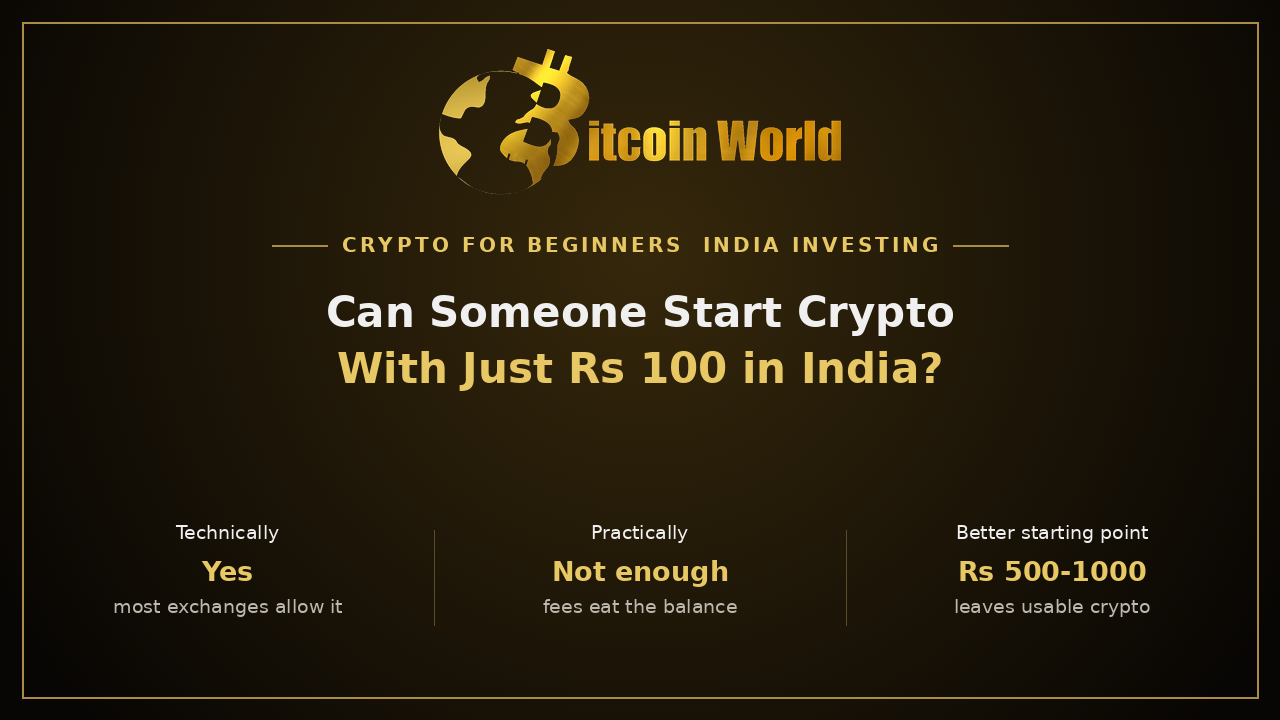 Can Someone Start Crypto With Just Rs 100 in India?
Can Someone Start Crypto With Just Rs 100 in India?
Yes, you can deposit Rs 100 on most Indian crypto exchanges and buy a small fraction of a cryptocurrency. But whether that Rs 100 is a useful investment is a different question entirely. After exchange trading fees, the 1% TDS on any sale, the inability to offset losses against other gains, and the network fees required to ever move your crypto off the platform, a Rs 100 starting amount often gets trapped in a wallet it cannot exit. This article explains exactly what happens to Rs 100 in the Indian crypto market in 2026, and what a more realistic minimum actually looks like.
What Does Rs 100 Actually Buy You?
In rupee terms, Rs 100 buys a very small fraction of any major cryptocurrency.
- Bitcoin: At a Bitcoin price of approximately Rs 70 lakh (around $83,000), Rs 100 buys you roughly 0.0000014 BTC, or about 143 satoshis. You own a real piece of the Bitcoin network, but it is a very small one.
- Ethereum: At approximately Rs 2.5 lakh per ETH, Rs 100 buys you around 0.0004 ETH. Again, a legally owned fraction with a real market value, just a very small one.
- Stablecoins (USDT/USDC): Rs 100 buys you approximately 1.2 USDT at current exchange rates. Stablecoins peg their value to the US dollar, so this holding does not fluctuate in USD terms, though the INR value will move with the dollar-rupee rate.
- The fraction itself is not the problem: Indian exchanges support fractional purchases down to very small units, so owning a tiny fraction of Bitcoin or Ethereum is entirely legitimate. The problem is what happens next.
What Fees and Costs Hit a Rs 100 Investment?
Every step of buying, holding, and eventually selling or withdrawing a Rs 100 crypto position involves costs that are largely fixed regardless of investment size, meaning small investments bear a disproportionately high cost burden.
- Exchange trading fee: Most Indian platforms charge between 0.1% and 0.5% per trade. On a Rs 100 purchase, this comes to Rs 0.10 to Rs 0.50, which is negligible.
- 1% TDS on sale: When you sell your crypto, the exchange deducts 1% of the sale amount as TDS under Section 194S. On a Rs 110 sale, that is Rs 1.10 deducted before the INR reaches your wallet. This TDS is credited to your Form 26AS and counts against your eventual 30% tax liability, but it is still cash out of your hands immediately.
- 30% flat tax on any gain: If your Rs 100 investment grows to Rs 110, the Rs 10 gain is taxed at 30%, meaning Rs 3 in tax is owed at ITR filing time. After TDS and tax, your actual take-home on a 10% return is closer to Rs 6.
- INR withdrawal fee: When you eventually sell and withdraw the rupees to your bank account, most exchanges charge a flat fee between Rs 5 and Rs 25 per withdrawal. On a Rs 100 or Rs 110 balance, this fee is significant as a percentage.
- Network fees if you withdraw crypto: If instead of selling you try to withdraw the crypto itself to a personal wallet, Bitcoin network fees are typically Rs 150 to Rs 500, Ethereum gas fees can be Rs 500 or more, and even low-fee networks like Solana charge around Rs 1 to Rs 5. A Rs 100 Bitcoin holding simply cannot be withdrawn to a personal wallet economically.
What Minimum Trade Sizes Do Exchanges Actually Enforce?
This is where many first-time investors discover that the Rs 100 deposit minimum and the minimum trade size are two very different things.
- CoinDCX: Enforces minimum trade values that in practice require holdings worth more than Rs 100 before a sell order can be placed on many trading pairs.
- ZebPay: Similarly applies minimum order sizes that are expressed in crypto units, which at current prices can exceed the rupee value of a Rs 100 deposit.
- WazirX: Minimum trade sizes vary by coin and trading pair, with some pairs requiring a minimum of 0.001 BTC or equivalent, which at current prices is well above Rs 100.
- The practical outcome: You deposit Rs 100, buy a fraction of a coin, and then find you cannot sell that fraction because it falls below the minimum sell order size. Your money is stuck on the exchange until prices rise enough to push your holding above the minimum, or until you add more funds.
What Is a Realistic Minimum That Actually Works?
For a Rs 100 investment to avoid the traps above, you really need to invest closer to Rs 500 to Rs 1,000 as a starting amount.
- Rs 500: Clears the minimum trade size on most Indian platforms for major coins like Bitcoin and Ethereum. Leaves enough after trading fees to place a sell order when you want to exit. Still small enough to represent very manageable risk for a first-time investor.
- Rs 1,000: A more comfortable floor. Covers trading fees, clears minimum trade sizes reliably, leaves a INR balance large enough to withdraw after the withdrawal fee, and gives you room to absorb a modest price drop without your holding becoming economically worthless to sell.
- Rs 2,000 to Rs 5,000: The range at which the investment starts to make practical sense even if you plan to eventually move your crypto off the exchange into a personal wallet, since this range can cover both the asset and the network withdrawal fee on most blockchains.
Is There a Way to Invest Meaningfully With Very Small Amounts?
There are a few approaches that make small amounts more workable for Indian crypto investors.
- Systematic Investment Plan style crypto buying: Many Indian platforms now allow you to set up recurring purchases of a fixed rupee amount on a daily, weekly, or monthly basis. Even Rs 200 per week compounds meaningfully over time and keeps your average cost smooth, while each individual purchase stays within the platform and avoids withdrawal fee issues until your total holding grows large enough to warrant moving.
- Stablecoins as a first step: Buying USDT or USDC with Rs 100 to Rs 500 lets you learn the platform mechanics without exposure to price volatility. When you are ready to buy Bitcoin or Ethereum, you can convert your stablecoin holding rather than making a fresh INR deposit.
- Choosing low-fee chains: If you want to eventually self-custody your holdings, starting with assets on Solana, Polygon, or BNB Chain rather than Bitcoin or Ethereum means your future withdrawal costs stay under Rs 10, making small self-custody positions economically viable.
Frequently Asked Questions
Will my Rs 100 crypto investment grow?
It might. Crypto prices are volatile and can increase as well as decrease. A Rs 100 investment in Bitcoin one year ago would be worth more today, but a Rs 100 investment at other points in history would be worth less. No crypto investment comes with a guarantee of growth, and the 30% flat tax means your after-tax returns are always lower than the raw price movement suggests.
Can I withdraw Rs 100 worth of Bitcoin to my own wallet?
Not economically. Bitcoin network fees for a withdrawal typically range from Rs 150 to Rs 500 depending on congestion, which means the fee would exceed the value being withdrawn. To make a Bitcoin self-custody withdrawal economically sensible, your holding needs to be significantly larger than the network fee, which in practice means holding at least Rs 2,000 to Rs 5,000 worth of BTC before the move makes financial sense.
What is the smallest amount of crypto an Indian exchange will let me buy?
Most platforms express their minimums in crypto units rather than rupees. For Bitcoin on most Indian exchanges, the minimum is typically 0.0001 BTC. At current prices, that minimum is worth approximately Rs 700. This is why a Rs 100 deposit may not be enough to actually execute a Bitcoin trade even if the deposit itself is accepted.
Conclusion: Rs 100 Can Get You Started But Not Very Far
Starting crypto in India with Rs 100 is technically possible but practically limited. The exchange will accept your deposit, but minimum trade sizes, network fees, and the mechanics of the 1% TDS and 30% tax mean that Rs 100 quickly runs into walls that larger investments do not face. For most first-time Indian crypto investors, Rs 500 is the true usable floor for a single investment, and Rs 1,000 is the amount at which the experience starts to feel like a real investment rather than an exercise in navigating fee structures. Start with whatever amount you are comfortable losing entirely, keep it on a registered exchange until your holding is large enough to withdraw economically, and build your knowledge before your position size.
This post Can Someone Start Crypto With Just Rs 100 in India? first appeared on BitcoinWorld.