Key Insights: Zcash (ZEC) price climbed from $60 to $1,500, yet Grayscale sees room for growth. ZEC crypto now equals 1.5% of Bitcoin’s market cap, up from below 0.1%. Privacy could help Zcas
Key Insights:
- Zcash (ZEC) price climbed from $60 to $1,500, yet Grayscale sees room for growth.
- ZEC crypto now equals 1.5% of Bitcoin’s market cap, up from below 0.1%.
- Privacy could help Zcash capture more market share, Grayscale says.
The Zcash price has come a long way since November 2, 2025, when a $100,000 ZEC target from analyst Baron Dominus was drawing attention.
Nearly 11 months later, the debate around Zcash looks less about an eye-catching target. It’s more about something measurable: how much ground the privacy coin can take from Bitcoin.
Grayscale’s September 29 research put that question at the center of its latest Zcash analysis. The firm said Zcash had risen from about $60 to roughly $1,500 over the past year.
ZEC’s market capitalization increased from less than 0.1% of Bitcoin’s to about 1.5%. Grayscale said that shift should not be viewed as a valuation ceiling.
That is a different way to read the Zcash price rally.
Zcash Price Has Moved Faster Than Its Bitcoin Share
The Zcash price move is difficult to miss. From the roughly $60 level cited by Grayscale a year ago to around $1,500, ZEC has gained about 25 times.
Yet its market capitalization is still only around 1.5% of Bitcoin’s. For Grayscale research, that gap matters more than the headline rally.
Bitcoin remains the dominant asset within Grayscale’s Currencies Crypto Sector. The category includes 11 qualifying cryptocurrencies, including Bitcoin, Zcash, XRP, and Litecoin.
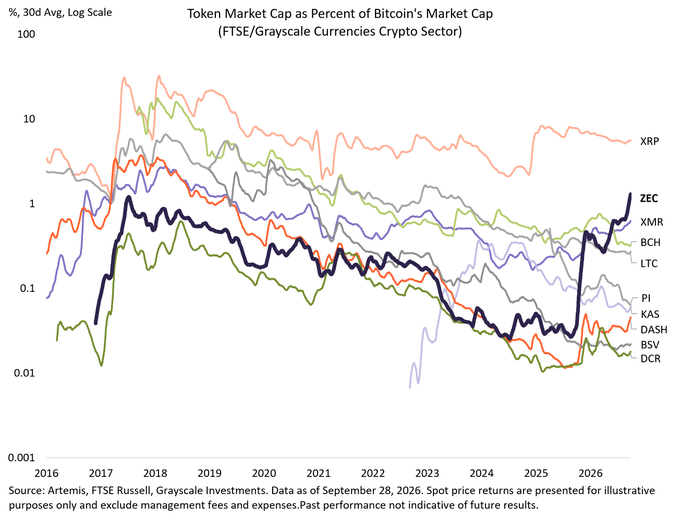
Zcash (ZEC) Market Cap as Percentage of BTC Market Cap | Source: Grayscale
Grayscale argues that Zcash’s rise should be viewed against the history of competition within that group rather than against Bitcoin alone.
XRP, for example, currently represents nearly 6% of Bitcoin’s market capitalization. During the 2017–18 market cycle, XRP, Bitcoin Cash, Litecoin and Dash each reached at least 3% of Bitcoin’s market cap. Zcash has not reached that historical threshold. That is the point Grayscale is making.
Zcash Price Now Rests on the Privacy Argument
The ZEC crypto case differs from older attempts to compete with Bitcoin because privacy is central to the network.
Zcash uses zero-knowledge proofs known as zk-SNARKs to shield transaction information. Grayscale’s broader research argues that privacy demand could increase as digital surveillance and analysis become more sophisticated.
The firm sees that feature as a potential source of additional market share. The Zcash price has already reflected part of that narrative.
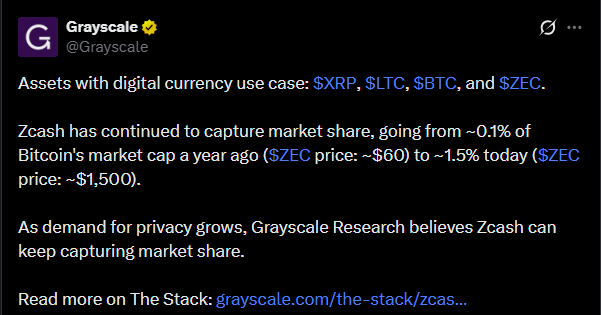
Zcash Can Keep Capturing Market Share | Source: Grayscale Research
In September, another Coin Republic comparison showed ZEC had gained about 174% over a three-month period, compared with roughly 31% for Bitcoin.
The same report said ZEC dominance rose from about 0.14% in March 2025 to as high as 0.80%. It cited Grayscale research on Zcash’s mining economics.
Those figures describe a sharp change in relative market activity. They do not establish where ZEC goes next.
The Old $100,000 Call Looks Very Different Now
The contrast with the November 2025 story is striking. On November 2 last year, Zcash was trading around $418, according to historical market data.
The Coin Republic report that day focused on Baron Dominus’ projection that ZEC could “explode to $100,000 this cycle.” Another market watcher highlighted similarities between Zcash’s chart and Bitcoin’s 2013 price structure. That was a price-prediction story.
Grayscale’s current thesis is not. It is built around relative market capitalization and the size of the digital-currency sector. That distinction matters. A token can rise sharply without materially challenging a much larger asset.
Grayscale’s argument is that Zcash does not need to replace Bitcoin to capture a meaningful share of the market.
A separate September 14 report quoted Arca’s head of research Katie Talati. She described a growing divide between early Bitcoin users and the asset’s increasingly institutional profile.
She said some crypto veterans were looking toward assets that still feel “private and uninstitutionalized.” She named Zcash among the names benefiting from that interest.
That does not prove a direct migration from Bitcoin into ZEC. It does, however, add context to Grayscale’s privacy thesis.
The Market-Share Question Is Now Bigger Than the Price Chart
Grayscale’s central claim is straightforward: Zcash has already taken a larger slice of the digital-currency market, but its slice remains small relative to Bitcoin.
The move from less than 0.1% to roughly 1.5% of Bitcoin’s market capitalization is substantial. It is also not unprecedented.
XRP’s nearly 6% share today and the 3% levels reached by several major altcoins during the 2017–18 cycle provide historical reference points. That does not make those outcomes a forecast for ZEC.
The post Can Zcash Price Keep Closing the Gap With BTC? Grayscale Weighs In appeared first on The Coin Republic.