This is the Crypto Market and Macro Asia Session roundup for the window 00:00 UTC to 11:59 UTC on November 24, 2026, covering five stories. According to the cited reports, the US Dollar Index
This is the Crypto Market and Macro Asia Session roundup for the window 00:00 UTC to 11:59 UTC on November 24, 2026, covering five stories. According to the cited reports, the US Dollar Index climbed to a 20-month high of 104.53 while USD/CAD held near 1.437 as the Canadian dollar approached an 18-month low, setting a broadly bearish macro tone ahead of Wednesday's US PCE inflation print and reinforcing reported de-risking signals from 42 Macro and Arthur Hayes on Bitcoin. Market, policy and company figures are attributed to the cited outlets and have not been independently verified here.
Key Takeaways
- USD/CAD traded at approximately 1.437 as the Canadian dollar neared an 18-month low, with the Bank of Canada's December 9 rate decision split nearly evenly between a smaller hike and a hold, per Crypto Briefing.
- 42 Macro founder Darius Dale stated the firm had de-risked out of Bitcoin entirely and outlined a potential downside target of approximately $38,400 if the S&P 500 falls 20% from its October 6 peak, per CoinTelegraph.
- Arthur Hayes argued on X that Nvidia's 31% share gain following Jensen Huang's reinstatement as CEO was the worst possible outcome for crypto, as a resilient equity market reduces Federal Reserve urgency to ease, per KuCoin News.
- The US Dollar Index reached 104.53 on November 24, its highest level since March 2025, with October PCE inflation data due Wednesday at a consensus estimate of 3.8% year over year, per InvestingCube and FXStreet.
- Gemini appointed former US Treasury Assistant Secretary John York as Chief Operating Officer effective November 18, 2026, as the exchange reported a Q3 2026 net loss of $58.6 million, improved from $159.5 million a year earlier, per Crypto Briefing.
USD/CAD Holds Near 1.437 as Canadian Dollar Nears 18-Month Low Ahead of US PCE Data
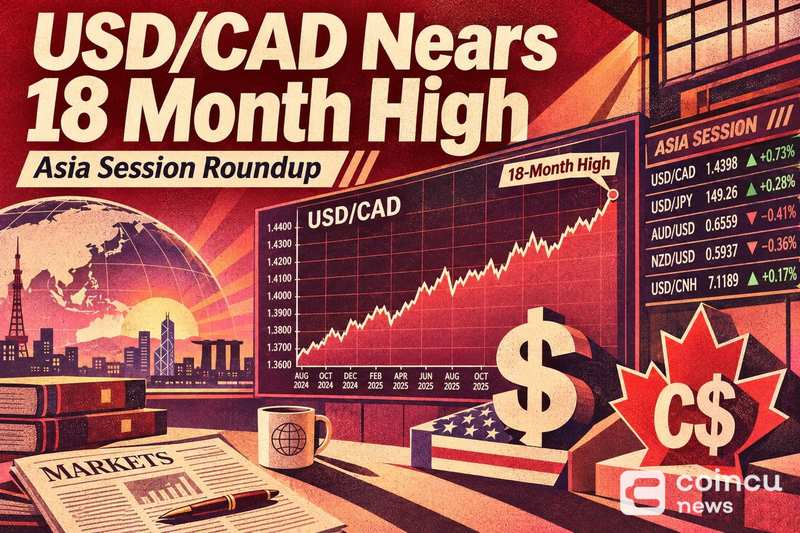
The USD/CAD pair traded at approximately 1.437 during the Asia session, with the Canadian dollar near an 18-month low against the US dollar, according to Crypto Briefing. The weakness persisted despite the Bank of Canada having recently raised its policy rate to 2.50%, a move that failed to arrest CAD's slide as dollar-index strength overpowered the domestic rate impulse. For related coverage, see Bitmine ETH Treasury: Asia Session Roundup, Nov. 18, 2026.
Prediction markets ahead of the Bank of Canada's December 9, 2026 decision showed 50.5% odds for a smaller hike and 49% odds for a hold, with the probability of a hike of 50 basis points or more standing at just 0.1%, per Crypto Briefing. The near-even split reflects diminished conviction about the BoC's next move as inflation dynamics and labour data remain ambiguous. Context on this theme: Decibel pre-deposits exceed $50M as month-end launch nears.
The proximate catalyst for the next leg of USD/CAD volatility is October US PCE inflation data due Wednesday, November 25. The PCE reading is the Fed's preferred inflation gauge and the last major data input before the Federal Reserve's December meeting; a hotter-than-expected print would reinforce the case for continued tightening, adding further pressure to CAD and other risk-sensitive currencies. For traders watching the crypto-macro intersection, a surging US dollar raises global borrowing costs and historically compresses appetite for risk assets including Bitcoin, a dynamic that played out visibly during the Asia session roundup from November 18. More on this in Ledger-Related Wallet Draining Incident Nears $90M in Losses.
42 Macro's Darius Dale Has De-Risked From Bitcoin, Eyes Re-Entry When Indicators Turn Neutral or Bullish
42 Macro founder Darius Dale said his firm had fully exited its Bitcoin position and was waiting for proprietary indicators to shift from bearish to neutral or bullish before re-entering, according to CoinTelegraph. Dale stated: "We've already de-risked out of Bitcoin. Our stress levels are low. We're just waiting to buy." The de-risking came as Bitcoin posted a recent two-year low near $55,100, a level cited by CoinTelegraph from 42 Macro's research but not independently cross-checked against exchange data.
42 Macro outlined approximately $38,400 as a potential Bitcoin downside target in a scenario where the S&P 500 falls 20% from its October 6 peak; the index was down approximately 7.4% from that peak at the time of the report. Dale framed the thesis around liquidity rather than fundamentals, stating: "Bitcoin doesn't generate earnings. Bitcoin needs liquidity to go up."
Looking further out, 42 Macro expected favorable conditions for Bitcoin around mid-2027, with Dale calling 2027 "a phenomenal year for stocks, gold, Bitcoin" contingent on a Fed pivot he placed in late June or early Q3 2027 as inflation eases, per CoinTelegraph. The firm's public de-risking adds institutional weight to the current bearish near-term read and sets a concrete re-entry framework traders can track against incoming macro data. Bitcoin traded at $60,198 as of November 24, 2026, down 1.71% over 24 hours and down 25.22% over 30 days, per CoinGecko.
Arthur Hayes Says Nvidia's 31% Rally Is the Worst Outcome for Crypto, Argues US Equities Must Fall to Trigger Fed Liquidity
BitMEX co-founder Arthur Hayes posted on X on November 23 that Nvidia's surge was counterproductive for digital assets, writing: "The $NVDA pump is the worst thing that could happen for our crypto bags. We need US equities to burn so the Fed prints," according to KuCoin News. The post followed Nvidia shares rising 31% after Jensen Huang was reinstated as CEO, a move that wiped $12.2 billion from short sellers, per KuCoin News.
Hayes's argument rests on a specific causal chain: a resilient Nasdaq-led equity rally removes the financial-stability pressure that would otherwise compel the Fed to inject liquidity, and without that liquidity injection, Bitcoin lacks the monetary tailwind it needs to recover. Spot Bitcoin ETFs recorded $4.71 billion in net outflows in November 2026, per KuCoin News, consistent with the institutional capital reallocation Hayes's framework implies.
Bitcoin was down approximately 25% over 30 days and trading near $60,000 as of the session, on pace for what KuCoin News described as its worst November since 2018. The total crypto market cap stood at approximately $2.06 trillion, down 4.13% over 24 hours, with BTC dominance at 58.65%, per CoinGecko global data as of November 24, 2026. The Crypto Fear and Greed Index sat at 11, labeled Extreme Fear, per Alternative.me.
US Dollar Index Hits 20-Month High at 104.53 as PCE Inflation Test Looms on Wednesday
The US Dollar Index reached 104.53 on Monday, November 24, its highest level since March 2025, marking a 20-month peak, per InvestingCube. The DXY gained approximately 2.3% in November, which InvestingCube described as its strongest November performance in a decade, though that decade comparison rests on a single source and has not been independently verified. New York Fed President John Williams said on Monday that persistent inflation continued to justify tighter monetary policy, per InvestingCube.
October PCE inflation, the Federal Reserve's preferred price gauge, was expected at 3.8% year over year ahead of Wednesday's release, making it the last major inflation data point before the Fed's December meeting, according to FXStreet. TD Securities expected the Fed to hike rates three consecutive times starting in December 2026, per InvestingCube. Treasury yields had reached 5.15% on November 13, contributing to a broader selloff in technology stocks, though that figure comes from a single InvestingCube report and has not been cross-checked against official Treasury data.
A DXY above 104 amplifies selling pressure on crypto and emerging-market assets by raising global dollar-denominated borrowing costs and reducing appetite for non-yielding risk assets. Wednesday's PCE print is the pivotal near-term event: a reading above 3.8% would firm December Fed hike expectations and could push the DXY higher, while an in-line or softer outcome could ease dollar strength temporarily and reduce near-term selling pressure on Bitcoin. The prior Bitcoin rally toward $79,000 coincided with a period of softer dollar conditions, illustrating how directly DXY direction has tracked crypto momentum in recent months.
Gemini named John York as Chief Operating Officer effective November 18, 2026, filling a role vacant since February 2026 when COO Marshall Beard, the CFO, and the CLO departed simultaneously, according to Crypto Briefing. York is a former US Treasury Assistant Secretary who managed a 1,200-person workforce and contributed to workforce reductions totaling 28,000 employees that generated over $5 billion in annual savings, per the same report.
York joined Gemini in July 2026 as VP of Operations and was promoted to COO after roughly four months. His compensation package includes a $400,000 base salary and 304,878 restricted stock units vesting over four years, per Crypto Briefing. Gemini reduced its workforce by approximately 25% and exited certain international markets earlier in 2026.
The exchange reported a Q3 2026 net loss of $58.6 million, improved from a $159.5 million loss in Q3 2025, as operating expenses dropped 30% to $119.9 million, per Crypto Briefing. The appointment of a former senior Treasury official as COO signals an effort to bolster operational credibility and regulatory standing at a critical point in the exchange's recovery, though Crypto Briefing does not assert that the hire changes Gemini's financial trajectory. For context on the broader regulatory environment shaping exchange hiring decisions, the CLARITY Act's progress toward a Senate vote remains a live variable for US-domiciled crypto firms.
Session Outlook: What These Stories Add Up To
Outlook as of 11:59 UTC on November 24, 2026, based on reports reviewed during the session window. Source-publication dates are listed separately below and may fall outside that window.
Overall read: Bearish. Four of the five scorecard items describe a tightening macro regime driven by reported dollar strength and reduced Fed pivot urgency, with 42 Macro's Bitcoin de-risking and Hayes's liquidity-delay argument adding weight to the downside case. Only Gemini's COO appointment carries a positive operational signal, and it is isolated from the macro narrative.
- USD/CAD near 1.437 and Canadian dollar at 18-month low (Nov 23, 2026, Crypto Briefing): Negative for Crypto Market and Macro, because a strengthening dollar raises global borrowing costs and reduces appetite for risk assets including Bitcoin.
- 42 Macro de-risks Bitcoin (Nov 24, 2026, CoinTelegraph): Negative for Crypto Market and Macro, because the firm's conditional downside scenario reflects a cautious near-term view.
- Arthur Hayes warns Nvidia's 31% rally delays Fed easing (Nov 24, 2026, KuCoin News): Negative for Crypto Market and Macro, because a resilient equity market led by AI-sector strength removes the financial-stress trigger Hayes identifies as the primary catalyst for Fed liquidity and a Bitcoin recovery.
- DXY hits 104.53, 20-month high, with PCE due Wednesday (Nov 24, 2026, InvestingCube/FXStreet): Negative for Crypto Market and Macro, because a multi-year dollar peak ahead of a potentially hot PCE reading raises the probability of additional Fed tightening and sustained crypto headwinds.
- Gemini names John York as COO effective November 18 (Nov 24, 2026, Crypto Briefing): Positive for Crypto Market and Macro, because filling a nine-month executive vacancy with a former Treasury official signals operational stabilization and regulatory credibility at a major US exchange.
The scorecard lists four Negative labels, one Positive label, and no Neutral labels.
Connecting the dots: The four bearish items are not independent; they point to a single underlying force. Nvidia's AI-driven equity rally suggests the US economy's most watched growth sector remains robust, reducing financial-stability pressure on the Fed and supporting the case for additional rate hikes, which TD Securities expects to begin in December. That Fed hawkishness is the common driver behind the DXY's 20-month high, the CAD's 18-month weakness, and the liquidity drought 42 Macro and Hayes each describe as the central obstacle for Bitcoin. The Fear and Greed Index reading of 11, Extreme Fear per Alternative.me, reflects how deeply that macro regime has been absorbed by crypto market participants.
What could happen next: If Wednesday's October PCE inflation data prints above the 3.8% year-over-year consensus cited by FXStreet, Fed December hike expectations will firm further, the DXY may press higher, and Bitcoin could test the intermediate support range 42 Macro described in the coming sessions. If PCE prints in-line or softer than expected, dollar strength could ease temporarily, reducing near-term selling pressure on crypto and potentially triggering a short-cover bounce from the deeply oversold Fear and Greed level, over the next few sessions. If the S&P 500 continues to draw support from AI-sector earnings through year-end, the Fed pivot 42 Macro expects around late June or early Q3 2027 would remain the dominant medium-term timeline for a durable Bitcoin recovery.
This outlook is editorial analysis based on the reports above and is not financial advice.
What to Watch Next
- US October PCE inflation data, due Wednesday, November 25, 2026: consensus estimate of 3.8% year over year, the last major inflation input before the Federal Reserve's December meeting, per FXStreet.
- Bank of Canada December 9, 2026 rate decision: prediction markets show 50.5% odds for a smaller hike and 49% odds for a hold, per Crypto Briefing.
This roundup summarizes reporting reviewed from 00:00 UTC on November 24, 2026 to 11:59 UTC on November 24, 2026. Source-publication dates may differ from the session window. Each item links to its original source.
Editorial credits
MA
Mayowa Adebajo
Writer · Coincu
HN
Haruto Nakamura
Editor · Coincu
Monitors published articles around the clock and can correct or withdraw them.
Checked by Coincu QC Team before publishing on November 24, 2026 for headline accuracy, original value, metadata, commercial disclosure, authorship claims and risk disclosure: our AI review system checks every article before it goes live, and our editor monitors it after publication. Report an error.
Coincu uses AI for research, drafting and review. Our editorial team is responsible for every article and corrects or withdraws articles when needed. How we review.
Disclaimer: This article is for informational purposes only and does not constitute financial or investment advice. Cryptocurrency and digital asset markets carry significant risk. Always do your own research before making decisions.
The post Canadian Dollar Nears 18-Month Low as USD/CAD Holds Near 1.437: Asia Session Roundup was initially published on Coincu.