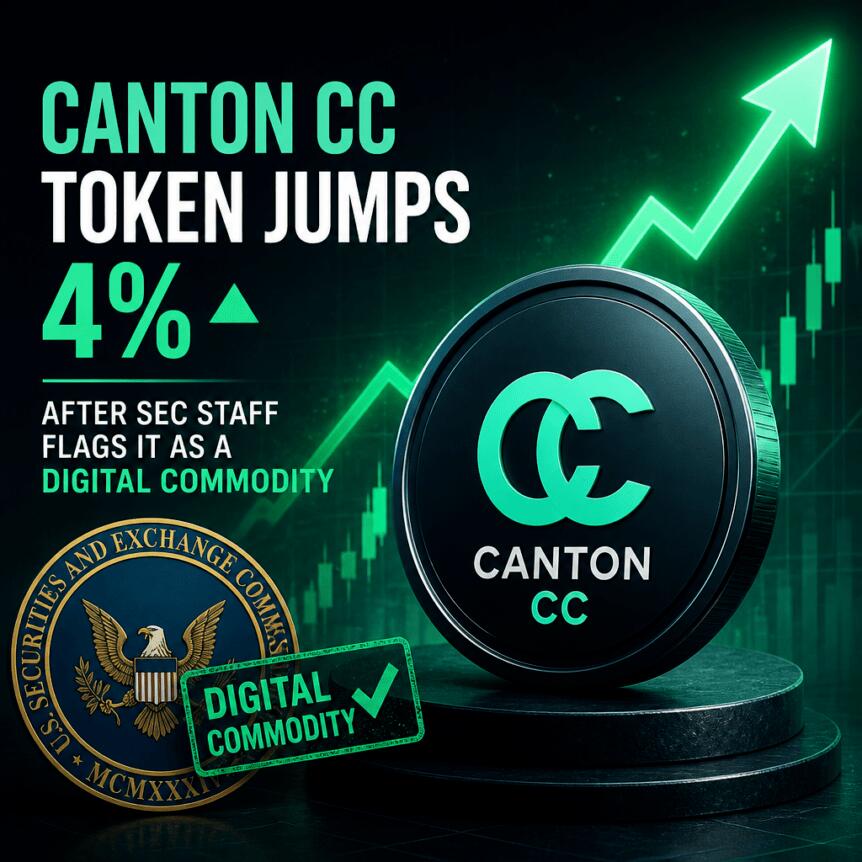
Canton Network’s native token, Canton Coin (CC), jumped about 4% on Wednesday after the US Securities and Exchange Commission’s (SEC) Division of Corporation Finance issued a no-action letter
Canton Network’s native token, Canton Coin (CC), jumped about 4% on Wednesday after the US Securities and Exchange Commission’s (SEC) Division of Corporation Finance issued a no-action letter that, in the agency staff’s view, treats the asset as a “digital commodity.”
At 10:27 am UTC, CC was trading around $0.098, according to CoinMarketCap, though it remained down roughly 4.2% on the week. The move is notable not just for the price reaction, but because the SEC’s staff explained why, based on the token’s proposed issuance and distribution, it does not anticipate enforcement action tied to the current structure.
Key takeaways
- The SEC staff’s no-action letter indicates it views CC as a “digital commodity,” tied to network usage rather than profits from a central team.
- The letter suggests the SEC would not recommend enforcement action over CC’s issuance without securities registration, if tokens are created under the conditions outlined by Canton.
- Canton’s filings emphasize that participants earn CC through operating infrastructure and applications, with protocol rules governing minting based on activity.
- This outcome aligns with the SEC’s March guidance distinguishing digital commodities from securities—while still leaving room for securities-law risk in how tokens are offered and sold.
Why the SEC staff letter moved the market
In a Tuesday letter, the SEC’s Division of Corporation Finance accepted Canton’s explanation that the token’s value is driven by how the network operates and by demand for CC-linked access or participation, rather than by efforts by a promoter expected to generate profits for holders.
While such letters are not a formal court ruling or a binding determination of legal status, they can be market-relevant because they reflect the SEC staff’s current enforcement posture under specific fact patterns. For token issuers and investors, that distinction matters: it can reduce near-term regulatory uncertainty, but it does not eliminate the need to analyze sales, marketing, and secondary-market behavior under securities laws.
How Canton says CC is earned and minted
The regulatory context of the letter centers on the mechanics of CC’s issuance. In a Friday filing to the SEC, Canton developer Digital Asset stated that network participants earn CC by operating infrastructure and applications, with the protocol determining token minting limits based on activity.
That framing is designed to address a core question regulators often ask in crypto cases: whether the economic reality resembles an investment contract—where profits depend on the efforts of others—or a commodity-like asset whose value is linked primarily to network usage and market demand.
The no-action letter also states that SEC staff would not recommend enforcement action over CC’s issuance without securities registration, provided tokens are issued under the conditions described by Canton in its submission. For market participants, the practical implication is that adherence to those conditions remains central; changes to token distribution or how participants are compensated could affect how the letter applies.
Digital commodities vs. securities: the SEC’s March framework
The Canton decision sits within a broader SEC approach laid out earlier this year. The SEC issued guidance in March distinguishing digital commodities—such as Bitcoin and Ether—from securities. The agency’s position in that guidance is that while certain tokens may not be securities themselves, the way they are offered and sold can still trigger securities-law obligations.
That nuance matters for holders and exchanges. Even if SEC staff describes a token as a digital commodity for purposes of enforcement risk in a particular issuance scenario, market actors still need to consider whether fundraising, promotion, distribution, and trading practices introduce securities-law concerns.
The SEC staff’s letter to Canton also carries an important boundary: it reflects the views of staff and the specific request presented. As the filing materials and SEC posture indicate, it is not a binding ruling that permanently settles the question for all circumstances.
No-action letters continue to set guardrails across the sector
Earlier token-related no-action letters from SEC staff show a pattern of targeted regulatory engagement with crypto projects. The SEC staff previously issued no-action guidance to projects including DoubleZero (2Z) in September 2025 and the Solana-native decentralized physical infrastructure network (DePIN) project Fuse in November 2025.
For investors and builders, these letters function less like blanket approvals and more like guardrails: they can clarify what structures regulators are willing to tolerate under current enforcement priorities. They also underscore that the SEC’s focus is not solely on the token’s underlying technology, but on how economic benefits are produced and distributed.
In Canton’s case, the SEC staff’s acceptance of Canton’s explanation—centering network operation and participant activity—helps reinforce the agency’s commodity framing when a token’s economics are sufficiently tied to decentralized participation rather than a profit-seeking managerial effort.
Looking ahead, market participants should watch whether Canton’s issuance and operating incentives continue to match the conditions described in the SEC staff letter, and whether any changes to token distribution, promotion, or participation rules could alter the regulatory risk profile. As always, the question is unlikely to end with a single letter—particularly given the SEC’s longstanding view that securities concerns can arise from the offer and sale, even when a token is characterized as more commodity-like.
This article was originally published as Canton CC Token Jumps 4% After SEC Staff Flags It as a Digital Commodity on Crypto Breaking News – your trusted source for crypto news, Bitcoin news, and blockchain updates.