The Cardano Foundation added ADA support to the official x402 software kit, furnishing developers with the code to build apps and AI agents that pay for online services in the token. The paym
The Cardano Foundation added ADA support to the official x402 software kit, furnishing developers with the code to build apps and AI agents that pay for online services in the token.
The payment facilitator behind it has only ever run on a test network, never on the mainnet.
Cardano is joining 12 other network types in the kit, including Ethereum-compatible chains, Solana, the XRP Ledger, Algorand, Stellar, Hedera, and NEAR.
Coinbase’s standard turns HTTP 402 into a checkout
x402 “revives HTTP 402 Payment Required as a real payment flow: a resource server quotes a price, a client pays, and the server serves,” the facilitator’s README says.
Coinbase formulated the standard in 2025 and then turned it over to a Linux Foundation-backed group. Members include Visa, Mastercard, Stripe, Google, and Amazon Web Services.
The Cardano Foundation wrote on X that “The agent economy just got a Cardano rail.” Any service already running x402 can turn on Cardano, the post said.
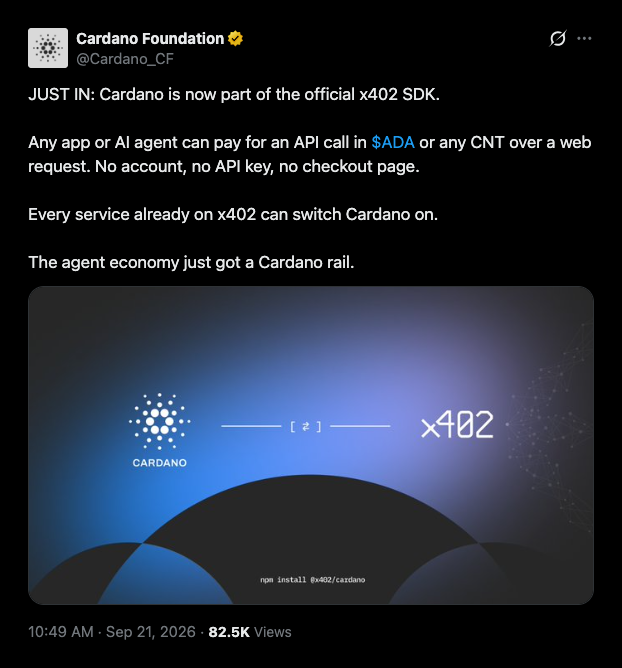
The Cardano Foundation’s post on X, announcing Cardano in the official x402 SDK.
Java code passes 166 tests and one preprod payment
Foundation engineers began with a specification that was accepted in June and then developed client and server code as well as a facilitator.
The facilitator informs the resource server whether the payment was valid and whether it settled, so the server itself does not need to have any blockchain integration.
According to its GitHub repository, the facilitator, which was written in Java, has passed 166 unit tests and performed a real on-chain transaction end-to-end on Cardano’s pre-production network.
It hasn’t run against the mainnet, and the repo encourages developers to go through a mainnet checklist first.
The facilitator’s documentation says the service does not hold keys or sign transactions. It can only verify transactions that a payer has already signed and submit them. The service can’t move any funds on its own.
Cardano support is available only in the TypeScript package of the kit, @x402/cardano. Python is scheduled next, but there’s no given date yet.
Cardano arrives at a rail that competitors first reached. In a review of analyst data earlier this year, Cryptopolitan found that much of the x402 activity that was making headlines was exaggerated.
That report, citing work by Artemis analyst Lucas and a16z crypto partner Noah Levine, said around 48% of transactions and 81% of transaction volume traced back to wash trading and self-dealing as of December.
In a 30-day span, x402.org logged $24 million in volume, Allium Labs reported around $3 million, and Artemis put it under $2 million.
The spread was blamed on the immaturity of the tracking infrastructure, Levine said. In February, Cryptopolitan reported that AI agents were making only limited, proof-of-concept payments on x402, with most on-chain activity being driven by regular trading bots.
Don’t just read crypto news. Understand it. Subscribe to our newsletter. It's free.