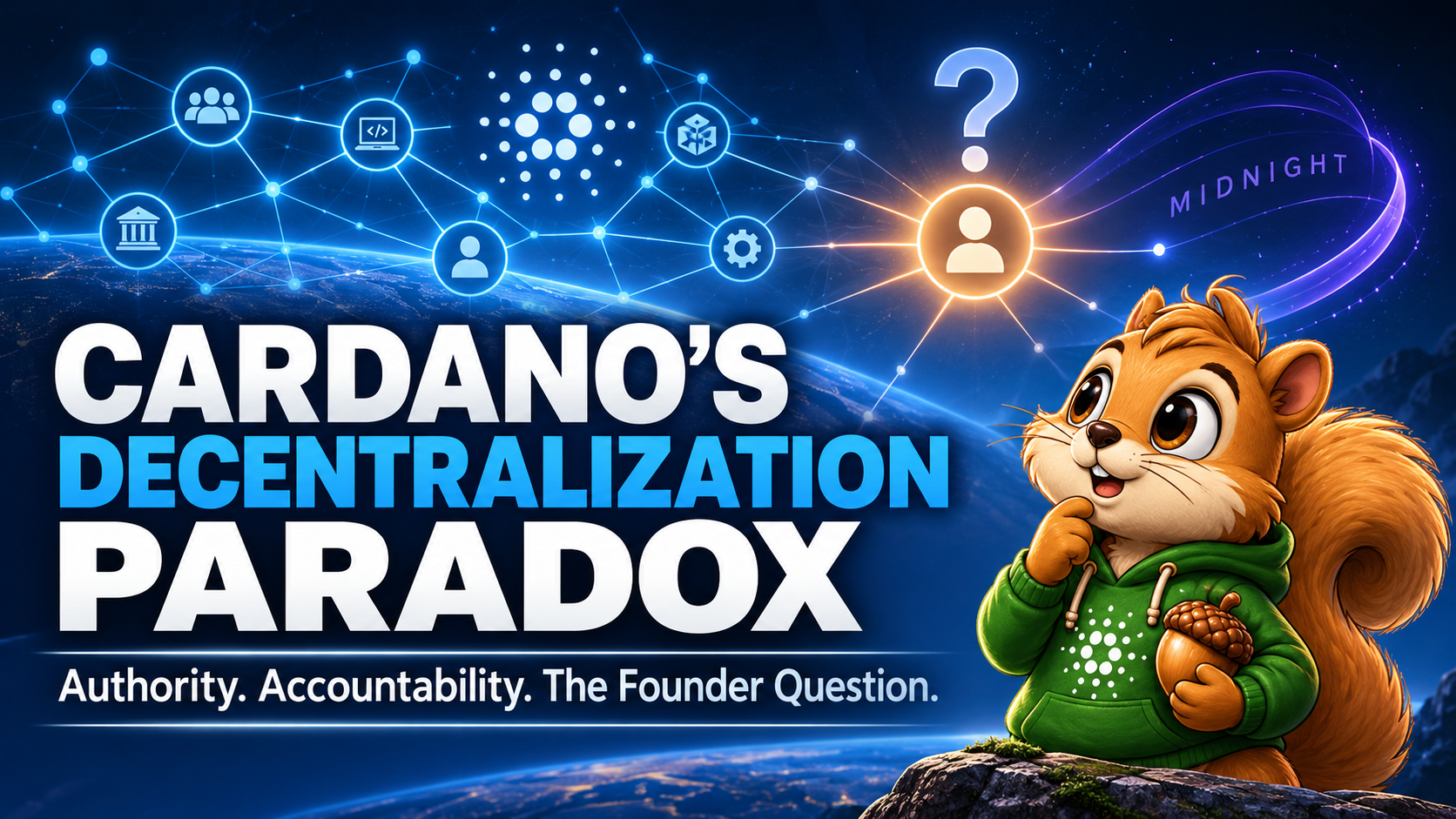
🐿️ A Question Worth Asking Cardano has spent years building toward decentralization. Its community can now participate in governance, influence treasury decisions, and help shape the network
Cardano has spent years building toward decentralization.
Its community can now participate in governance, influence treasury decisions, and help shape the network's future.
Yet when ADA underperforms, adoption disappoints, or Charles Hoskinson turns his attention toward Midnight, much of the criticism still seems to fall on one person.
Isn't there a contradiction here?
We want Cardano to become less dependent on its founder. But we also expect that founder to remain responsible for nearly everything.
And when he focuses on building something new, we question why he isn't doing more for Cardano.
At SUGR, we've been exploring blockchain technology through our Learn with Sugar educational series.
The recent debate surrounding Charles and Midnight inspired us to examine something beyond the technology itself:
Can decision-making become decentralized while responsibility remains concentrated on one individual?
We're not suggesting Charles is beyond criticism. We're asking whether the expectations placed on him are consistent with the authority he actually holds.
Let's explore that question.
Cardano's original development involved three independent organizations with different primary responsibilities.
Input Output (IOG): Research, engineering, and protocol development.
EMURGO: Commercialization, business development, and ecosystem adoption.
Cardano Foundation: Ecosystem stewardship, institutional engagement, and support for adoption.
Charles Hoskinson leads IOG. He does not have unilateral executive authority over EMURGO or the Cardano Foundation.
That distinction matters.
If Cardano faces commercial adoption challenges, shouldn't we examine the performance of all organizations whose mandates include ecosystem development?
What measurable results have their initiatives produced? How effectively have resources been converted into sustainable users, applications, partnerships, and economic activity?
These are reasonable questions for every organization, including IOG.
We're not claiming that EMURGO or the Foundation have accomplished nothing. Nor are we suggesting that engineering decisions have no effect on adoption.
Their responsibilities overlap, and their decisions influence one another.
But influence is not the same as control, and shared responsibility should not become sole responsibility.
Accountability should reflect authority, commitments, and the ability to influence outcomes.
Otherwise, the most recognizable person becomes the easiest target, regardless of who actually controls the relevant decisions.
One frustration we often see in cryptocurrency discussions is the tendency to measure technological progress through token prices.
But are those really the same thing?
Consider what Cardano has developed:
Ouroboros: A research-driven proof-of-stake consensus protocol.
Extended UTXO: An accounting architecture designed around predictable transaction validation under defined conditions.
Native assets: Tokens supported directly by Cardano's ledger.
Smart contracts: Programmable applications supported through Plutus and other developer infrastructure.
On-chain governance: Mechanisms enabling broader participation in protocol and treasury decisions.
Cardano also has a strong history of network continuity and an engineering approach that emphasizes security research and formal methods.
These are meaningful achievements.
Do they mean Cardano is perfect? No.
Do they guarantee superior performance in every application? No.
Do they guarantee ADA price appreciation? Absolutely not.
But engineering progress and commercial adoption are different measurements of success.
A blockchain can have sophisticated technology without attracting enough users. A blockchain can also attract substantial economic activity while facing technical limitations.
Both dimensions matter.
IOG should be evaluated against its engineering commitments, including delays, remaining limitations, and architectural trade-offs.
But if adoption remains below expectations, shouldn't the evaluation extend to the entire ecosystem responsible for turning technology into products people actually use?
Technical infrastructure creates possibilities. Adoption turns those possibilities into economic activity.
Neither happens automatically.
Cardano's governance framework allows community representatives and other governance participants to influence important decisions.
Proposals can be debated, challenged, approved, or rejected. That's a significant step toward decentralized decision-making.
But greater authority also brings greater responsibility.
Consider a hypothetical example.
A prominent ecosystem contributor proposes an initiative intended to accelerate adoption. The proposal includes a budget, implementation plan, and expected outcomes.
Governance participants reject it.
Perhaps the budget was too high, the benefits were unclear, or voters preferred another approach. Those are legitimate reasons to reject funding.
But if the initiative cannot proceed as proposed, should its proposer alone be blamed for the missing outcome?
We don't think so.
That doesn't mean the proposal was necessarily good. It doesn't mean voters were wrong. And it certainly doesn't mean every governance participant shares the same opinion.
It means decisions have consequences, and accountability should follow the actual decision-making process.
If we want decentralized governance, we must accept that no individual can guarantee the outcome of every proposal.
We cannot expect one person to exercise authority that has deliberately been distributed among others.
Decentralization is not simply the right to participate in decisions. It's also the responsibility to understand their consequences.
Now let's address the controversy directly.
Charles Hoskinson has increasingly emphasized Midnight, a privacy-focused blockchain initiative developed by Input Output.
Midnight has its own network and NIGHT token, while pursuing interoperability and applications connected to the wider Cardano ecosystem.
Some ADA holders are concerned that attention and resources are shifting away from Cardano. That's a legitimate concern.
But there's another perspective worth considering.
What if Midnight represents a transition from developing Cardano's core infrastructure toward creating new products and capabilities around it?
Privacy is a genuine challenge for public blockchain adoption.
Businesses may need to protect commercially sensitive information. Individuals may need to disclose selected information without revealing everything publicly. Regulated applications may require confidentiality alongside verifiable compliance.
Midnight aims to address some of these challenges.
That could create opportunities for applications that would otherwise struggle to operate on fully transparent blockchain infrastructure.
But we should distinguish potential from proven results.
Midnight's success does not automatically guarantee increased demand for ADA.
NIGHT has its own economic role. Whether Midnight generates meaningful benefits for Cardano mainnet depends on actual integrations, usage, and economic activity.
Those outcomes should be measured.
However, questioning Midnight's economics is different from concluding that Charles has abandoned Cardano.
In his recent explanation of Finishing Cardano, Charles described a transition from building Cardano's original infrastructure toward building on and around the ecosystem.
That distinction deserves serious consideration.
If Cardano's long-term vision includes an ecosystem of applications and interconnected networks, shouldn't we evaluate Midnight by what it actually delivers?
Building something new doesn't necessarily mean abandoning what came before.
The important question is whether that new development produces measurable value.
Let's be clear about our position.
Charles remains one of Cardano's most influential figures. His statements shape expectations, his decisions influence development priorities, and his leadership and communication deserve scrutiny.
If IOG misses a commitment, people should ask why.
If Charles proposes an initiative, governance participants should examine its cost, feasibility, and expected benefits.
If Midnight is presented as beneficial to Cardano, people should ask how those benefits will be demonstrated.
Accountability is healthy. Selective accountability is not.
The same standard should apply to every organization and participant:
IOG: Engineering commitments and delivery.
EMURGO: Commercialization objectives and outcomes.
Cardano Foundation: Stewardship and adoption initiatives.
Funded projects: Measurable results against approved commitments.
Governance participants: The consequences of decisions they influence.
Independent builders: What they actually commit to and deliver.
Nobody deserves immunity from scrutiny. Not even Charles.
But neither should one person become the default explanation for every challenge across an ecosystem he does not fully control.
We should evaluate decisions, authority, and outcomes — not simply choose someone to blame.
Fair question.
SUGR is an independent community project on Cardano, inspired by the unusual 2013 Sugar Bush discussion involving Charles Hoskinson.
Our mission isn't simply to promote a token.
Through Learn with Sugar, we use animated stories and educational content to make cryptocurrency, blockchain technology, and the Cardano ecosystem easier to understand.
And the more we explore decentralization, the more we realize that technology is only part of the story.
Decentralization also changes how people share authority, make decisions, and accept responsibility.
We've encountered a smaller version of that challenge during our own community revival.
When we began rebuilding SUGR in August 2026, we inherited unresolved obligations from the original Sugar Factory.
Rather than ignoring that history, we worked to secure the legacy recovery reserve, establish transparent treasury controls, and create a recovery process for eligible holders.
Our first recovery settlement is still ahead of us.
We haven't completed everything, and we don't expect recognition simply for making commitments. We believe our work should be evaluated through actual delivery and verifiable records.
That experience reinforced a principle we're trying to follow:
Accept responsibility for what you control. Be transparent about what you cannot control. And demonstrate progress through actions.
We believe the same principle applies to Cardano's institutions, founders, builders, and governance participants.
SUGR is not affiliated with Charles, IOG, EMURGO, or the Cardano Foundation.
This article presents our independent editorial perspective, not a statement on behalf of those organizations.
We're not asking anyone to agree with us unconditionally. We're asking readers to consider whether accountability is being distributed as fairly as authority.
Instead of asking:
"Why isn't Charles doing more for Cardano?"
Perhaps we should ask:
"What does Cardano need to succeed without depending on Charles?"
That means evaluating whether its ecosystem can attract developers, users, businesses, liquidity, and sustainable economic activity.
It means examining how effectively institutions fulfill their mandates, recognizing the consequences of governance decisions, and supporting builders while holding them accountable for their commitments.
Cardano has made meaningful progress toward decentralizing its infrastructure and governance.
Its next challenge is demonstrating that decentralized institutions, independent builders, and community governance can collectively support sustainable adoption.
That responsibility cannot reasonably belong to one individual alone.
Charles's contributions deserve recognition. His decisions deserve scrutiny. Other organizations deserve the same scrutiny.
And the community deserves both influence over Cardano's future and an understanding of the responsibilities that accompany that influence.
If we want Cardano to become less dependent on its founder, perhaps we should stop treating him as the sole person responsible for its future.
That doesn't mean ignoring mistakes. It means recognizing that Cardano belongs to a much larger ecosystem, and that ecosystem has responsibilities of its own.
We know this topic inspires strong opinions.
Some believe Charles should remain the driving force behind Cardano's adoption. Others believe its institutions and community should take greater responsibility.
Both perspectives deserve to be examined.
So here's our question:
If Cardano's future is supposed to be decentralized, who should be accountable for its adoption — Charles Hoskinson, its founding institutions, or the community itself?
And what measurable evidence should we use to evaluate that responsibility?
We welcome disagreement, including criticism of our reasoning. Let's challenge ideas rather than individuals.
Because decentralization should mean more than distributing power.
It should also mean learning to share responsibility.
An independent editorial published by SUGR Community Revival.
🐿️ LET THE SQUIRREL PROMOTE THE FOREST.
🔎 DON'T TRUST THE SQUIRRELS — VERIFY THE SQUIRRELS.
https://sugarcardano.io/
#Cardano #ADA #Midnight #BlockchainGovernance #SUGR