Key Takeaways: ADA dropped below $0.19, hitting its lowest price in six years. JPG.Store and TapTools both shut down within the same six-week window. Cardano’s DeFi TVL sits at $123M, ranking
Key Takeaways:
- ADA dropped below $0.19, hitting its lowest price in six years.
- JPG.Store and TapTools both shut down within the same six-week window.
- Cardano’s DeFi TVL sits at $123M, ranking 28th globally – behind newer chains.
- The community voted down its own Summit funding and is blocking IOG’s research budget.
On June 4, the token trades at $0.1862, down over 20% in a single week, sitting at its lowest price point in six years and roughly 94% below the $3.09 all-time high it reached in September 2021. That alone would be a difficult story to tell, but the price is not even the most damaging part of what has happened to Cardano over the past two months.
Two pillars gone in six weeks
JPG.Store, the NFT marketplace that had served as the primary entry point for retail users into the Cardano ecosystem since 2021, completed its full shutdown on May 23. Within weeks, TapTools — the analytics dashboard that virtually every active ADA trader relied on to track on-chain data, wallet movements, and DeFi metrics — also ceased operations, citing unsustainable infrastructure costs. These were not peripheral projects; they were the ecosystem’s front door and its nervous system, respectively. Their closure within the same six-week window has left Cardano’s retail layer functionally gutted, with no comparable replacements announced or in sight.
Following these events, Cardano founder Charles Hoskinson shared a message via X warning the community that a consolidating market environment could lead to a broader “wave of failures” for undercapitalized dApps and teams. Shortly thereafter, Hoskinson posted an update stating, ‘I’m taking a break. TTYL,’ explicitly reflecting his frustration with ongoing treasury funding roadblocks.
The liquidity numbers don’t lie
Cardano’s Total Value Locked stands at approximately $109 million, according to data from DefiLlama, placing it 28th globally in DeFi rankings — behind newer, less-established networks like Aptos and Mantle, and roughly two orders of magnitude below Ethereum’s figures. SundaeSwap V2, the network’s primary decentralized exchange, clears around $1.86 million in daily volume, while Solana-based DEXs process over 400 times that figure on any given day. The 24-hour fee total across the entire Cardano network sits at approximately $2,153 — a number that reflects near-total absence of transactional demand rather than a temporary slowdown. ADA’s market capitalization has contracted to $6.75 billion, with the token now 93.8% below its all-time high and showing no credible sign of accumulation at current levels.
The weekly chart confirms the damage
The weekly ADA/USDT market structure highlights an extended downtrend with firm overhead resistance lines. The 50-week, 100-week, and 200-week simple moving averages (SMAs)—resting at $0.4892, $0.5717, and $0.4873 respectively—act as dominant macro resistance ceilings.
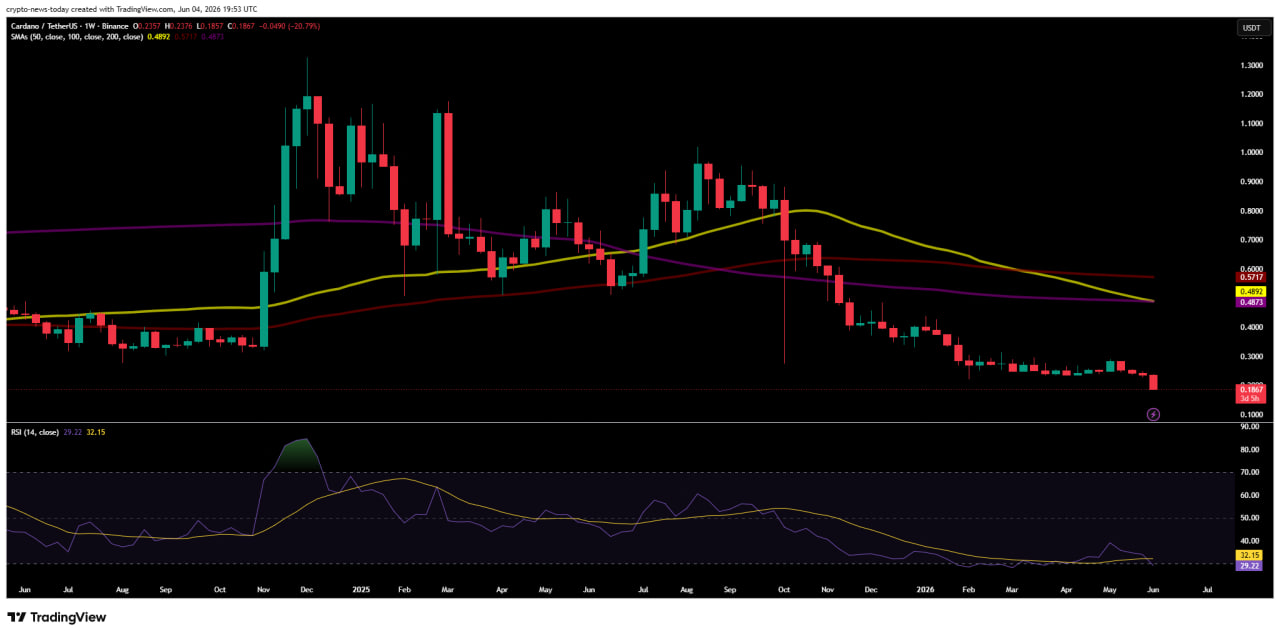
ADA/USDT chart (1W) ~ Source: TradingView
The RSI on the weekly timeframe reads 29.22 — technically oversold — but that reading has persisted for long enough that it no longer carries a meaningful reversal signal on its own. There is no base forming, no consolidation range, no pattern that suggests sellers are exhausting themselves. The path of least resistance remains downward until volume and on-chain activity give a different signal, and neither is present right now.
Governance is choking the project’s own infrastructure
Perhaps the most structurally significant development is the operational shift occurring within Cardano’s native governance framework. The Chang Hard Fork transitioned the network into the “Voltaire Era,” handing treasury control to Decentralized Representatives (DReps).
READ MORE:
 Crypto Volatility: Measuring the Drop From 2025 Highs
This decentralized budget management model has led to significant shifts in network funding priorities:
- Cardano Summit 2026 Cancellation: DReps rejected a 7.8 million ADA treasury proposal to fund the flagship Cardano Summit in Singapore, resulting in the event’s cancellation. Public voting documentation indicates the proposal secured a 65.21% approval rate, narrowly missing the required 66.67% two-thirds majority. Community financial reviews show that DReps exercised caution due to a projected budget imbalance, as the forecasted event revenue covered only $450,000 of the requested $2.26 million USD gross operating costs.
- Research & Development Rejection: A separate 32.9 million ADA research and development budget requested by Input Output Global (IOG)—the primary engineering firm behind Cardano’s core infrastructure—is facing an approximate 80% rejection rate from the active DRep body. Hoskinson has publicly stated that a prolonged funding halt risks the retention of core scientific and engineering staff.
Proponents frame this strict treasury management as evidence that on-chain decentralized governance functions exactly as intended, demonstrating that ADA holders hold genuine veto power over large institutional expenditures. Conversely, market analysts point out that this introduces a near-term coordination challenge, which can slow down crucial infrastructure funding and ecosystem marketing initiatives during market downturns.
What remains
The technical development side of Cardano presents a genuine counterargument to the death narrative. GitHub analytics place the network third globally in code commits — 17,417 across 550 repositories over the past year — behind only Ethereum and Internet Computer. The network hosts over 17,000 Plutus smart contracts, with smart contract interactions comprising more than 35% of daily transactions. German bank DZ Bank added ADA to its regulated institutional platform “meinKrypto” earlier this year, suggesting that some institutional interest in Cardano’s regulatory clarity persists even as retail abandons it.
The privacy-focused partner chain Midnight, backed by IOG and running corporate validators including Google and Vodafone, represents the network’s most significant near-term bet — an attempt to attract enterprise use cases the public chain has consistently failed to capture. Scaling infrastructure including Hydra and Mithril is technically operational, though without meaningful volume to justify it.
Despite resilient core development metrics, these fundamental strengths have failed to trigger accumulation or stem the loss of retail liquidity. Ultimately, Cardano finds itself at a historical crossroads: its future utility relies entirely on whether its decentralized governance model can adapt fast enough to fund vital retail tools before its remaining user-facing infrastructure faces a terminal shutdown.
The information provided in this article is for educational purposes only and does not constitute financial, investment, or trading advice. Coindoo.com does not endorse or recommend any specific investment strategy or cryptocurrency. Always conduct your own research and consult with a licensed financial advisor before making any investment decisions.
The post Cardano’s Ecosystem Is Collapsing – and Its Own Community Is Partly to Blame appeared first on Coindoo.