The Cardano Foundation had a grand plan for 2027, and it involved a dozen crypto conferences, four hackathons, booths, sponsorships and plane tickets for the projects building on its blockcha
The Cardano Foundation had a grand plan for 2027, and it involved a dozen crypto conferences, four hackathons, booths, sponsorships and plane tickets for the projects building on its blockchain.
The price? 25 million ADA, or roughly $3.6 million.
ADA is Cardano's native cryptocurrency. It is also used to vote on governance proposals, with voting power based on the amount of ADA held or delegated.
Related: China tariff threat knocks Bitcoin below $60,000
So far, the Cardano Foundation's proposal to spend $3.6 million on events in 2027 has faced strong pushback from ADA holders.
According to CardanoCube, around 1.11 billion ADA has been used to vote against the request, compared with just 141 million ADA in favor.
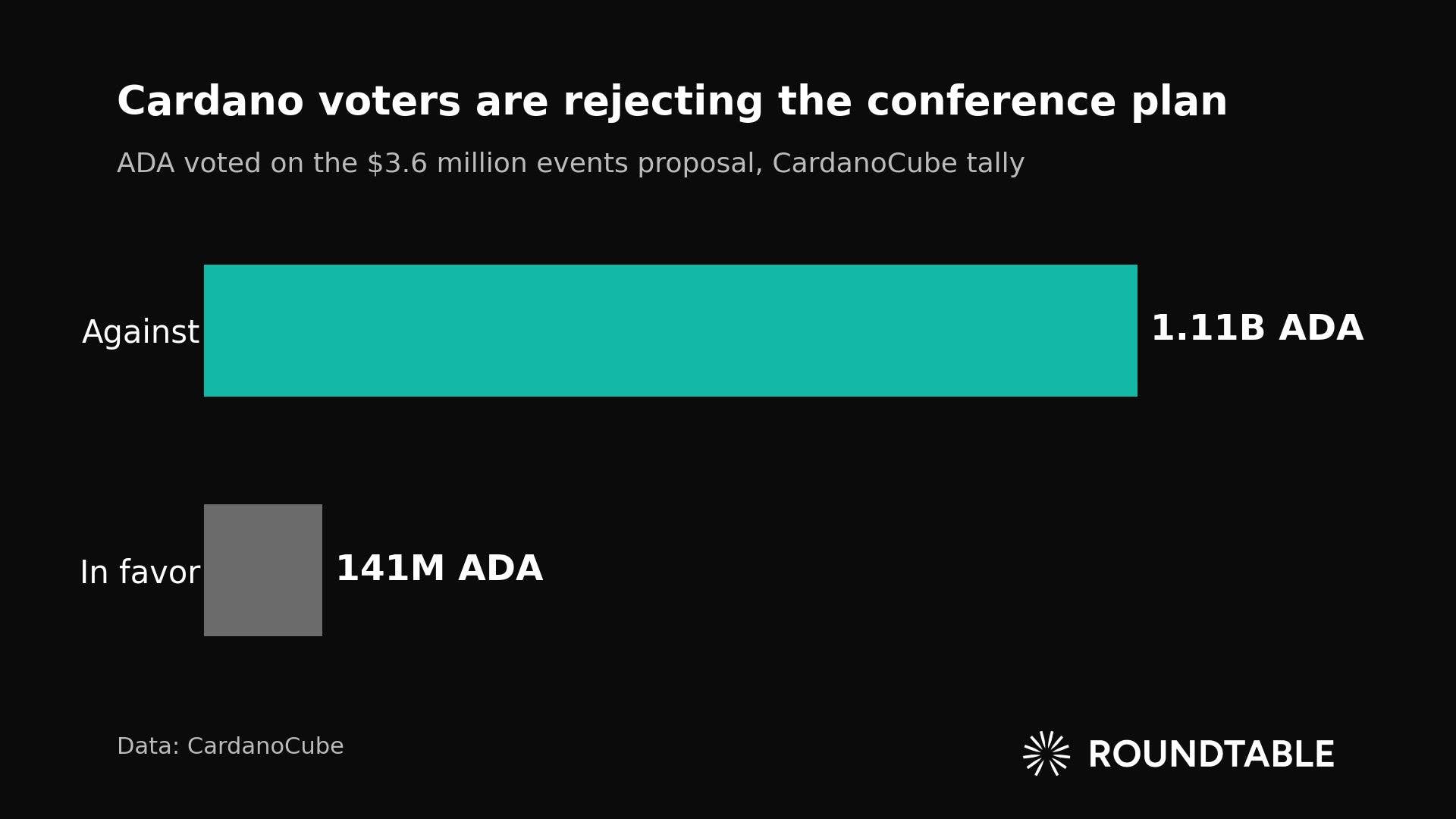
ADA committed against the Cardano Foundation's events proposal.
That is nearly eight votes against for every one in favor, compared with a five-to-one ratio when CoinDesk reported Monday.
Voting remains open until Dec. 20, so the outcome could still change.
The foundation's last events program was approved in 2025 with nearly 70% delegate support.
Related: Michael Saylor gets the regulator's nod he wanted, just not at full price
How Cardano spends its money
Cardano does not have a finance chief who signs off on spending.
Instead, it has a treasury, a shared pot of tokens, and the community decides what comes out of it. Coin holders hand their voting power to elected delegates, who vote on each request.
It's crypto democracy.
In practice, it works like a shareholder meeting where the shareholders actually read the budget.
The problem with the budget
The foundation's plan, filed Nov. 16, assumes ADA trades at 20 cents. At the time of writing, ADA was trading at around 14 cents.
That's a spending plan priced roughly 40% above the market. The foundation says it will cut events if the money falls short.
The biggest expense planned for 2027 is TOKEN2049 New York, budgeted at about $882,000.
Trending on TheStreet Roundtable:
The pushback is less about the conferences themselves, and more about whether they deliver results.
One delegate asked for "verifiable evidence connecting previous spending to adoption." In simpler terms, he wanted to see whether those events actually grew the network or simply generated publicity without bringing in lasting users and developers.
Others argue that promoting Cardano is already the foundation's job, so it should cover the roughly $2 million in sponsorship costs itself. Some would rather pay in smaller stages, released only when targets are hit.
The foundation says shared events give small Cardano projects a stage they could never afford alone. It says its last program beat every target, engaging 1,169 developers and showcasing 79 projects.
Representational image.
Not just one whale
On Monday, a single delegate known as YUTA accounted for about 482.5 million ADA, roughly two-thirds of the "no" votes at the time.
One large wallet can sway a vote, but more ADA holders are now speaking out against the plan.
This isn't the first time the foundation has faced resistance. The foundation's request to fund Cardano Summit 2026 failed, and the event was canceled. However, a smaller request to fund TOKEN2049 Singapore was approved.
Voters seem happy to fund a targeted trip, but not a world tour.
Why it matters beyond Cardano
The timing is tough.
Bitcoin is hovering near $60,000, close to its lowest level in two years, and investors have pulled a record $4.71 billion from U.S. spot Bitcoin ETFs in November, according to SoSoValue data.
The foundation has until Dec. 20 to win voters over, likely by asking for less and showing results. If not, Cardano may have a much quieter 2027.
Related: Coinbase wins dismissal of four-year investor lawsuit