A new CFTC advisory says certain regulated market operators may use bitcoin, ether, and payment stablecoins to meet financial resource requirements that cover at least 12 months of operating
A new CFTC advisory says certain regulated market operators may use bitcoin, ether, and payment stablecoins to meet financial resource requirements that cover at least 12 months of operating costs, according to theofficial CFTC announcement dated Monday, November 23, 2026.
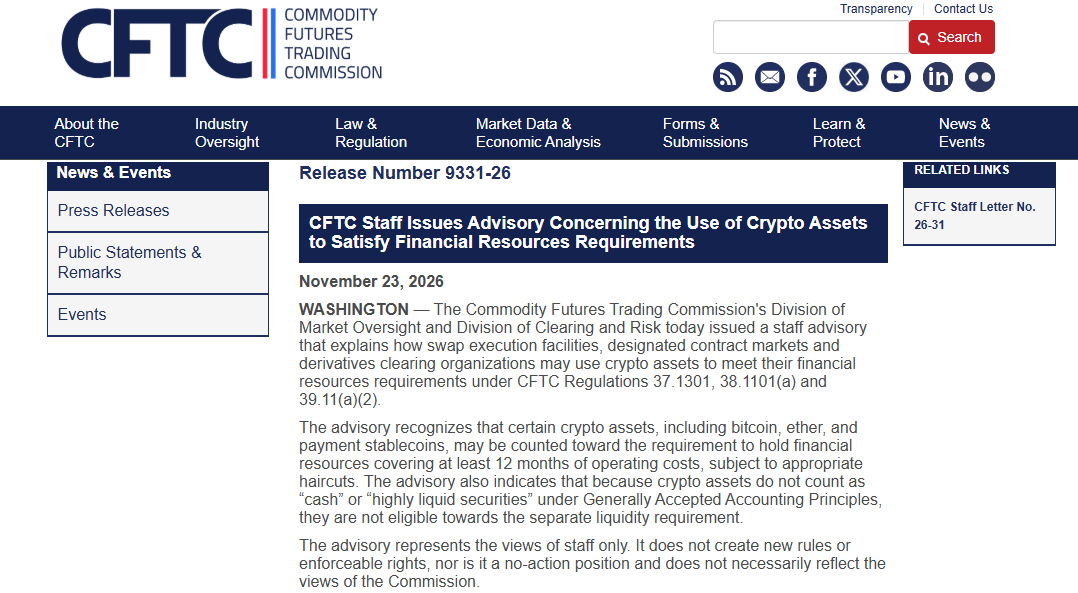
This crypto news update explains what changed, who is affected, and what stays the same.
Key Takeaways
CFTC staff says bitcoin, ether, and payment stablecoins may count toward financial resource rules for certain regulated markets.
Crypto counted this way faces haircuts, which are discounts on its market value.
It is a staff view and not a new rule, and crypto does not count toward the separate liquidity requirement.
What Does the CFTC Advisory Say About Crypto Reserves?
The advisory was issued by the Division of Market Oversight and the Division of Clearing and Risk, and it explains how swap execution facilities, designated contract markets, and derivatives clearing organizations may hold crypto assets.
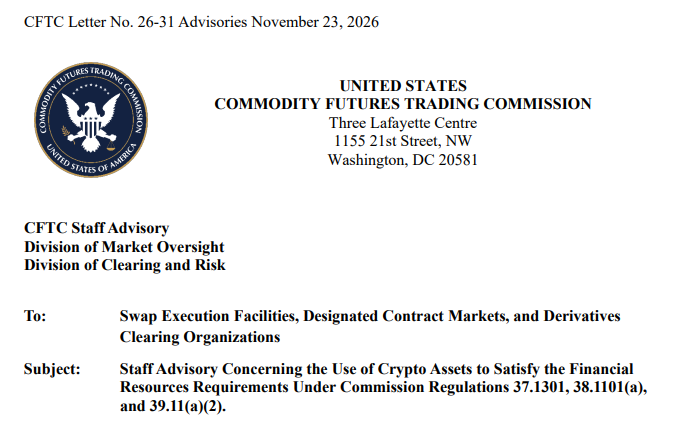
These firms must keep enough resources to run for at least 12 months, based on CFTC Regulations 37.1301, 38.1101(a), and 39.11(b), which are published on theeCFR website.
Bitcoin, ether, and payment stablecoins are named as assets that can be counted toward that 12-month cushion.
How Do Haircuts Work for Bitcoin, Ether, and Stablecoins?
A haircut is a discount applied to an asset's market value, so the amount counted is lower than the price you see on screen, which protects the firm if prices fall.
In a simple example that is not an actual CFTC rate, a firm holding $100 of a coin under a 20% haircut would only get credit for $80.
The CFTC advisory says crypto assets are subject to appropriate haircuts, so readers who need the exact terms should open the full advisory text.
Why Crypto Does Not Count Toward the Liquidity Requirement
The advisory says crypto assets are not "cash" or "highly liquid securities" under Generally Accepted Accounting Principles, so they are not eligible toward the separate liquidity requirement.
This means a firm can use crypto for its 12-month financial resources but still needs other assets to meet its liquidity rules.
For anyone following stablecoin regulation, this split is one of the most useful details in the whole document.
Is the CFTC Advisory a New Rule?
No, the advisory represents the views of staff only, and it does not create new rules or enforceable rights.
It is also not a no-action position, and it does not necessarily reflect the views of the Commission, as stated in the CFTC's own release.
Posts that describe it as a blanket approval skip these limits, so it helps to read the original text before sharing it.
What Does This Mean for Crypto Markets and Bitcoin Holders?
The CFTC advisory gives regulated exchanges and clearing firms more clarity on how they may hold reserves, and it puts bitcoin and ether in the same discussion as payment stablecoins.
It addresses regulated market entities and not individual traders, so everyday users do not need to change how they hold crypto.
Anyone tracking crypto regulation news may want to watch whether the Commission itself takes up the topic later, although no such step has been announced.
The Bottom Line
The CFTC advisory lets certain regulated markets count bitcoin, ether, and payment stablecoins toward 12 months of operating costs with haircuts, but it is a staff view, it is not a new rule, and it does not apply to the liquidity requirement.
Disclaimer: This article is for information only and is not financial or investment advice. Crypto assets carry risk, including the loss of funds, so verify current details with official sources.