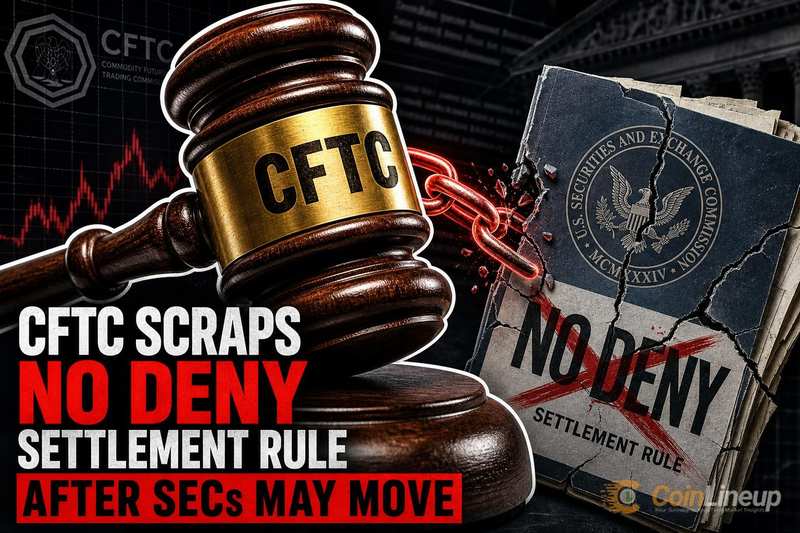
The CFTC has scrapped its longstanding no-deny settlement rule, a policy shift that follows the SEC's similar move in May. The change alters how both major U.S. financial regulators resolve e
The CFTC has scrapped its longstanding no-deny settlement rule, a policy shift that follows the SEC's similar move in May. The change alters how both major U.S. financial regulators resolve enforcement cases, with potential ripple effects for crypto firms facing regulatory action.
What the CFTC changed in its settlement policy
Under a no-deny settlement, companies and individuals could resolve enforcement cases without admitting or denying the allegations against them. This framework let regulators close cases efficiently while allowing defendants to avoid the reputational and legal consequences of a formal admission of wrongdoing.
The CFTC has now abandoned this approach, according to its recent enforcement announcement. Going forward, settling parties may be required to admit to certain facts or violations as a condition of resolution.
This marks a meaningful departure from decades of regulatory practice. The no-deny framework had been a cornerstone of how both the CFTC and SEC handled the vast majority of their cases, allowing high case throughput without the cost and uncertainty of litigation.
Why the SEC's May move matters to this decision
The SEC made a comparable policy shift in May 2026, moving away from its own no-deny settlement structure. The CFTC's decision to follow within weeks suggests a broader recalibration of federal enforcement philosophy rather than an isolated agency decision.
When two independent regulators that oversee overlapping segments of the digital asset market adopt the same posture in quick succession, it signals a durable shift in Washington's approach to financial enforcement. Crypto firms that have historically navigated Washington's evolving regulatory stance now face a more demanding settlement environment from both agencies.
The parallel moves also reduce the strategic advantage defendants previously had in choosing which agency's process might be more lenient. With both the SEC and CFTC now requiring admissions, the settlement calculus for respondents changes significantly.
What it could mean for crypto cases and market participants
For crypto exchanges, token projects, and DeFi protocols, the practical impact centers on enforcement negotiations. Admissions made in CFTC or SEC settlements can be used as evidence in follow-on private litigation, making settlements more costly and legally risky for defendants.
This could push more respondents to contest charges rather than settle, potentially slowing the pace of CFTC enforcement actions if cases increasingly proceed to adjudication. Firms weighing compliance investments may view the shift as raising the stakes of any future regulatory encounter.
Market participants exploring areas where CFTC jurisdiction applies, including derivatives, futures, and certain commodities-linked digital assets, should note that the agency's posture has hardened. Even projects in adjacent sectors, such as those navigating infrastructure-level acquisitions or pursuing presale-stage growth, will need to factor stricter federal settlement terms into their regulatory planning.
The full operational details of the CFTC's revised framework, including how broadly admissions will be required and whether exceptions will exist for smaller cases, have not yet been fully outlined. How aggressively the agency applies the new policy in practice will determine its real-world impact on crypto enforcement.
Disclaimer: This article is for informational purposes only and does not constitute financial or investment advice. Cryptocurrency and digital asset markets carry significant risk. Always do your own research before making decisions.
Read original article on coinlineup.com